
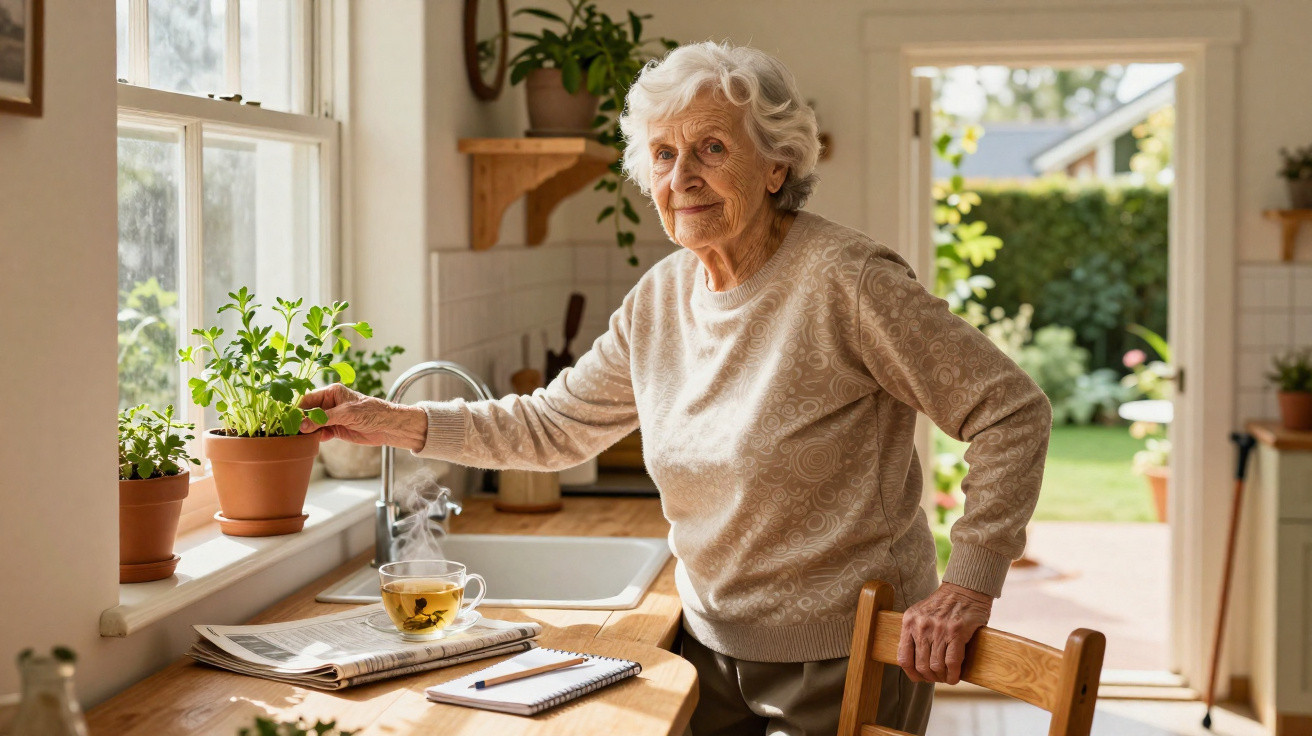
At [time] in a small terraced home carrying a faint scent of toast and lavender soap, a 102-year-old woman is already ready for the day: lipstick applied, cardigan fastened incorrectly on one side. She moves slowly, yet needs no walking stick. Behind her, the kettle hums while the radio murmurs news from a world that has transformed three times since her birth. A handwritten reminder sits on the fridge: “Move or rust.”
Her name is Edith. She lives by herself and tells anyone willing to hear it the same thing: “I refuse to ever end up in care.” She says it neither angrily nor dramatically, but with a composed determination that permits no debate. Her GP is concerned, her niece presses the matter, and the council posts information leaflets. Edith simply shrugs, pushes her tea across the table and lifts an eyebrow. That shrug has a history.
The quiet rituals of a very long life
When asked how she has lived beyond 100, Edith does not mention genetics or wonder diets. Instead, she describes her morning routine. While the toast is browning, she stands at the kitchen worktop and completes ten gentle heel raises. Every morning, with her fingertips resting lightly on the edge and her back upright, she counts them quietly aloud. There is no gym subscription and no smartwatch, only a small routine she refuses to abandon.
To Edith, a long life is not an abstract concept. It means washing her own mug, wiping the worktop and drawing the curtains herself. These modest actions keep her legs, arms and, in her words, “what’s left of my brain” active. She continues to write a daily list, even when it contains only three items. The list is not really about efficiency; it is about refusing to watch her own life from the sidelines.
Edith understands the figures more thoroughly than most people might anticipate. Her friend Doris entered a care home at 89, “just for a few weeks after a fall.” In less than six months, Doris was walking only a handful of steps. Meals came to her chair; there were no stairs, no kettle to lift and no garden to cross to reach the washing line. Withdrawal can arrive so quietly that families often fail to notice it: one fewer walk, one additional nap, one more “I’ll do it for you, Mum.”
Research points in the same direction. Older adults who lose everyday physical tasks such as making tea, hanging out washing and taking gentle shopping trips can see their strength and balance decline over months rather than years. Falls become more common, recovery takes longer, and independence ebbs away through a succession of small, kindly intended shortcuts rather than one major choice. Edith saw this unfold and set herself a rule: if she is physically able to do something, she does it.
She explains it with an almost brutal plainness. For her, living longer is not solely about accumulating birthdays. It is about putting off the point at which other people make decisions on her behalf. She knows she cannot govern everything; she has buried her husband, siblings and friends. Yet routine remains the territory where she feels she has control. This is why she rejects “care” as an end point. In her mind, care does not mean comfort; it is the day she no longer chooses how to spend her Tuesday mornings.
The non-negotiable habits Edith swears by
By “simple routines”, Edith means precisely that. Her breakfast never varies much: a slice of buttered toast, half a banana and weak tea with milk. It may not be perfect, but it is dependable, and her stomach prefers dependability. At lunchtime she eats soup or vegetables with a little fish or chicken. Her evening meal is a light snack: cheese, a biscuit or occasionally a square of dark chocolate. No fasting and no elaborate Instagram recipes, only food she knows.
Her most important fixed habit comes between meals. Twice daily, she takes what she calls a “house tour”. She walks from the front door to the back, treating pieces of furniture as stopping points. At each one, she lightly touches it and raises one foot for three seconds before doing the same with the other. It appears insignificant, but as balance practice it is invaluable. She has performed it quietly for years without ever labelling it exercise. That is the key: it does not feel like a workout. It feels like confirming that both the house and her body still belong to her.
Anyone who has tried to support an ageing parent will recognise the odd conflict. You want them to be safe, so you carry their shopping, remove every possible hazard and encourage them to sit down. They want to remain able, so they insist on doing things that make your pulse race. Edith notices the fear in her niece’s eyes as she carries a washing basket upstairs. Still, she says: “If I stop going upstairs, I’ll never go up again.” She has a point. Muscles do not politely retire; they disappear when we no longer require them to work.
Naturally, there are boundaries. Edith does not stand on chairs to reach upper shelves. After her cousin tripped over a rug and broke a hip, she removed most of her own rugs. Her GP persuaded her to fit a light grab rail by the bath, and she accepted it. Her principle is straightforward: alter the home, not her whole life. That distinction is where many families find difficulty. Out of affection, they eliminate every effort from daily life. In doing so, they also quietly remove the practice that keeps a body capable. It is a painful paradox that nobody explains in hospital.
Edith is adept at cutting through the wellness chatter that fills social media. She laughs at younger people discussing “bio-hacking”. “We just called it getting on with it,” she says as she straightens her cardigan. Her foundations would bore any influencer: regular bedtimes, opening a window for fresh air, handwriting letters to keep her fingers supple and reading the newspaper so she can argue with its headlines. Yet these are the very habits that keep her connected to the world, rather than drifting on the sofa in front of the television all day.
Once a week, a neighbour drives her to the supermarket. The trip takes an hour, although someone younger could complete it in ten minutes. They move at an unhurried pace, Edith leaning on the trolley, feeling the peaches and comparing costs. Shopping is not the real point. It is a walking session disguised as an errand, social contact and a reminder that she is entitled to occupy space. By the journey home, she is exhausted in the best way: the sort of tiredness that tells her she has used her strength rather than given it up.
She frequently repeats a saying that is partly humorous and partly utterly serious: “If you let people wrap you in cotton wool, you suffocate.” She has watched it happen: the neighbour who stopped leaving home alone after a fright, and the friend whose family handled everything “to make life easier” and who can now no longer make a cup of tea unaided. Edith would prefer a slow walk through drizzle to becoming somebody waiting for a bell to be answered.
Her habits are not flawless. On wet days she eats too many biscuits, and when her knees ache she occasionally misses her heel raises. Let us be honest: nobody truly does this every day. That candour is one reason people listen to her. She is not offering a promise of eternal youth. She speaks instead about holding on to everyday dignity for as long as the body permits, even when the mirror is unkind.
What she does differently from most people her age
One of Edith’s understated strengths is her approach to rest. She takes naps but never goes to bed during the afternoon. In a window-side corner of her living room, she has a “rest chair”. When her energy falls, she makes tea, sits there for 20 minutes and watches outside. There is no television and no scrolling on a phone; she simply observes the street. That modest rule - chair rather than bed - prevents a brief pause becoming a three-hour sleep that disrupts her night.
Her evenings follow a surprisingly clear pattern. At 7 p.m., she switches on the radio, has something light to eat and telephones someone: a niece, a former neighbour or the woman from church who does not drive after dark. These conversations are her social physiotherapy. They keep her voice robust, exercise her memory and preserve her humour. Loneliness reduces appetite, movement and curiosity; Edith knows that routines gradually unravel without company. So she plans connection in the way younger people plan exercise sessions.
Her relationship with the health system is another factor in why she remains at home. She attends every appointment with a notebook and questions written in shaky capital letters. A list of her medication is taped inside a kitchen cupboard. She takes painkillers when required, rather than trying to “be brave”. Pain is one of independence’s quiet thieves: it causes people to move less, avoid stairs and miss outings. By viewing pain as an opponent rather than a test of character, she remains involved in life. The aim is not heroism; it is being able to walk to the bus stop next month.
“I’m not trying to live forever,” Edith says, staring straight at me. “I’m trying to live as myself until the last possible day. There’s a difference.”
Every Sunday afternoon, seated at the table with her pen, she works through a simple checklist:
- Can I still get in and out of the bath on my own this week?
- Did I walk outside the house at least three times?
- Have I spoken to someone face-to-face who is not a doctor or delivery driver?
In practical terms, these questions are blunt measures of whether she is moving towards the sort of dependence that ends with a care home brochure on the table. Emotionally, they mean something more: a small, undramatic weekly reckoning with her own limits. On a human level, we have all experienced the sense that something is slipping and the reluctance to examine it too closely. Edith examines it. That is her quiet bravery.
A stubborn kind of freedom that’s hard to measure
As you watch Edith wash her mug and hang up the tea towel, it becomes clear how many of her choices are absent from medical records. No file notes that she “still opens her own curtains”. There is no box to tick for “refuses to let fear organise her day”. Yet these small acts help explain why she remains in this home rather than sitting in a lounge smelling of disinfectant and boiled vegetables. Her life does not resemble a lifestyle blog; it resembles someone repeatedly choosing small efforts.
This exposes a tension many families feel deeply. They want parents and grandparents to be safe and nearby, but do not want to suffocate what makes them themselves. Edith’s words - “I refuse to ever end up in care” - also serve as a warning to everyone else. If we build a world in which old age means passivity, care homes will be filled not only with frail bodies but with people whose initiative has slowly been worn away through love. It is not a comfortable idea.
Her routines will not be appropriate for everybody. Some will need support sooner or feel safer with professionals close by. Chronic illness, finances and housing do not give every life the same choices. What Edith provides is not a blueprint but a question: which parts of your independence would you defend as fiercely as she defends her morning heel raises? It might be preparing your own meals while your hands still allow it, walking to the corner shop rather than ordering absolutely everything online, or simply refusing to allow every risk and statistic to determine the shape of your days.
When she has finished her tea, she rises with one hand on the table and gives me a look that makes clear the interview has ended. “I’ve got things to do,” she smiles. At 102, perhaps that is the real secret. Not supplements or miracle exercises, but the quiet and stubborn conviction that, while you still have things to do - however modest or slow - you are living your own life rather than waiting for someone else to run it for you.
| Key point | Details | Why it matters to readers |
|---|---|---|
| Turn daily chores into “hidden exercise” | Treat tasks such as making tea, hanging out washing and light shopping as regular movement sessions: do heel raises at the worktop, balance holds beside the sink and slow walks with a trolley. | This maintains strength and balance without a gym, making it much more practical for older adults and carers to sustain. |
| Protect short daytime rests from becoming long naps | Set up a designated “rest chair” rather than using the bed, use a timer for 20–30 minutes and connect rest with a small ritual such as tea or radio. | It helps avoid broken night-time sleep and the cycle of tiredness, inactivity and lost independence that can follow lengthy afternoon naps. |
| Use simple weekly self-checks | Each week, ask three questions: Can I bathe myself? Did I go outside three times? Did I see or speak to someone socially? | This provides an early indication when abilities begin to decline, allowing families to adapt the home or routines before a crisis compels a move into care. |
FAQ
Is it really safe for someone over 90 to live alone? It depends less on age than on the stability of their health, mobility and home environment. Regular check-ins, grab rails, effective lighting and frank conversations about what is becoming more difficult can make living alone much safer.
What daily routine helps older people stay independent the longest? Gentle movement spread throughout the day - getting up regularly, taking short walks and doing basic balance exercises - alongside reliable meals, regular sleep and some social contact generally works better than occasional strenuous effort.
How can I encourage my parent to keep doing things without sounding pushy? Suggest completing tasks alongside them rather than taking over: fold washing together, walk to the shop side by side or cook as a team. Presenting it as shared time rather than an assessment of their ability is usually more respectful.
What are early signs that someone might soon need extra care? Look out for repeated falls or near-falls, unopened post accumulating, spoiled food in the fridge, a strong body odour, or avoiding stairs and outings they previously managed. Such changes often emerge months before an emergency.
Can small routines really delay going into a care home? They often can. Keeping muscles, balance, memory and social connections active can buy valuable time before full-time care is needed, even if it cannot prevent it indefinitely.




Comments
No comments yet. Be the first to comment!
Leave a Comment