
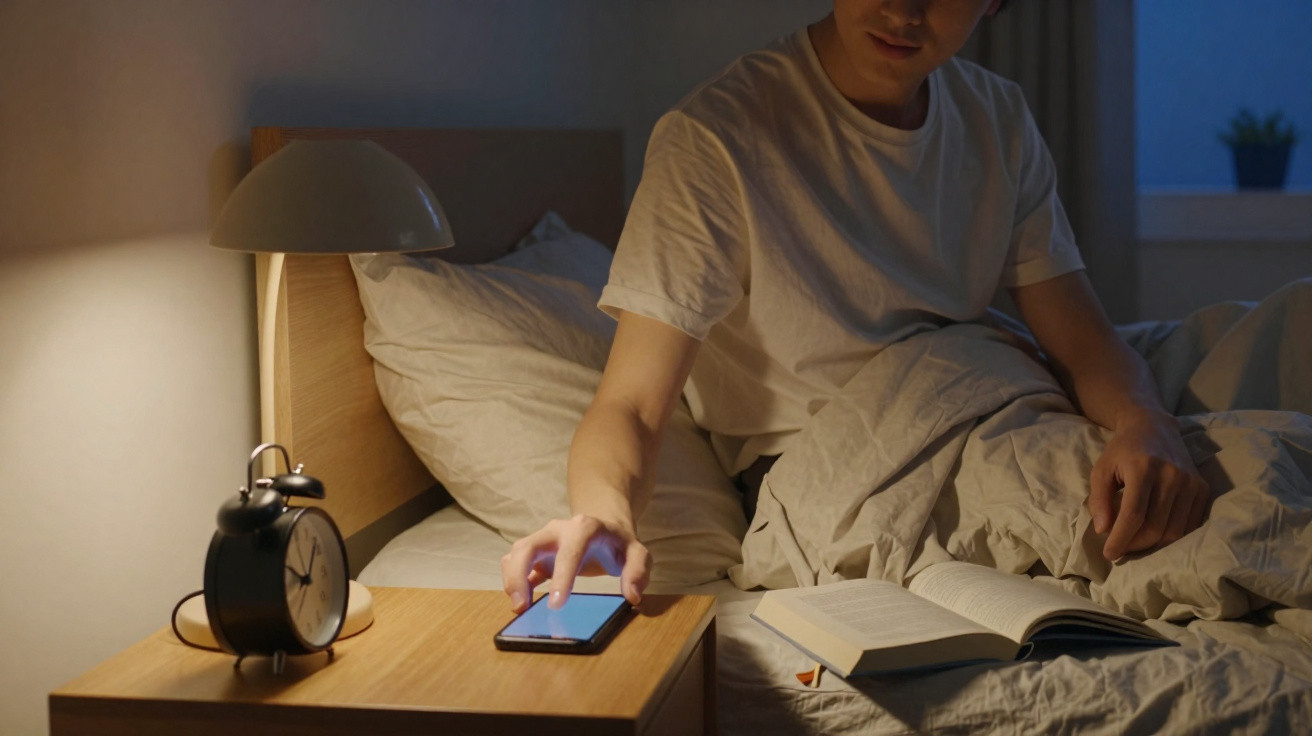
There is a moment at night that can feel almost sacred. The lights are dim, the duvet feels cool against your legs, and the world is at last beginning to settle. You think, “Tonight I’m going to sleep early. Tonight will be different.” You glance at the clock, plump up your pillow and release a long, end-of-day breath. Then, almost without thinking, your hand reaches for the single thing that undoes it all: your phone.
You have no intention of staying on it for long - “Just five minutes,” you tell yourself. A few messages, a brief scroll, perhaps that video a colleague mentioned. After a tiring day, your brain ought to be slowing down. Yet the instant the display lights up, something in you switches back on. You can sense it happening: your thoughts speed up, your eyes become more alert and your body subtly tightens. When you finally lock the screen, it is no longer early. Your mind, meanwhile, is fully awake.
We like to think it helps us relax. But what if this small bedtime routine is really teaching your brain to remain on high alert at precisely the point when it needs to let go?
The story we tell ourselves in bed
We all know the feeling of turning over, seeing 23:48, 00:12 or 01:03 on the clock, and getting that sharp pang of guilt. “Why am I still awake?” is generally followed by “Why am I still on my phone?” Close your eyes and the screen’s glow is still there, with tiny after-images hovering like ghosts. The odd part is that you knew, even as you picked it up, that it would not help you get to sleep. Still, you did it.
Every night, a quiet internal bargain takes place. You are exhausted, but you also believe you “deserve” a bit of scrolling, a few reels or one final look at the news. It is your reward, your escape, your chance to catch up. You frame it as soothing: a digital lullaby that will softly carry you off to sleep. But your heart rate slowly rises, your thoughts begin racing one another and the sleepy gentleness you had ten minutes before slips away.
Let’s be honest: we do not regard the time before sleep as valuable; we see it as whatever is left over. It becomes the day’s scraps, when anything is allowed - one more email, another TikTok, one more comments-section row. Rather than protecting those minutes, we throw things into them. Then we wonder why our brains will not simply turn off on demand.
The pre-sleep habit that wakes your brain up
It is not only “screen time” - it is what happens on the screen
Blue light gets plenty of attention, and it does matter. The cool, bright light emitted by phones and tablets signals daytime to your brain, disrupting melatonin, the hormone that guides you towards sleep. Yet that is only part of the picture. Light is not the only stimulant. The real issue is the content: an endless, unpredictable rush of information delivered to your mind immediately before bed.
That habit of having “just one more scroll”? That is the real culprit. Your brain is drawn to novelty and is designed to spark when something unfamiliar appears. Each swipe brings another small burst of “What’s next? What’s next? What’s next?” News alerts, messages, partly amusing reels and partly frightening headlines effectively shake your brain rather than soothe it. It is an espresso-sized dose of stimulation dressed up as relaxation.
Social feeds, news apps and quick-cut videos are designed to hold your attention, not to ease you gently away. Your bedtime habit is not restful; it is active work. You process stories, faces, views and drama. You compare, respond and judge. By the time you set your phone aside, your brain has quietly shifted from “bedtime mode” into “battlefield mode”. Sleep has little chance.
The hidden anxiety under the scroll
There is another dimension, one that settles in the pit of your stomach. You may open your phone to unwind, but how relaxed can you truly be while scrolling through wars, climate disasters, political turmoil and the polished perfection of people who somehow fitted in a 5am workout and a green smoothie? That contrast - global chaos alongside your own unwashed hair on the pillow - creates a low, persistent undercurrent of anxiety.
You would not read every distressing headline aloud to a child who was trying to sleep. You would not show them a highlights reel of everyone else’s life as they closed their eyes. Yet that is what we do to ourselves. We label it “catching up” on the day, as though knowing every final dreadful detail will make sleep come more easily. Somewhere inside, we know it has the opposite effect.
Your brain does not simply file a shocking clip or cruel comment away and carry on. It continues turning it over. At times, this appears as a knot in your chest; at others, it is restless energy in your legs. The bed has not changed and neither has the room, but your mind is already partway into tomorrow, rehearsing arguments, fretting about work and visualising headlines. You wanted reassurance, yet you ended up feeding the part of yourself that responds to threat.
What your brain really needs before sleep
Human brains like patterns and conclusions. Stories reach an ending, and days need a sense of closure. When we move directly from frantic scrolling to dropping the phone on the bedside table, we miss that natural ending. It is like snapping a book shut halfway through a chapter and expecting your mind to be content. It is hardly surprising that it keeps searching quietly for what is missing.
In a more peaceful world, the lead-up to sleep would be very different. You might have a modest ritual, like a private handshake with yourself: wash your face, write down a couple of thoughts, lower the lights and take a few slow breaths. Nothing elaborate, only signals your brain can recognise as “We’re done for today.” Instead, many of us send the reverse message: we remain connected to everyone else’s lives until the final second and never quite return to our own.
Your brain is not asking you to turn into a faultless wellness guru who drinks herbal tea and uses lavender spray every night. It simply needs some regularity and some compassion. It needs a gentler handover. When it does not get one, the result is not merely the loss of an hour’s sleep; it also reduces the quality of whatever rest you do get.
The stubborn little logic of “one last check”
The fear of missing out on… what, exactly?
Watch yourself carefully in the moments before bed and there is often a brief flicker of fear. “What if I miss something?” Perhaps it is a message from somebody you like, breaking news or a viral meme that everyone will be quoting tomorrow. The amusing thing is that you almost never remember what you saw the previous night. It fades into a general blur of noise. Even so, the compulsion to look can feel strong, almost bodily.
That impulse is your brain trying to find certainty. It wants reassurance that problems have been solved, that nobody is cross with you and that nothing catastrophic happened while you brushed your teeth. Your phone appears to offer that reassurance - open it, take a look, make sure everything is fine. But it seldom provides such a neat, comforting answer. More often, it gives you unfinished conversations, alarming headlines and the quiet impression that everyone else is better at life than you are.
This is when the cruel reasoning takes hold: the more you seek calm through your phone, the more material it supplies to unsettle you. “One last check” turns into two, then three, then a small deep dive into a friend’s holiday pictures or a stranger’s loud online dispute. When you finally put it down, your brain is more crowded, not clearer. Yet the following night, you will probably repeat it.
The buzz that remains after dark
Consider the seconds just after the screen goes dark. The room instantly feels darker and almost excessively quiet. You may hear a faint sound of traffic outside, the fridge in the next room or the gentle movement of sheets as you turn over. Inside your head, however, there is no silence. Pictures flicker, phrases repeat and a song from a video plays irritatingly in the background of your thoughts.
That lingering buzz is your brain attempting to process and organise everything it has taken in. It resembles clearing up after a noisy party when all you want is to collapse into bed. You will forget some of it by morning, but for now it is enough to keep you hovering just above genuine sleep. You may drift in and out, but it is a light, twitchy kind of rest rather than the deep, weighty drop your body truly requires.
This is the bitter irony: the routine we believe settles us is exactly what holds us in that half-awake state. We call it “unwinding”, when in fact we are tightening the coil, layer by layer, until nothing feels calm. When we wake exhausted, it is easy to blame stress, work, age or something else. Often, the hidden culprit is that 20–40 minute period when your brain needed quiet and received chaos.
What changes when you protect the final 30 minutes
Here is the honest part: nobody remakes their sleep habits overnight with a miracle routine. People try a fresh approach for two days, fail to feel instant magic and go straight back to doomscrolling in the dark. Genuine change is dull at first. It is neither glamorous nor Instagrammable. It may simply mean stubbornly leaving your phone on the other side of the room and spending time with your own thoughts, even when they are untidy.
Yet something changes when you make the last half-hour of the day non-negotiable. You begin to sense the boundaries of your day again, rather than allowing everything to run into everything else. Perhaps you read several pages of a book, stretch a little or lie still and listen to your own breathing rather than a video stranger’s voice. It is quieter and, at first, a little uncomfortable - like meeting yourself after neglecting yourself for a long time.
That discomfort is your brain decompressing. Once the continuous flow of fresh content stops, it finally has room to revisit the day in its own way. The arguments, successes, emails you regret and kind remark someone made at lunch all reappear; your mind rearranges them and starts gently releasing them. Scrolling takes this mental housekeeping from you. Protect that time for a week and your sleep can often become deeper in an almost old-fashioned way, like recalling how you slept as a child.
What can you do with a restless, wired brain?
Kinder habits that do not feel like a punishment
The worst advice is the type that sounds ideal but feels impossible to follow. “Just stop looking at your phone before bed” is a perfect example. You are not a robot; you are a person who is tired, sometimes lonely, stressed much of the time and seeking a small hit of comfort. Remove that without offering a substitute and, naturally, you will reach for it again. The answer is not to eliminate the ritual, but to alter what it gives you.
Perhaps you keep the phone, but use it differently. Set a boundary: no social feeds, news or emails during the last half-hour. Choose only things that settle you, such as a podcast with gentle voices, a saved playlist or an uncomplicated puzzle game that asks little of you. Or go analogue: use a notebook, make a short list of “three things I survived today”, or pick up a paperback with creased pages and a faint paper scent that no device can reproduce.
You are not trying to achieve a flawless, monk-like calm. You are merely steering your brain away from constant stimulation and towards something that says: “You’re safe, the day is done, nothing urgent is expected of you now.” Repeating that message night after night is more potent than any trending sleep hack or expensive device. It is ancient, straightforward and instantly understood by your nervous system.
The gentle strength of doing “almost” enough
There is a particular relief in accepting that you may never be the person who leaves their phone downstairs every evening and meditates for 20 minutes by soft candlelight. Perhaps you become someone who puts their phone on aeroplane mode at 10.30pm and reads four pages of a slightly battered novel instead. That remains a different way of living. It is still a different brain, slowly learning not to anticipate fireworks immediately before sleep.
Change does not have to be dramatic to be meaningful. On some nights, you may slip and find yourself far down a comment thread at midnight. Fine. Pay attention to how your body feels - the clenched jaw, the buzzing chest - and remember that this is not “relaxing”, regardless of how firmly your habits attempt to rename it. Then try again the next evening. Not flawlessly. Only a little better.
The real shift happens when you stop pretending your pre-sleep ritual is harmless downtime. Once you recognise it as stimulation - as caffeine for the mind - you cannot unsee it. From that point, even a very small change becomes an act of self-respect: a quiet way to tell your overworked brain that it does not need to be “on” until the instant you fall asleep.
The moment you genuinely put the phone down
Picture this: you are in bed with the lights low, automatically reaching for your phone. Then you notice yourself. You feel that familiar pull, the urge to find out what is happening outside your four walls. And you do one small but radical thing. You put the phone face down, just beyond easy reach, and leave it there.
Initially, your mind squirms. It searches for something to hold on to - a concern, a plan or a replay of a conversation that went badly. The room seems too quiet, like a stage once the band has gone. Gradually, though, other sensations appear: the weight of your body on the mattress, the warmth beneath the covers and the soft rhythm of your own breath. Rather than numbing yourself with noise, you start noticing that you exist.
That’s the habit that truly calms the brain: giving it permission to stop performing. There is no audience, no feed and no breaking story. There is only you, the darkness and the simple, almost old-fashioned act of going to sleep. The pre-sleep habit that stimulates your brain will always be there, one tap away. But tonight, perhaps, you allow the world to continue without you for half an hour - and find that your mind still knows how to rest when you finally allow it to.






Comments
No comments yet. Be the first to comment!
Leave a Comment