
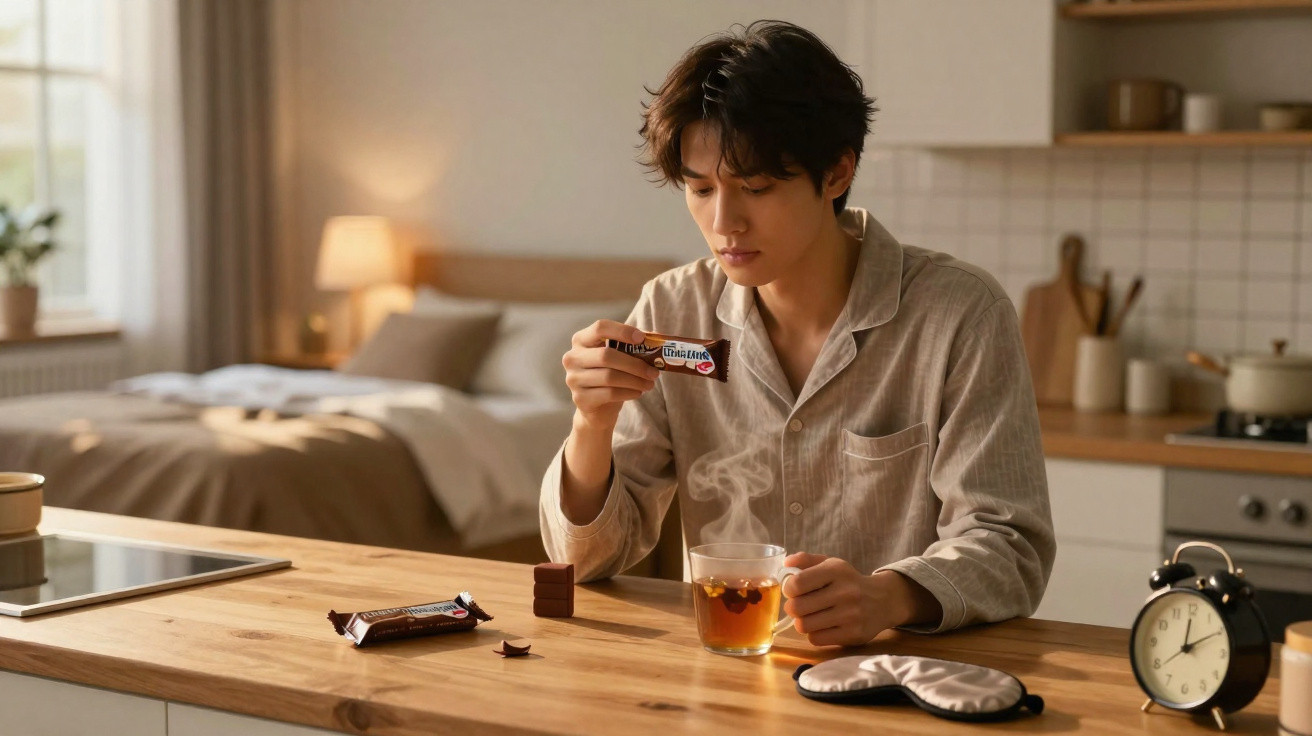
Train air, music through my headphones, the crackle of a wrapper - after a long day, it seemed like a modest win. I told myself it was “clean” fuel rather than a proper snack, merely enough to get me through to dinner. Yet, night after night, I would get into bed and look at the ceiling as my heart behaved as though it were on a gentle jog. It took weeks for the pattern to become obvious, and it was almost embarrassing once it did: the later I ate the bar, the worse I slept. Could that neat, sensible snack really be less harmless after 6 PM?
The habit that quietly disrupts your night
An evening protein bar often appears at the end of a day built around good intentions. Perhaps lunch slipped away, dinner is going to be late, or you have been to the gym; in each case, the bar becomes a dependable companion. It is fast, contained and somehow signals “health” without requiring the effort of an actual meal. We have all known the moment when its wrapper seems to crinkle like a little round of applause for being a functioning adult.
Then there are the evenings when your mind refuses to settle. You wake at 2:43, then again at 4:10, while your wearable confirms what your tired face has already suggested: light sleep is replacing the deeper stages, and your heart rate is sitting slightly above its usual level. Over several weeks, the relationship becomes clearer. That late bar may be the understated saboteur.
I began comparing nights when I had the commuting snack with nights when I did not. The change emerged in the time it took to fall asleep and in the amount of restless turning. It was not striking on every occasion, but it happened consistently enough to make me wonder why. Research does not treat protein as a villain in every situation, but it does identify late-evening effects that can make a bar an unsuitable companion for bed.
The heat issue: protein speeds you up when your body needs to cool
As night approaches, your body naturally wants to cool down. That gradual fall in core temperature tells the brain that sleep is safe and timely. Protein, however, acts more like a furnace. It has a greater thermic effect of food than carbohydrates or fat, so digesting it requires more energy and produces heat as your body gets to work.
Researchers measuring this after-meal energy burn have found that protein can increase energy expenditure and core temperature more than other macronutrients. At lunchtime, that small rise may be unnoticeable. But at 8:30 PM, when melatonin is tapping your shoulder, it can mean the difference between drifting off smoothly and feeling inexplicably restless. One review of sleep physiology describes how even minor rises in temperature can postpone sleep onset and reduce deep sleep during the first part of the night.
When the body needs to cool, a late protein-heavy snack leans on the thermostat the other way.
How protein affects your core temperature
Consider the warm flush after a large steak or a whey shake - you may feel it even if you never put a name to it. It is digestion switching on the keyboard lights just as you are trying to darken the room. Bars commonly pack 20 grams or more of protein into a compact, sweet parcel. That amount may work efficiently for muscle, while being less convenient for sleep.
Laboratory trials comparing different macronutrient combinations show that protein in the evening can raise both heart rate and metabolic rate slightly. Even modest increases leave you one step nearer wakefulness. Suddenly the duvet feels too heavy, and the pillow turns into something you have to negotiate with.
The amino-acid traffic jam in your brain
Sleep chemistry depends partly on serotonin and melatonin, both of which are made from the amino acid tryptophan. To reach the brain, tryptophan must cross the blood-brain barrier while competing against other large neutral amino acids - rather like a busy motorway with too few lanes. A protein-rich snack fills that motorway with rivals, including tyrosine and branched-chain amino acids. They build up at the toll booth, and tryptophan does not always get priority.
This helps explain why some research finds that evening carbohydrate can be useful: insulin encourages competing amino acids into muscle, allowing tryptophan to make its way into the brain. That does not turn a pint of ice cream into a sleep remedy, but it does clarify why a purely protein-based late snack may shift brain chemistry away from drowsiness. A longstanding body of research has followed this ratio effect for decades, and newer papers on sleep and nutrition continue to identify the same gatekeeper issue.
There are qualifications. Different proteins do not all influence the ratio in precisely the same way, and people do not all react alike. Even so, the broad picture remains: crowded lanes, slower tryptophan movement and a brain that needs longer to settle. If a late bar has ever left you feeling wired but tired, that may be more than a narrative you invented for yourself.
Hidden stimulants and noisy digestion
Protein bars contain more than protein. They are compact ecosystems of cocoa, green tea extract, guarana, B-vitamins and sugar alcohols with names that sound as though they belong in a chemistry test. Cocoa contains caffeine, and some “energy” bars discreetly include more of it. For people who are sensitive to sleep disruption, even a small quantity can push the night in the wrong direction.
Then there are the sugar alcohols - erythritol, maltitol, sorbitol - which can cause gas, bloating, and midnight bathroom journeys. If you have ever felt a soft balloon expanding beneath your waistband while your partner breathes peacefully beside you, you know how that story goes. Bars also tend to contain fibre to promote fullness, which is excellent at noon but less appealing when your gut decides to practise its performance at 1 AM.
B-vitamins are frequently presented as a benefit. They are vital for metabolism and energy - exactly the processes you may not want to encourage before bed. A small group of people notice a buzzy, alert sensation after eating a fortified bar, especially when the home is already quiet and the lights are dim. That is not simply your imagination; it is chemistry in gym clothes.
After 6 PM meets your body clock
For many of us, 6 PM marks the start of the long approach to night. Melatonin begins to rise, cortisol starts to ease away, and the nervous system should be moving into a gentler gear. Studies of late eating associate meals and snacks eaten close to bedtime - roughly two to three hours beforehand - with greater wakefulness, lighter sleep and altered REM timing. A bar at 7:30 before a 10 PM bedtime falls squarely within that potentially difficult window.
Researchers who shift dinner from an earlier to a later time observe changes in glucose processing and body temperature that continue into the night. This is not a moral judgement about eating late. It is a matter of logistics. A body preparing for repair receives a job instead, and that job involves blood flow to the gut, heat and a degree of sympathetic activation.
When melatonin encounters a snack
Melatonin does not sedate you; it starts a chain of signals that makes sleep more accessible. Food that demands insulin and digestive effort can sit awkwardly within that sequence. It is a tug-of-war: your internal clock pulls in one direction while your plate pulls in the other. After 6 PM, the rope begins to tighten.
Not every research question has been resolved, and outcomes differ according to age, sex and activity levels. Nevertheless, the overall message is sufficiently clear for a practical takeaway: an earlier dinner can support a quieter night. A late-night protein bar? To your circadian system, it may register as dinner in disguise.
“But I heard casein before bed helps recovery”
In small controlled trials involving active adults, casein shakes before sleep did not damage sleep and sometimes improved overnight muscle protein synthesis. Those studies used carefully controlled drinks, often without the extra ingredients found in bars, and participants were not navigating a 7 PM commute or a stressful inbox. When assessed using polysomnography in quiet rooms, the shakes appeared broadly neutral for sleep architecture.
Everyday life is noisier. Bars are not simply casein, and your Tuesday is not a laboratory. Eat a dense, fortified, high-fibre bar under bright kitchen lighting while doomscrolling, and the outcome may be different. Frankly, nobody repeats that exact routine in precisely the same way every day.
The conclusion across the studies is this: late-night protein is not inherently harmful for everyone, but in mixed real-world circumstances - additives, timing and stress - it can lean towards greater wakefulness. For some people, that lean becomes a slide.
What the research actually suggests
Diet-induced thermogenesis is greatest with protein, increasing core body temperature for hours. Sleep research indicates that the brain benefits from a fall in temperature, allowing faster sleep onset and an earlier descent into deep sleep. Taken together, the reasoning fits: a protein-heavy snack eaten too late can interrupt that cooling process.
Studies examining nutrition and sleep also monitor amino-acid ratios. More protein close to bedtime may reduce the ratio of tryptophan to competing amino acids, one of the brain’s routes towards serotonin and melatonin. Meanwhile, carbohydrates consumed a few hours earlier can often reduce the time needed to drift off. This does not mean sugar is medicine; it means composition and timing both count.
Population research on late eating finds lower sleep efficiency and more awakenings, whereas smaller clinical trials of athletes drinking casein tend to show little harm. The apparent conflict is about context. Bars occupy the untidy middle ground, bringing cocoa, sweeteners, fibres and caffeine-adjacent extracts that are absent from the clean laboratory drinks. Your nights occupy that middle ground too.
Simple alternatives that do not hit your sleep
If you exercise after work and need protein, try to have it earlier. A proper dinner containing protein at 6 or 6:30 gives your body several hours to complete the heat-producing work before bed. If you still need a later snack, opt for something small and easy on the stomach - a little Greek yoghurt with honey, a banana, a kiwi or a few oat crackers. These choices favour a more tryptophan-friendly ratio without inflating your gut or concealing stimulants.
If the bar ritual is something you enjoy, eat half earlier and save the rest for the following day. Check labels for caffeine sources, cocoa levels and sugar alcohols. Marketing may make plenty of noise, but the ingredients list tells the real story. At night, a simpler bar with fewer added fortifications is often more forgiving.
Routines matter too. Lower the lights, have a warm shower and place your phone face down. Some people drink a small glass of warm milk or a magnesium-rich drink without cocoa. Others take a ten-minute walk after dinner to begin the cooling process. The aim is not perfection, but gently guiding the system towards calm.
A small experiment worth trying
Test a two-week change: avoid protein bars after 6 PM, have dinner earlier and choose a light, carbohydrate-forward snack only if needed. Monitor something straightforward - how long you take to fall asleep, how often you wake and how your mood feels at 10 AM. If you wear a watch or ring, observe your resting heart rate pattern overnight. Notice when it falls; earlier is generally preferable.
If your nights get deeper and your mornings less sandy, you’ve learned something your body was trying to tell you.
You may spot tiny changes first - the bedroom seems cooler, your partner’s breathing begins to match your own, and the traffic or street sounds fade into a distant hum. That is what a system in sync can feel like. The bar will still be available at 3 PM, when it behaves better. Move it earlier and you may finally discover what your sleep had been concealing all along.





Comments
No comments yet. Be the first to comment!
Leave a Comment