
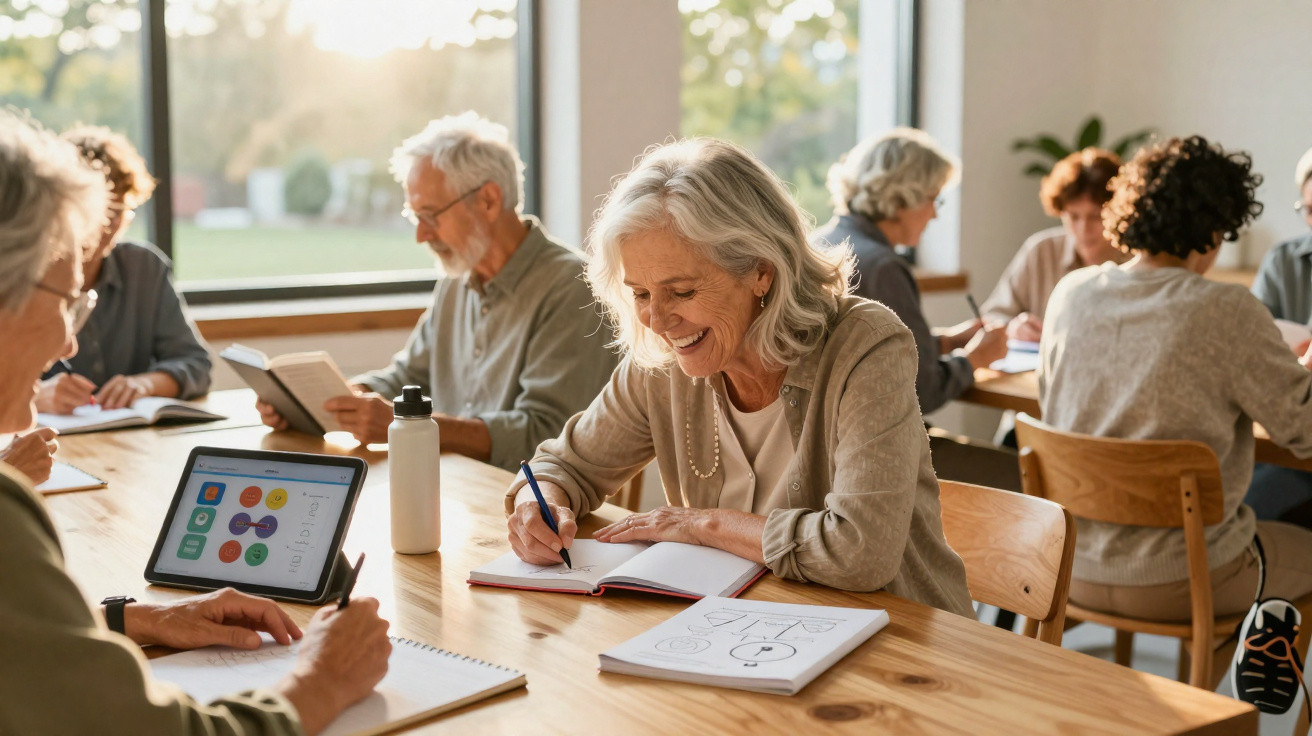
The room carried a faint scent of coffee and printer ink, while the gentle clatter of keyboards was the only sound. At first glance, it was an ordinary computing class, apart from one noticeable feature: nearly every learner had white hair. Maria, 72, stared at her monitor in concentration before breaking into a smile when she sent her first email, full of emojis, to her granddaughter. Across the room, Jorge, 68, was working out cloud storage and laughing whenever he clicked the wrong option.
Nobody claimed it was straightforward. Equally, nobody was prepared to give up.
It was almost possible to watch their brains building new pathways before your eyes.
Why learning after 60 quietly reshapes the brain
Entering a language class for older people can feel a little like arriving at a busy gym. The effort is tangible. Adults over 60 are wrestling their tongues around unfamiliar vocabulary, working through the awkwardness, small humiliations and repeated “Sorry, what was that again?” moments.
The atmosphere is not the same as in a classroom of teenagers. There is less performance and more calm resolve. There is less anxiety about marks, but more concern about one day losing their sense of self.
Oddly enough, that concern often helps to keep them mentally sharp.
In 2023, a major study in a leading neurology journal tracked older adults over a number of years. Participants who continued to acquire new abilities – including digital photography, foreign languages and intricate knitting patterns – experienced slower cognitive decline than people who remained with familiar routines.
The gap was clear rather than marginal. Those who began new pursuits several times each week achieved better results in memory assessments and attention tasks, even once their education and health were taken into account.
One participant aged 74, who began to learn guitar “for the brain, not the concert hall”, said that his days suddenly seemed longer because his mind had something meaningful to work on.
Inside the brain, the process resembles a refurbishment. Learning something genuinely unfamiliar – rather than endlessly scrolling the same news or completing the crossword you have done for 20 years – compels the brain to create new connections.
Neuroscientists describe this as neuroplasticity: new synapses, new routes and additional “backup routes” for information. As ageing affects some regions, other areas can therefore be ready to take over.
Challenge is the essential part. Familiar pastimes are comforting, whereas new activities put just enough pressure on the brain to keep it active and alert.
How to turn everyday life into a brain-training ground after 60
The encouraging part is that no expensive programme or neuroscience qualification is required. The brain responds well to almost any activity that initially feels a little uncomfortable. That might mean mastering online banking, taking up tai chi, joining a choir or following a YouTube drawing course at the kitchen table.
One simple guideline is effective: take on one new activity at a time, in three brief sessions each week. The aim is not heroics, but regular practice.
Realistically, hardly anyone manages it every day. Regularity is far more valuable than perfection.
Many people over 60 privately tell themselves, “I’m too old for this, I’ll just slow everyone down.” That belief does more damage than any birthday. People often stop themselves before making an attempt, particularly where technology is concerned.
The answer is to find places where errors are expected: community centres, public libraries, church halls and online groups explicitly marked “for beginners”. It also means accepting the uncomfortable early stage as part of learning, rather than treating it as proof of failure.
We have all experienced that point when our fingers will not do what our minds intend, and we feel like shutting the laptop or closing the book.
A retired nurse I met, aged 69, expressed it in a way that stayed with me:
“I don’t learn to stay young, I learn to stay myself. If I stop being curious, that’s when I feel old.”
Every January, she followed a small ritual by choosing a “brain project” for the year. Italian came first one year, watercolour the following year, and then simple website coding.
Here is the sort of relaxed “brain menu” that can genuinely help:
- Choose one ability that makes you slightly nervous, such as public speaking or Zoom.
- Choose one that brings you pleasure, such as painting, baking unfamiliar recipes or singing.
- Choose one social stretch, such as a book club, dance class or volunteering in a different role.
- Keep each session to 30–45 minutes so that mental tiredness does not set in.
- Say small achievements out loud, even when nobody else is there to hear them.
The quiet power of staying a beginner at 60, 70, and beyond
There is something profoundly affecting about seeing a 78-year-old man follow a yoga class through an unstable tablet connection in his living room, or a 65-year-old grandmother learn video editing to assemble family footage. These scenes do not become viral sensations. No medals are handed out. Still, away from public view, such modest efforts can slow cognitive ageing and build mental reserves beyond what statistics can fully measure.
Returning to beginner status after a lifetime of being the person who “knows how things work” may be humbling and even unsettling. Yet it can also feel unexpectedly liberating.
You do not need to excel. You only need to be willing.
| Key point | Detail | Value for the reader |
|---|---|---|
| New learning slows decline | Demanding activities build new neural connections and cognitive reserve | Offers a practical way to safeguard memory and attention over time |
| Small, regular effort works | Three brief weekly sessions spent learning a new skill work better than intense but infrequent bursts | Helps the habit seem achievable rather than daunting |
| Social and emotional benefits | Learning alongside other people lessens isolation while improving mood and confidence | Encourages readers to make connections, rather than simply “train their brain” alone |
FAQ:
- Does it matter what I learn after 60? Yes, provided it is truly new and mildly demanding. Learning a language, musical instrument, dance form or technology skill usually has more benefit than repeating the same puzzle for years.
- Is it too late to start at 70 or 80? No. Research shows benefits even at very advanced ages. Improvements may be more modest, but the brain continues to adapt, particularly when learning is regular and socially engaging.
- Do brain games on my phone really help? They may offer a small benefit for particular abilities, such as reaction time, but broader real-world activities – such as cooking unfamiliar dishes or joining a class – generally provide richer benefits.
- What if I have memory problems already? Gentle learning with support may still be beneficial. Speak to a healthcare professional, begin gradually and prioritise enjoyable, low-pressure activities over performance.
- How long before I notice any effect? Some people feel mentally “brighter” after a few weeks. Changes to brain structure take months, so think in seasons rather than days, and value the enjoyment of learning as well as the outcome.






Comments
No comments yet. Be the first to comment!
Leave a Comment