
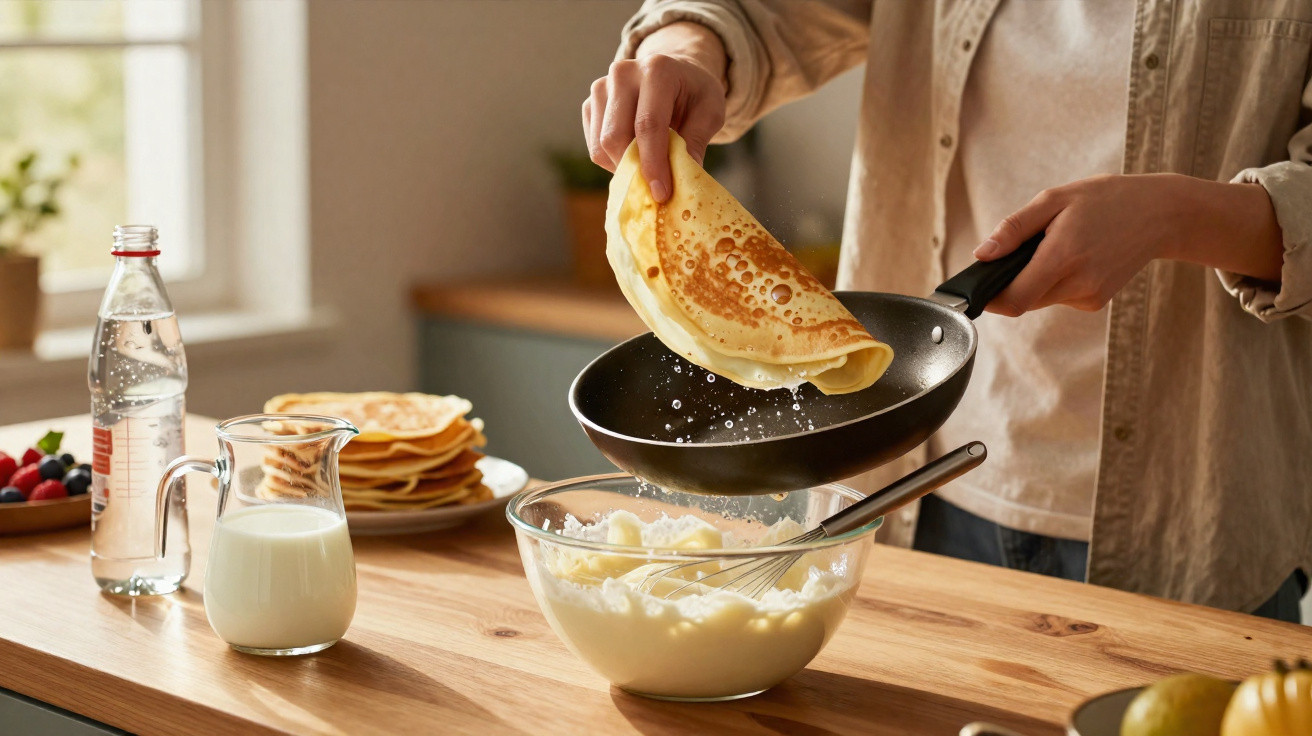
Many people love crêpes, but the overly full feeling afterwards can be frustrating. The batter can, however, be adjusted to make it lighter, airier and easier to digest - without sacrificing flavour, the scent of butter in the pan or crisp edges. The answer is not an expensive specialist product, but a straightforward ratio and an unassuming everyday drink.
The 50/50 rule: half the milk, the same enjoyment
The principle is simple: replace half the usual quantity of milk in crêpe batter with water. That is all it takes. No exotic powder, no complicated diet cooking - just a small change to the liquid.
"The rule of thumb: 50 per cent milk, 50 per cent water - the same amount of batter, but far lighter on the stomach."
A typical home recipe uses 500 millilitres of milk, eggs, flour, a little sugar and perhaps vanilla. For a lighter version, use:
- 250 ml cow's milk
- 250 ml water (tap water or mineral water)
- The remaining ingredients as usual
This reduces the calories, fat and protein in each crêpe by roughly a third. The texture stays soft and flexible, yet the stomach feels noticeably less weighed down - particularly when eating several crêpes or cooking them late in the evening.
Why water makes such a difference in crêpe batter
Milk contributes fat, lactose and protein. Although these add flavour, they also make the batter denser. Water, by contrast, is entirely “neutral”: it contains no calories, fat or protein.
Combining the two has several effects:
- The overall energy per crêpe is lower.
- The batter becomes more fluid and spreads more easily in the pan.
- The crêpes feel less “heavy” in the mouth and sit less heavily in the stomach.
The method is kinder to the budget, too: tap water costs virtually nothing, whereas milk does not. Anyone regularly making large batches for family or friends can make a noticeable saving - without taking anything away from anyone.
Extra-airy crêpes with sparkling water: like little cushions of air
For an even lighter result, choose sparkling mineral water rather than still water. Its carbonation is dissolved carbon dioxide (CO₂), which expands when heated and creates tiny bubbles in the pan.
"The effect of sparkling water in the batter: countless microbubbles that aerate the crêpe and create delicate, slightly lacy edges."
To achieve this, it helps to follow a particular mixing order:
- Mix the batter as usual with milk, eggs, flour and the other ingredients - leaving out the water at first.
- Take well-chilled sparkling water from the fridge.
- Stir the cold sparkling water in only at the end, so as much carbonation as possible remains in the batter.
- Heat the pan very thoroughly before adding the first ladleful of batter.
The combination of ice-cold sparkling water and a hot pan produces a kind of “thermal shock”: the crêpe's surface sets quickly while escaping gas bubbles disperse through the still-soft layer of batter. This creates the characteristic paper-thin edge familiar from many Breton crêperies.
No sparkling water available? You can still recreate the effect
If there is no open bottle of mineral water to hand, the carbonation effect can be replicated. All that is needed is tap water, a little bicarbonate of soda and a few drops of lemon juice.
Bicarbonate of soda reacts with the acid in the lemon, producing carbon dioxide. This gas aerates the batter in much the same way as sparkling water.
A practical guide is:
- 250 ml cold water
- 1 teaspoon bicarbonate of soda
- A few drops of lemon juice
Add the mixture to the prepared batter at the end. Cook the crêpes promptly, so the gas does not dissipate before the pan is hot.
Can crêpe batter be made entirely without milk?
Anyone who reacts strongly to milk or wants to significantly reduce their lactose intake can leave out milk altogether and use only water or sparkling water. It works technically: the crêpes hold together in the pan and can be turned over.
"Without milk, the batter tastes slightly less ‘rounded’, but this can be balanced easily with flavourings and toppings."
For a version made with 100 per cent water, it is advisable to use:
- A little more egg to provide structure and binding
- A dash of vanilla extract or orange blossom water for flavour
- A well-greased pan to prevent sticking
Many people report feeling hardly any heaviness even after a large serving of these crêpes - especially when they are topped with fruit, quark or yoghurt rather than only chocolate and caramel.
How to make the perfect light crêpe batter at home
Anyone wishing to try the 50/50 idea can use this basic recipe for around 12 thin crêpes:
| Ingredient | Quantity |
|---|---|
| Wheat flour (Type 405 or 550) | 250 g |
| Eggs | 3 |
| Milk | 250 ml |
| Water or sparkling water | 250 ml |
| Pinch of salt, a little sugar | To taste |
| Butter or oil for the pan | A few drops per crêpe |
First combine the flour, salt and sugar, then stir in the eggs and gradually add the milk until a smooth batter forms. Any lumps can be removed easily with a whisk or hand blender. Fold in the water or sparkling water only at the very end, then leave the batter to rest for at least 20 to 30 minutes. After resting, it becomes more uniform, responds better to heat and is less likely to tear.
Why pan choice and temperature matter
A non-stick frying pan with a shallow rim is particularly helpful for very thin, light batter. Start with a high heat, so the batter forms a fine crust as soon as it touches the metal. Then lower the temperature slightly, preventing the crêpe from burning before it has cooked through.
Only a little fat is needed: a small knob of butter or a drop of oil spread with kitchen paper adds flavour and stops sticking. If the milk is greatly reduced or omitted completely, grease the pan a little more generously, as less fat from the milk will be present in the batter.
Pairing light crêpes cleverly
Airy batter is only half the equation - the topping also determines how the stomach responds. To keep crêpes genuinely easy to digest, choose more often:
- Fresh berries or apple slices
- Yoghurt, quark or skyr
- A thin spread of nut butter
- A little honey or maple syrup instead of a thick layer of sugar
Those who generously add chocolate spread, caramel and thick swirls of whipped cream will naturally still feel some weight in their stomach, even with lighter batter. The 50/50 trick shifts the balance, but it does not turn a dessert into a diet meal.
Why this crêpe trick also makes sense in everyday life
The technique of halving the milk content originally came from times when milk was scarce and expensive. Today, it happens to suit a more conscious approach to calories and cost extremely well. Many households are trying to use fewer animal products without giving up trusted favourite dishes. This is precisely where the water component proves its value.
Once this approach becomes familiar, it can be applied to other batters: waffles, pancakes and savoury versions can often be lightened with a splash of water or sparkling water. It creates a kind of building-block principle: volume and enjoyment remain, while the heaviness decreases - and the family will usually only notice that the crêpes somehow taste “lighter”.


Comments
No comments yet. Be the first to comment!
Leave a Comment