
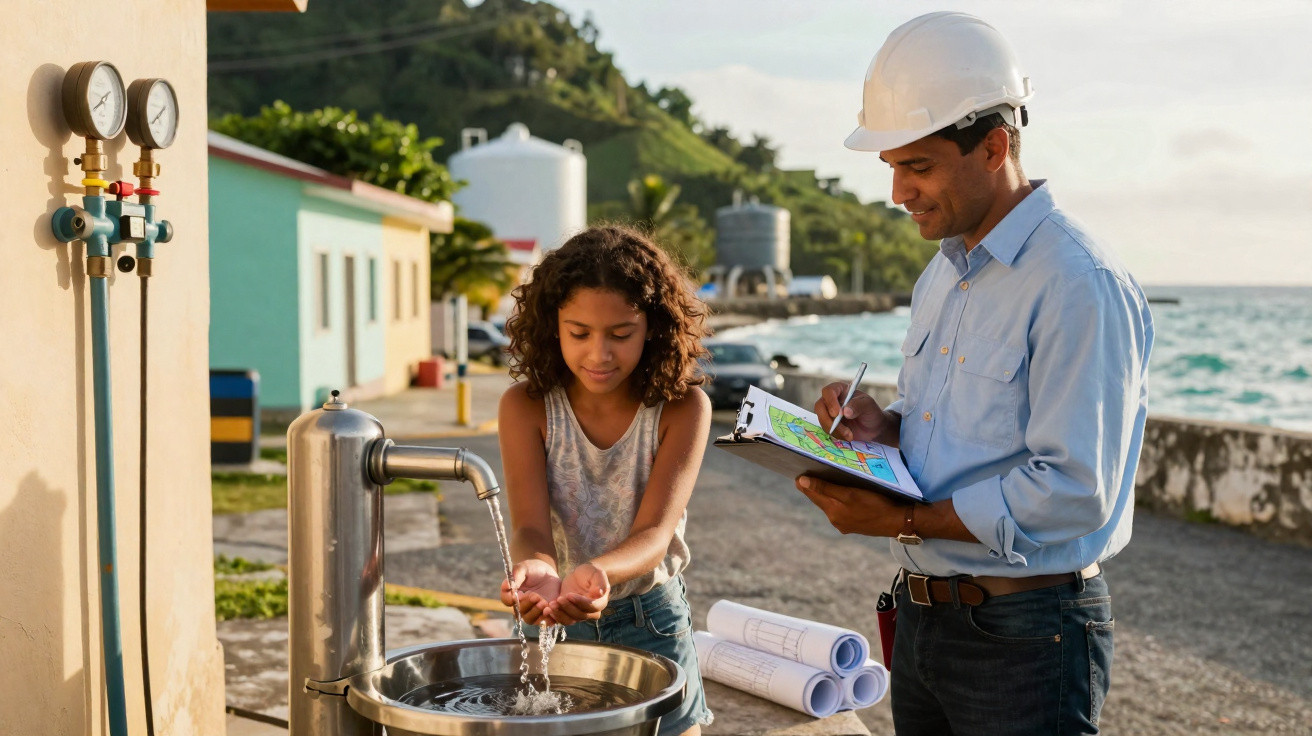
On one of the Caribbean’s largest islands, a major engineering programme is steadily emerging while taps deliver less water each year.
To guarantee safe drinking water, the local government has sought French public-works expertise for a €144 million initiative that will transform the way the island collects, treats and supplies water.
A Caribbean island facing increasing water pressure
The unnamed island, the Caribbean’s third-largest by area, has a population of several million and a rapidly expanding tourism industry. Its beaches and resort hotels draw travellers from Europe and North America, but unreliable supplies and deteriorating pipes remain a reality for many local people.
Extended dry periods, unpredictable rainfall and fast urban expansion have placed the water network under severe pressure. In some areas, residents routinely face weak water pressure or overnight supply cuts. Rural communities frequently depend on tanker deliveries or private wells whose water quality may be uncertain.
The €144 million project is designed as a turning point: from patchwork fixes to a long-term, island-wide drinking water strategy.
In response to these growing challenges, the authorities asked France for assistance. France has considerable experience of operating water systems in overseas territories and coastal locations vulnerable to hurricanes and saltwater intrusion.
Why France was brought in for support
France was not the island’s former colonial power, but infrastructure and climate-adaptation cooperation agreements have enabled joint schemes. French public bodies and engineering companies have built specialist expertise in:
- Planning extensive drinking water networks for small islands
- Safeguarding infrastructure against cyclones, storm surges and corrosion
- Cutting leaks and unlawful connections in ageing pipe networks
- Incorporating renewable energy into water treatment facilities
For the Caribbean administration, using French teams offers a means of accelerating the planning process and strengthening access to climate funding from European and international lenders. French specialists already understand comparable challenges in Guadeloupe, Martinique, Réunion and Mayotte, where drought and water losses have prompted major reforms.
The €144 million cost and what it will fund
The programme is expected to cost €144 million overall and will be delivered over a number of years. Its funding is set to combine public spending, development-bank finance and potentially green bonds.
| Main component | Share of budget (approx.) |
|---|---|
| New water treatment plants and upgrades | 35% |
| Rehabilitation and extension of distribution network | 30% |
| Storage reservoirs and pumping stations | 20% |
| Digital monitoring, leak detection and meters | 10% |
| Technical assistance, training and contingency | 5% |
French engineering businesses will not receive the entire sum. The budget also provides for local contractors, pipe suppliers, energy links, land purchases and environmental compensation for ecosystems affected by the works.
What residents can expect from the drinking water project
The scheme’s central commitment is straightforward: dependable, safe water supplies around the clock for homes and businesses. Although this may appear basic, weekly water interruptions are commonplace in many Caribbean communities.
The improved network is intended to:
- Protect raw-water supplies from rivers, reservoirs and underground aquifers
- Expand treatment capacity to match rising demand
- Replace damaged and inadequate pipes in densely populated urban districts
- Install storage tanks to manage demand peaks and emergencies
- Lower contamination risks from ageing networks located close to sewers
The island’s authorities are betting that stable drinking water will support health, tourism and long-term economic growth all at once.
People living in informal settlements and peri-urban areas are likely to benefit most. Many currently pay more per litre than hotel complexes because they must buy from small suppliers or rely on tanker deliveries. A wider public network could help address that imbalance.
Engineers working against climate change trends
The construction timetable is demanding. Recent droughts have reduced reservoir levels to historic lows, while storms have exposed the weakness of current infrastructure. French and local engineers have been given a brief that incorporates climate forecasts for the decades ahead.
They will need to prepare for higher temperatures, heavier rainfall events and sea-level rise that can force saltwater into coastal aquifers. Where feasible, treatment facilities and pumping stations will be located on higher ground, using strengthened structures and backup power supplies.
Water managers refer to “resilience”, rather than capacity alone: the system must continue operating when hurricanes bring down electricity lines or destroy road access.
How the France partnership will operate
The arrangement with France extends beyond a single construction deal. It also covers technical support, workforce training and digital tools for the island’s water utility.
French public agencies are expected to offer:
- Hydrological assessments mapping the water resources available
- Economic studies covering tariffs, subsidies and investment requirements
- Training for local technicians and managers
- Guidance on public procurement and anti-corruption protections
Some engineers and managers could spend time in France or French overseas territories to see how comparable systems are managed. Such exchanges are intended to build local expertise instead of creating reliance on overseas consultants.
The goal is a water utility that can stand on its own feet once the French teams leave the island.
Political concerns and public expectations
Foreign involvement in an essential public service can be politically contentious. Opposition groups often challenge these agreements, citing concerns over lost control or excessive costs. For this project, local leaders have emphasised that the water network will stay publicly owned and be run by a domestic authority.
Engaging with residents will be important. Building work will bring temporary road closures, noise and occasional interruptions to supply. Project leaders intend to run information campaigns so communities understand when disruption will happen, why it is necessary and what gains should follow.
Tariffs are another sensitive matter. Modernised infrastructure has ongoing operating costs. Although grants and low-cost loans lessen the pressure, customers may face gradual price changes. The authorities have pledged social tariffs and targeted assistance for low-income households, to ensure vulnerable families are not shut out of the network.
Why drinking water schemes are becoming larger
Over the past decade, the Caribbean has experienced a rise in major water-investment programmes. Population growth, tourism and climate change are closely interconnected. Hotels and cruise ships consume substantial quantities of water, while farmers contend with unreliable rainfall. Governments are often forced to choose between desalination, intensive leak reduction and demand management.
For this project, the island is initially prioritising conventional sources: dams, rivers and aquifers. Desalination could follow as a reserve measure. France has experience with both options. In places such as French Polynesia and Mayotte, combining desalinated water with collected rainwater has reduced reliance on any one source.
Key terms and everyday examples
Two ideas are particularly useful for understanding the scheme: “non-revenue water” and “resilience”. Non-revenue water covers all water leaving a treatment plant that is never paid for. It may escape through leaks, evaporate from uncovered reservoirs or be lost through illegal connections. In certain Caribbean networks, this figure exceeds 50%.
Even limited reductions can produce substantial benefits. If the island presently loses 40% of its treated water, reducing this to 25% would immediately release millions of litres each day, without taking more water from a river or drilling another well. This could postpone costly desalination projects and reduce environmental harm.
Resilience, meanwhile, means retaining service during difficult conditions. A resilient system can redirect water after a major pipe fails, use a reserve reservoir in a drought or move onto emergency power during storms. In everyday terms, it means water still comes from the tap when the weather becomes severe.
The changes will be felt in practical circumstances. A street trader might no longer lose a working day because there is no water for washing utensils. A small guesthouse could welcome more visitors throughout the year with less concern about rationing. Schools and health clinics could organise services without having to transport water in barrels.
Other islands across the region are watching closely. Should the French-backed project be completed on time and within budget, it could become a model for similar collaborations between Caribbean governments and overseas technical partners, combining finance, engineering and climate planning to maintain clean water supplies in a hotter and less predictable century.






Comments
No comments yet. Be the first to comment!
Leave a Comment