
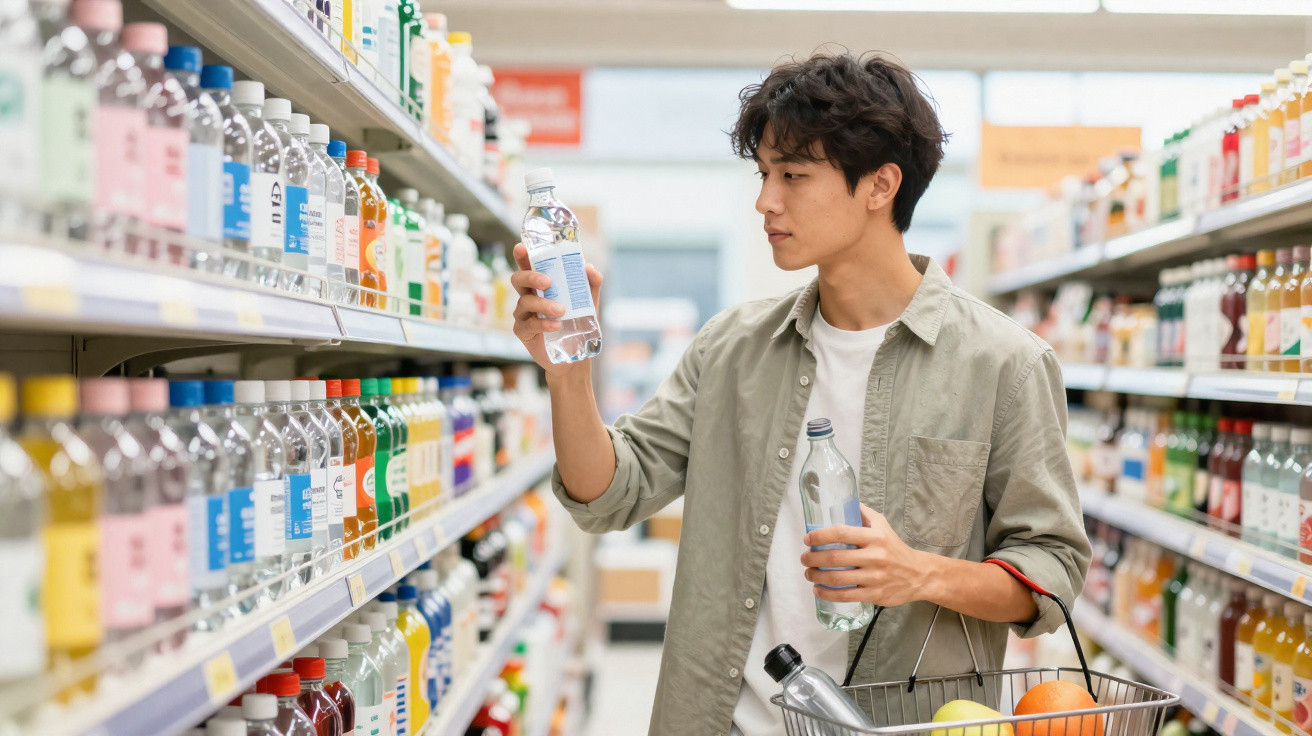
Fruit-flavoured waters can appear to be a lighter, healthier alternative to fizzy drinks.
Yet the reality behind the packaging is less straightforward.
As supermarket aisles increasingly offer lemon, grapefruit and peach-apricot waters, French consumer magazine 60 Millions de consommateurs has examined what these bottles truly contain, the ways they are processed and who benefits financially. Its findings have implications for health, household budgets and communities located around valuable water sources.
Flavoured water: a soft drink in disguise?
Flavoured waters have existed since the end of the 1980s, although they have only recently emerged as a major category in their own right. Circana data shows that, in France alone, sales totalled approximately €199.5 million from May 2024 to May 2025.
That figure may seem substantial, but it remains far below sales of unflavoured bottled water. Natural still waters alone brought in around €2.5 billion over the same period. Flavoured bottles are still a niche product, albeit one growing quickly – and their popularity prompts renewed scrutiny of their nutritional qualities.
Flavoured waters often sit next to mineral water on the shelf, but nutritionally they behave far more like soft drinks.
Added sugar is present in most brands. A typical 200 ml glass generally contains between 5 and 10 grams, while some products reach 15–16 grams – roughly two and a half sugar cubes. This puts their sweetness close to that of conventional lemonade.
By comparison, the World Health Organization recommends about 25 grams of free sugars daily for an adult seeking optimal health, rather than simply staying within the official 50-gram ceiling. Two sizeable glasses of flavoured water can therefore account for much of that “budget”.
Flavoured water does not share mineral water's legal status
A widespread misunderstanding is that flavoured water is merely “mineral water with a hint of fruit”. From both a legal and technical perspective, this is incorrect.
Under European law, natural mineral water and spring water have protected status. They must be bottled where they are sourced, may not be disinfected, and must retain consistent mineral composition. Their marketing is founded on purity and an unbroken connection with the spring.
Adding flavourings, sweeteners or other ingredients changes that status. Even if they begin as mineral or spring water, flavoured products enter another regulatory category and are regulated more like soft drinks than protected-source waters.
Flavoured waters can be subject to disinfection and processing steps similar to those used for tap water, unlike natural mineral waters.
This change in regulation gives manufacturers considerably greater scope, but can also make matters less clear for shoppers. Bottles may prominently display the name of a renowned spa town or natural spring, whereas the fact that they are no longer legally “mineral water” may only feature in small print.
What treatment can involve in practice
Rules allow flavoured waters to receive several treatments commonly used to manage ordinary drinking water, including:
- Filtration for particle removal and clarity adjustment
- Disinfection, commonly through ozone or ultraviolet light
- Carbonation changes, by adding or removing CO₂
- Taste correction with food-grade additives
Such processes are neither exceptional nor automatically harmful. Similar methods are used to manage municipal tap water throughout Europe. The distinction is that these interventions are expressly prohibited for mineral waters, but permitted for flavoured waters.
Sugar, sweeteners and “pleasure drinks”
Nutritionally, plain water and flavoured bottled products are markedly different. 60 Millions de consommateurs notes that the sugar level in many flavoured waters is “far from negligible”, particularly for children who could consume them every day.
These drinks fit more accurately in the “treat” category than in the “everyday hydration” category.
Some manufacturers now sell “no added sugar” or “zero” options that use sweeteners instead. These can lower calorie intake, but questions persist about the effect of intense sweeteners on appetite regulation and taste preferences, particularly among younger consumers.
For parents, this presents a familiar trade-off: flavoured waters may encourage children to drink more than plain water would, yet repeated exposure to sugar still has consequences for dental health and long-term metabolic risk.
How a typical glass compares
| Beverage (200 ml) | Approx. sugar | Comment |
|---|---|---|
| Tap water | 0 g | Hydration only |
| Plain mineral water | 0 g | Mineral content varies by brand |
| Flavoured water (typical) | 5–10 g | More similar to a light soft drink |
| Flavoured water (high end) | 15–16 g | Similar to lemonade |
For adults trying to manage their weight or blood sugar, replacing cola with sweet flavoured water does reduce sugar intake – though by much less than many people assume.
Bottled water as a local cash machine
Every bottle is linked to a particular area. In France, local authorities hosting springs or water catchments are paid by operators according to the quantities extracted and bottled.
The standard royalty is limited to €0.58 per hectolitre (100 litres), with exported volumes excluded. A separate additional levy of €0.53 per hectolitre also contributes towards pensions for self-employed farmers.
For certain spa towns, bottled water royalties represent a steady, highly visible revenue stream that can shape local politics and planning decisions.
Several prominent water towns received significant sums in 2024:
- Volvic: about €3.8 million in receipts
- Vittel: around €2.3 million
- Évian-les-Bains: roughly €2 million
- La Salvetat-sur-Agout: about €1 million
These amounts are far from insignificant. They support municipal finances and can help pay for public schemes, infrastructure and local services. Bottled water's economic importance reaches well beyond the supermarket shelf.
Flavoured water and territorial tensions
Rising demand for bottled drinks, flavoured varieties included, can increase pressure on aquifers and surrounding ecosystems. In places already affected by water shortages, communities sometimes challenge whether industrial extraction for commercial beverages should take precedence over farming or household requirements.
Against this backdrop, an apparently harmless bottle of flavoured water becomes part of a broader discussion over water as a common resource, corporate responsibility and an equitable return for host areas.
Reading the label critically
Knowing a handful of technical expressions can help shoppers assess what is actually in a bottle.
- “Natural mineral water” indicates strict protection requirements and an absence of disinfection treatments.
- “Spring water” has a composition more similar to tap water, but is still bottled at its source.
- “Flavoured water” or “water-based soft drink” signals the addition of ingredients and greater flexibility in processing.
- “Aromas” or “flavourings” can be natural or artificial; labels seldom give detailed information about their origin.
When sugar is listed near the beginning of the ingredients, the product functions much like a soft drink, however “light” its marketing may appear. If sweeteners including acesulfame K, sucralose or stevia are named, the drink will taste sweet without carrying the same calorie content.
Practical swaps and scenarios
In reality, plenty of people will continue to drink flavoured waters on warm days or as an occasional treat. The important considerations are frequency and quantity.
Three everyday examples illustrate the difference:
- Daily staple: Drinking two 500 ml bottles of sugary flavoured water each day may provide 50–80 grams of sugar – more than many fizzy drinks.
- Occasional treat: Having one small bottle once or twice weekly keeps sugar consumption limited and treats it as a pleasure rather than a standard drink.
- Transition tool: Switching from full-sugar fizzy drinks to unsweetened flavoured water, before moving to lightly infused tap water, can make it easier to reduce overall sweetness.
At home, straightforward alternatives can cut both sugar and packaging: chilled tap water infused with citrus slices, cucumber, mint or frozen berries provides a mild flavour without additional processing and at very little cost.
Health, environment and the bigger picture
Flavoured bottled waters sit where several trends meet: increasing concerns over tap water quality, the promotion of “healthier” soft drinks and the search for fresh revenue in a saturated drinks market.
For individuals, the principal concerns are concealed sugar intake and the belief that every water-based beverage provides neutral hydration. For communities, the issues include groundwater extraction, local financial reliance on a small number of large brands and whether extraction rates can be sustained over time.
Recognising that flavoured waters are often treated, can contain substantial sugar and hold significant economic power puts these colourful bottles into perspective: they are neither villains nor miracle drinks, but processed products best chosen knowingly and with some moderation.






Comments
No comments yet. Be the first to comment!
Leave a Comment