
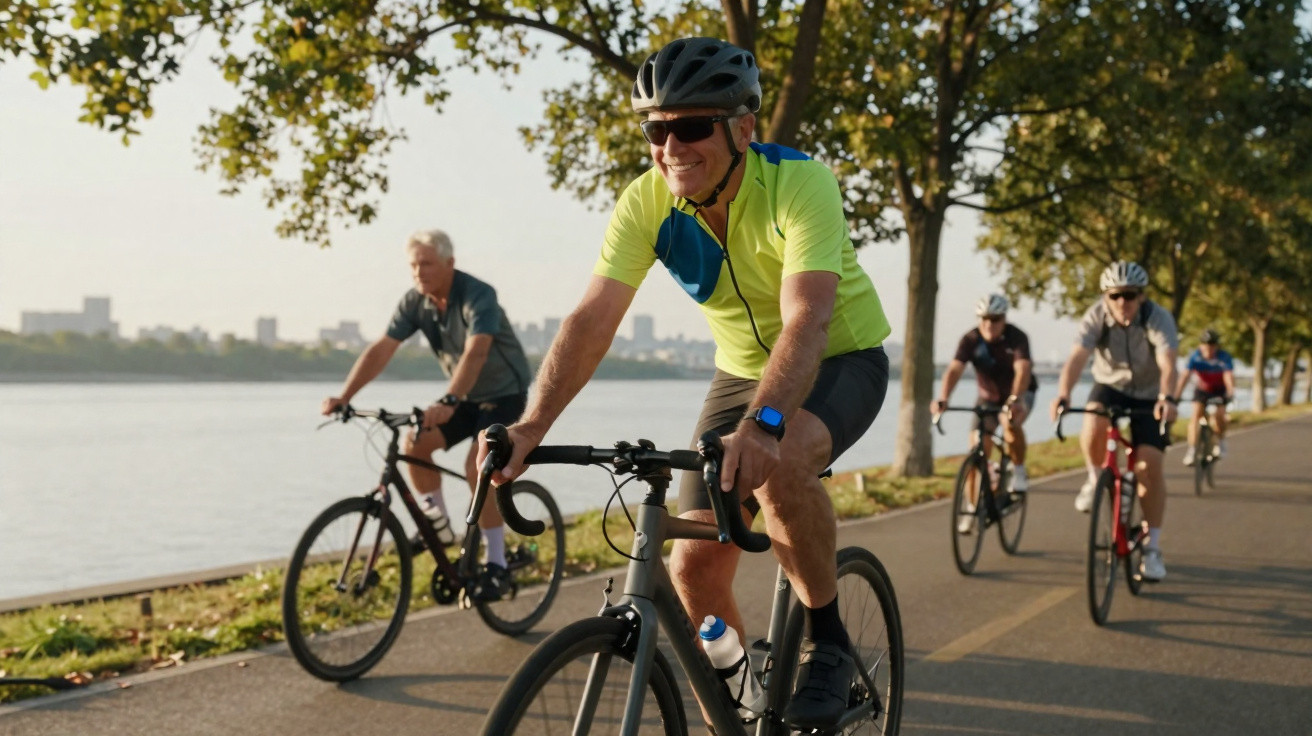
On the riverside cycle path, a small group of silver-shining helmets glides past. Among them is a man with a grey beard, a yellow rain jacket and a powerful pedal stroke. He is 63, once had knee trouble, and now wears a grin wider than his handlebars. Two kilometres further on, another woman in her early 50s struggles up the stairs to the Underground. Every step sends a sharp pain through her knees, a quiet reminder of her years at a desk. They are almost the same age – yet their bodies seem to belong to two entirely different worlds.
What happens when, after 55, you do not slow down but start pedalling again?
Why cycling after 55 can suddenly make all the difference
When people picture exercise after 55, they often imagine yoga mats and Nordic walking poles: quiet, gentle and “suitable for older people”. Then an older man on a Sunday ride calmly cycles past three times as many cars on his trekking bike. His knees make no sound; only the gears click. Cycling has a reassuring quality: it takes away the frantic pace of ageing without stealing your momentum. For people whose joints have already endured plenty, it can feel like a small biomechanical trick. The body is moving, the load is shared out – and suddenly, being 60 no longer feels like standing still, but like covering distance.
Sports doctors now know this scene well. Someone arrives at the clinic in their mid-to-late 50s with knee osteoarthritis. Running is barely possible, and every staircase feels like an internal battle. Once the acute pain has eased, the advice is often: “Get on a bike.” This is not simply a fallback option. Sports medicine studies show that joints are subjected to far less strain during cycling than while running – depending on pace and technique, it may be only a fraction of the impact load. That is why exercise bikes in rehabilitation clinics are rarely unused. Anyone who has seen a 70-year-old pedal pain-free for the first seven minutes after an operation will not quickly forget the expression on their face.
The explanation lies in the mechanics. When cycling, the saddle and frame take a substantial share of your body weight. Your knees move through a relatively controlled range, without the harsh impact moments involved in jogging. The effort is spread across the hips, thighs, glutes and calves. The better the gearing – in other words, your choice of gear – and riding position, the more precisely this load can be managed. Even vulnerable joints can therefore stay active without constantly having to sound the alarm. This is more than comfort; it is a form of protection against the gradual stiffening that many people accept as “normal”.
How to build muscle by cycling without punishing your joints
Getting started does not mean tackling a 60-kilometre ride. It begins with a straightforward, almost unremarkable routine: 20–30 minutes, three times a week. Choose level routes, easy gears and a relaxed pedal stroke. If you have not exercised for a long time, you can think of the first rides as “walks on wheels”. What matters is a smooth, even movement – the pedals should turn in circles, not be stamped on. On an e-bike, it is perfectly fine to use generous assistance at first, then gradually reduce it after a few weeks. This is especially relevant for people over 60, whose cardiovascular system may need a little time to get going.
The familiar mistake after the first successes is feeling 30 again and treating the bike like a gym machine set to maximum. Too much ambition, gears that are too high, climbs that are too steep. The following morning, your knees may complain like offended colleagues. Let us be honest: no one does joint-friendly stretching and strength work every day, however easy advice guides make it sound. What is realistic is increasing gradually, scheduling rest days and not continuously ignoring your own pulse. It also means swallowing your pride when you would rather get off and walk up a hill, or turn up the e-bike assistance.
“Cycling is like a negotiated compromise with the body,” says a sports orthopaedist from Cologne. “You give up the impacts but keep the movement. That is exactly what older joints love.”
If you want to strengthen your muscles deliberately, you do not need to go faster – only train with more purpose. A simple structure that many people over 55 can manage well is:
- 2–3 easy rides a week (20–40 minutes, low gears, at a conversational pace)
- 1 ride with short “strength blocks”: pedal a little harder for 5× one minute, with 2–3 very relaxed minutes in between
- every 2–3 weeks, extend the longest ride by 10–15 minutes
This develops thigh and glute muscles, stabilises the core and reduces strain on the joints over time. Occasionally riding out of the saddle against light resistance, or adding small climbs, gives the body fresh stimulus without overwhelming it.
What cycling does for the mind – and why it matters twice as much after 55
At some point, it is no longer only about knees, cartilage and muscle groups. Many people who return to cycling later in life describe something else: a feeling of reclaiming what they had lost. Their local area suddenly seems larger; trips to a friend’s house, the market or the lake become manageable again, without focusing on timetables or back pain. The breeze helps organise thoughts, sounds become softer and everyday life moves a few metres into the background. People coping with a quiet emptiness during the menopause or the transition into retirement, in particular, often find a surprisingly simple answer on two wheels: movement that does not feel like an obligation, but like an opportunity.
Many people underestimate how closely mobility is connected to self-image. If you experience your body only as an object that must be handled with caution, you will often withdraw. Short rides, perhaps initially only to the bakery or the park, create a different perspective: you see yourself as someone who can still travel a distance. The joints are lubricated every day, the muscles are gently challenged and the heart has more to do than simply climb staircases. Then there is that small, almost childlike pleasure when your own shadow cycles alongside you on the tarmac. No fitness craze and no pressure to perform. Just a bike, a route and the quiet realisation that 55 is not the end of the story, but a new chapter that you can quite literally experience.
| Key point | Detail | Benefit for the reader |
|---|---|---|
| Joint-friendly exercise | Cycling shifts body weight onto the saddle and frame, reducing impact strain on the knees and hips | Less painful activity is possible, even with osteoarthritis or after operations |
| Building muscle without overdoing it | Regular rides in easy gears strengthen the thighs, glutes and core muscles | Greater stability in everyday life, better joint protection and a lower risk of falls |
| Psychological effect | Cycling creates a sense of achievement, expands your range of movement and restores a feeling of self-determination | Better quality of life, motivation, social contact and enjoyment of movement |
FAQ:
- How often should people over 55 cycle each week? For beginners, 2–3 sessions of 20–40 minutes a week are enough. If you feel comfortable, you can gradually increase this to 4 rides, with at least one rest day in between.
- Is riding an e-bike really “proper” exercise? Yes, provided you are not constantly using the highest assistance setting. Your heart, muscles and joints benefit with a motor too – the important thing is that you are still making a noticeable effort at the pedals.
- What should you do with knee osteoarthritis – can cycling be harmful? For most forms of knee osteoarthritis, cycling is considered beneficial, as long as the saddle is set slightly higher, easy gears are used and you avoid steep, long climbs. If in doubt, seek medical advice first.
- What type of bike makes sense after 55? A comfortable frame with an upright riding position, reliable brakes and wider tyres is ideal for many people. For longer or hillier routes, a trekking bike or e-bike can make getting started considerably easier.
- How can I tell that I have done too much? Typical warning signs include ongoing joint or muscle pain lasting more than 24–48 hours, severe exhaustion or sleep problems. In that case, take one or two days off and adjust the intensity or distance.






Comments
No comments yet. Be the first to comment!
Leave a Comment