
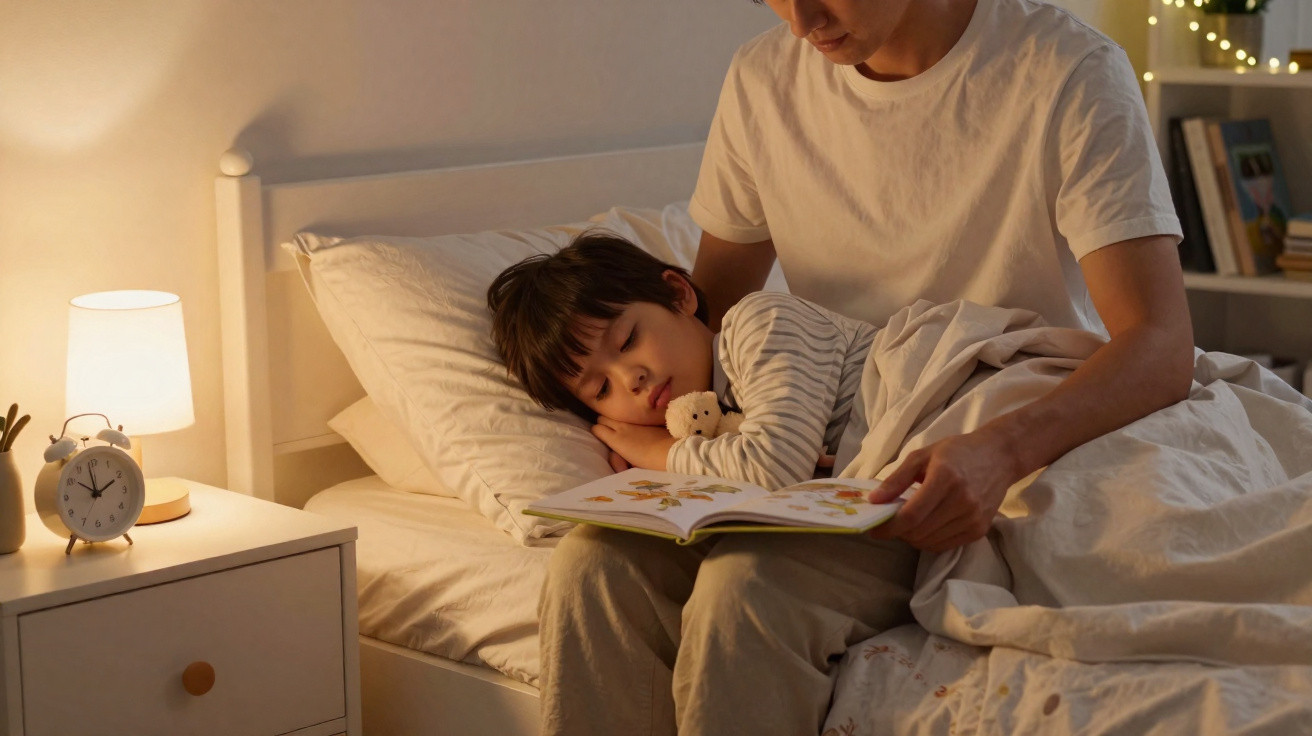
Quiet objections emerge from the darkness, followed by an indignant, “But I’m not tired at all yet!” In the hallway, there is a half-folded pile of laundry; in the living room, an unanswered email from your boss is still flashing. It is 8.43 pm, and your patience is starting to fray as your child suddenly wants to have an existential debate about the correct number of cuddly toys. We all know that point when the day should have been over long ago, yet its most exhausting part is only just beginning. The good news is that falling asleep without a fight is not some unattainable Instagram fantasy. It only feels that way at first.
Why falling asleep can feel like a power struggle for children
When a child shouts “No!” in the evening, they are rarely objecting only to bed. It is about control, separation and that vague sense that they are about to be alone. Adults often underestimate how loud silence can feel inside a four-year-old’s mind. The lights go out, voices become quieter and everyone starts moving more slowly - while your child’s brain says: hang on, what is happening here? That internal alarm then appears as a performance: one more glass of water, one more kiss, one more question about dinosaurs.
The psychologist whose waiting room I was sitting in while researching this article told me about a five-year-old who had meltdowns for almost two hours every evening. He was not “difficult” or “badly behaved”. He was frightened of letting go of the day. His parents had a very packed schedule: nursery, speech therapy, a visit to the grandparents, then television in the evening. The boy was overloaded, like a browser with 37 tabs open. Once the family changed two things - fewer activities after 5 pm and a consistent, calm bedtime routine - he suddenly needed only 20 minutes to fall asleep. No magic, simply fewer stimuli.
Many children resist bedtime because their bodies and minds do not wind down at the same speed. Their system is still in “playground mode” while we have already switched into “sofa mode”. Then there are our own expectations: surely the child should fall asleep on the first attempt, so that we can still “function”. Let’s be honest: nobody manages that every single day. That pressure combines with parental exhaustion, making every small delay feel like an attack. A biological process turns into relationship drama.
The art of a bedtime routine that really works
Perhaps the most important tool is a brief, clear and repeatable bedtime routine. It does not need to be perfect or Pinterest-worthy. It needs to be familiar. Children love rituals because they create predictability. When roughly the same things happen each evening - brushing teeth, pyjamas, a story, lights out - the nervous system can gradually learn that it is time to settle. Many parents have a theoretical plan in mind but keep changing the sequence. That confuses children more than we realise.
A common stumbling block is allowing the routine to become too long and overloaded. First there is energetic rough-and-tumble play, then a TikTok video with loud music, followed by three stories, then a phone in bed “just for a moment” to help the child “calm down”. In reality, the opposite happens. Stimulation rises, the body releases stress hormones, and you are left with a child who is technically tired but internally dancing at a festival. Parents often feel ashamed and say things such as “We’ve completely messed it up.” Yet most are simply dealing with an everyday life that is constantly overflowing.
“Children do not sleep better because we become stricter, but because they feel safe and know what to expect,” says a nursery practitioner who has supervised lunchtime sleep groups for 20 years.
- Keep the routine brief: 20–30 minutes is entirely enough.
- Include the same 3–4 steps every evening.
- Avoid introducing new games or screens during the final hour before bed.
- Give early warning of transitions: “Two more turns on the slide, then we’re going home.”
- Stick to a clear order, even when the day has been chaotic.
How to move from conflict to cooperation at bedtime
Falling asleep tends to work better when children feel that they have some say. Not over bedtime itself - that is your decision. But they can make small choices along the way. Offer two options rather than 20: would you like to brush your teeth first or put your pyjamas on first? Shall it be the green or the blue pyjamas tonight? These tiny choices give children what they are internally demanding: a little autonomy at a time when so much is decided for them. Suddenly, the route to bed is no longer simply a “marching order”.
Language is another game changer. “If you don’t go to bed now, there’ll be no playground tomorrow” sounds like punishment and creates resistance. “We’re helping your body settle now so you can run around again tomorrow” tells a different story. Children are highly sensitive to tone and language, often more so than to the content itself. Sometimes one gentle sentence at the right moment can shorten a half-hour argument. Many parents only realise afterwards how sharp they sound in the evening, when their own battery is empty.
It can also help to create a kind of “sleep team” feeling during the day: you and your child against tiredness, rather than the two of you against each other. One father told me that he says in the evening: “We’re going to put tiredness to bed together now, okay? You tell it to go into your feet, and I’ll tell it to go into your shoulders.” Then they take three deep breaths together. Does that sound a little esoteric? Perhaps. Does it work for a surprisingly large number of children? Yes. Something important happens as a result: the child experiences falling asleep as a process they can shape, rather than merely something imposed on them from above.
The most matter-of-fact truth in all this is that some evenings will remain difficult, however good the strategy is. Children are not machines. They have growth spurts, bad days, unspoken worries and sometimes simply a bad mood. If, on those days, you think, “I can’t do this any more,” that does not mean you are inadequate; it means you are human. Being responsible does not mean staying calm all the time. It means returning, continuing to practise and not losing yourself. Sometimes the most loving step in the evening is to set a boundary, turn out the light, lie beside them - and start afresh tomorrow.
| Key point | Detail | Benefit for the reader |
|---|---|---|
| Rituals rather than improvisation | A short, repeatable bedtime routine with a few clear steps | The child knows what is coming, their nervous system can settle and there is less drama |
| Fewer stimuli before sleep | No screens or wild play during the final hour, with gentle transitions | Faster sleep onset and less of a “festival in the head” despite tiredness |
| Cooperation rather than a power struggle | Limited choices, gentle language and a shared “sleep team” feeling | Less resistance, more willingness to join in and calmer evenings for everyone |
FAQ:
- At what age can a consistent bedtime routine work? A simple, repeatable sequence can help babies from around three months old: a regular sleeping bag, dimmed lights and a quiet song. The older a child becomes, the more consciously they can help shape the steps - from around the age of two, small tasks such as “You choose the book” work surprisingly well.
- What should I do if my child keeps getting out of bed? Stay calm and physically present, but do not start a fresh discussion every time. Briefly guide them back to bed and repeat the same short sentence, such as: “It’s bedtime; I’ll stay nearby.” Consistency without drama has a stronger long-term effect than lengthy negotiations.
- How long can a bedtime story last? For most children, 5–15 minutes is enough. It is better to read one story with full attention and without a phone in your hand than to rush through three stories half-heartedly. If your child always asks for “one more”, make a clear agreement in advance: one book or two very short ones - and stick to it.
- Is co-sleeping in the family bed “bad”? No, many families sleep in the same bed or room and are happy with that arrangement. What matters is whether it feels right for all of you. If one parent is secretly sleeping on the sofa because there is no room in the bed, it is worth having an honest conversation and perhaps making a gradual change.
- How can I handle my own impatience in the evening? A mini ritual just for you can work wonders: take five deep breaths by the kitchen door or drink a glass of water before entering the child’s bedroom. Allow yourself to think: “I’m tired and irritated, and I’m still taking care of this.” That small act of inner acknowledgement often relieves the harshest pressure.






Comments
No comments yet. Be the first to comment!
Leave a Comment