
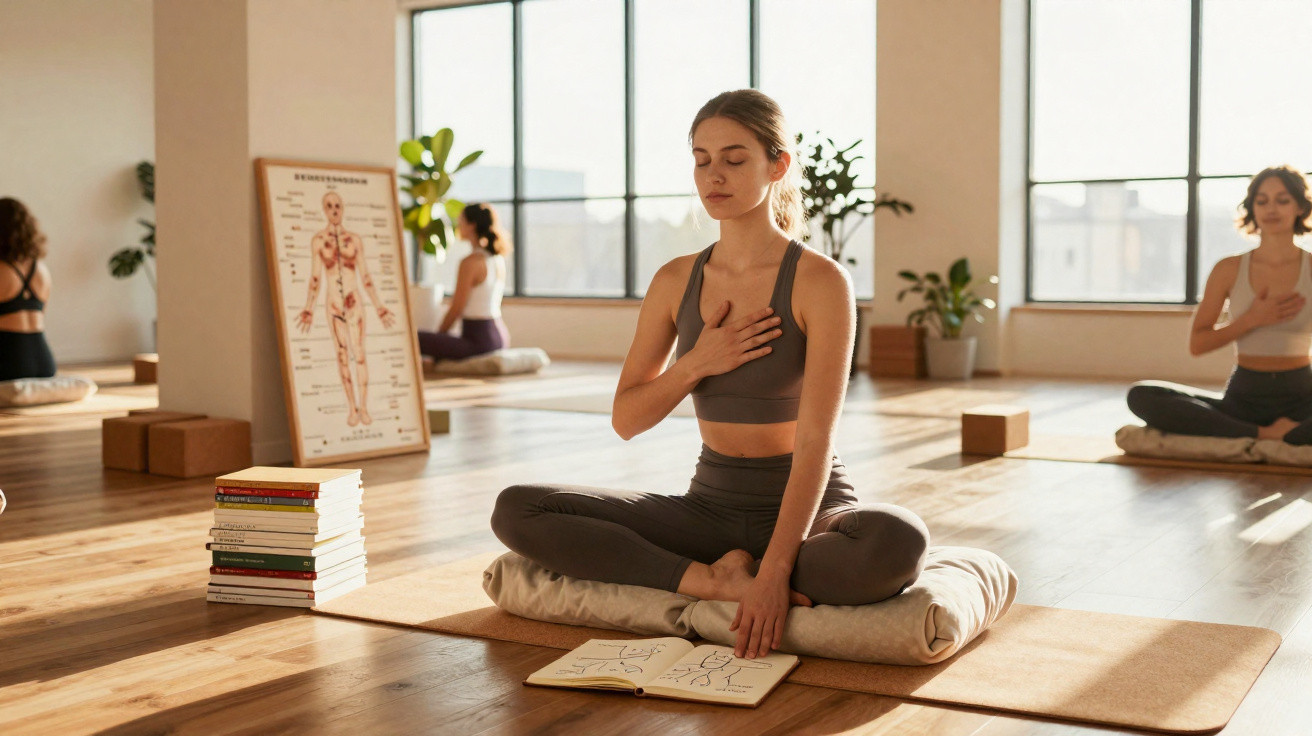
Are you considering a 100-hour Yin Yoga TTC but unsure which course to choose?
Have you noticed Yin Yoga classes advertised at your studio and wondered what to expect?
Yin Yoga is a form of yoga developed as a slower, deeper practice. It is intended to reach parts of the body that more active Yoga styles do not address.
Consider a dynamic Vinyasa class. These sessions are designed to raise your heart rate, with quick transitions from one asana to the next. Surya Namaskar, often called a flow sequence or Vinyasa, links the postures together and builds longer sequences.
During a Yin Yoga practice, every posture is held for between 1 minute and as long as 15 minutes. A typical class includes 8–10 postures. Rather than using Surya Namaskar, the practice uses counter-postures between asanas. Hip- and heart-‘opening’ asanas are popular themes.
Yin Yoga posture names and practice style
The style also uses different names for familiar postures. For instance, the hip opener known as Lizard in a ‘Yang’ practice is called Dragon in a ‘Yin’ class. Similarly, Bound Angle Pose is known as Butterfly.
At its core, Yin is understood as a gentle, slow practice that complements Yang.
According to the fundamental principles of Traditional Chinese Medicine (TCM), Yin should never be practised separately from Yang.
Core principles of Yin and Yang
Yin and Yang are opposing forces, such as heat and cold. However, they depend on one another: neither can exist without the other. Another central principle is transformation, as illustrated by the changing seasons. When particular boundaries and conditions are met, a process of mutual consumption occurs. In other words, when one aspect increases, the other decreases. Together, they continually seek balance.
Yin and Yang may be excessive or deficient, while pressure points can be Kyo or Jitsu. Energy is either drawn into or dispersed from a point.
Internal and external influences determine whether a state is full cold, full heat, empty cold and/or empty heat. Menopause and poor circulation, for example, illustrate different conditions.
When Yin and Yang are balanced, there are no signs or symptoms of dis-ease. The body is therefore neither excessively hot nor excessively cold.
A brief introduction to TCM
There are 5 elements in TCM. Each element is associated with particular organs, emotions, characteristics, seasons, chakras and ‘senses’.
FIRE – Heart and Small Intestine, Pericardium & Triple Burner
EARTH – Spleen and Stomach
METAL – Lungs and Large Intestine
WATER – Kidneys and Bladder
WOOD – Liver and Gall Bladder
Every element has a Yin and Yang meridian line, with several pressure points that can be used to tonify or disperse energy.
Meridian lines commonly used in Yin Yoga
Upper body: Heart, pericardium, lungs
Lower body: Spleen, liver and kidneys
Yin lines run along the inside of the body, while Yang lines run on the outside.
Traditional Chinese Medicine would work with 2/3 elements when treating a condition.
Would you like to learn more?
UPCOMING 100-hour Yin Yoga TTC March 2023
Whether you already teach Yoga and want to expand what you offer, or you simply enjoy Yin Yoga and would like to explore its theory and principles further, this 100-hour TTC is worth considering.
I will lecture on the basic principles of meridian lines and pressure points for Shakti Yoga’s upcoming Yin 100-hour TTC, which will take place in March 2023. The rest of the course will be delivered by Taryn Elise Herselman and Avril Chambers.
Lesson times will be confirmed in the new year. The 100 hours will comprise 50 contact hours and 50 hours of self-study. You will need to complete both written assignments and teaching practical hours. This includes submitting 5 class lesson plans and attending at least 10 Yin classes, signed off by external teachers.
Once you complete the course, you will receive a level 100 certified course with Yoga Alliance International.
See What does it mean to be Yoga Alliance accredited
Topics covered in depth
- Yin Yoga theory and principles
- Traditional Yin asanas and creative sequencing
- Yin according to Paul Grilley and Bernie Clark
- Pranayama/breathwork
- The difference between Yin and restorative yoga
- Yin and traditional medicine
- Pressure points and how to use them for healing
- Chakras: what they are and how to balance them
- Yin Yoga theory and principles
- Visualisations and meditations
For further information, please feel free to email me at [email protected] or visit the Shakti Yoga 100-hour TTC Event page.


Comments
No comments yet. Be the first to comment!
Leave a Comment