
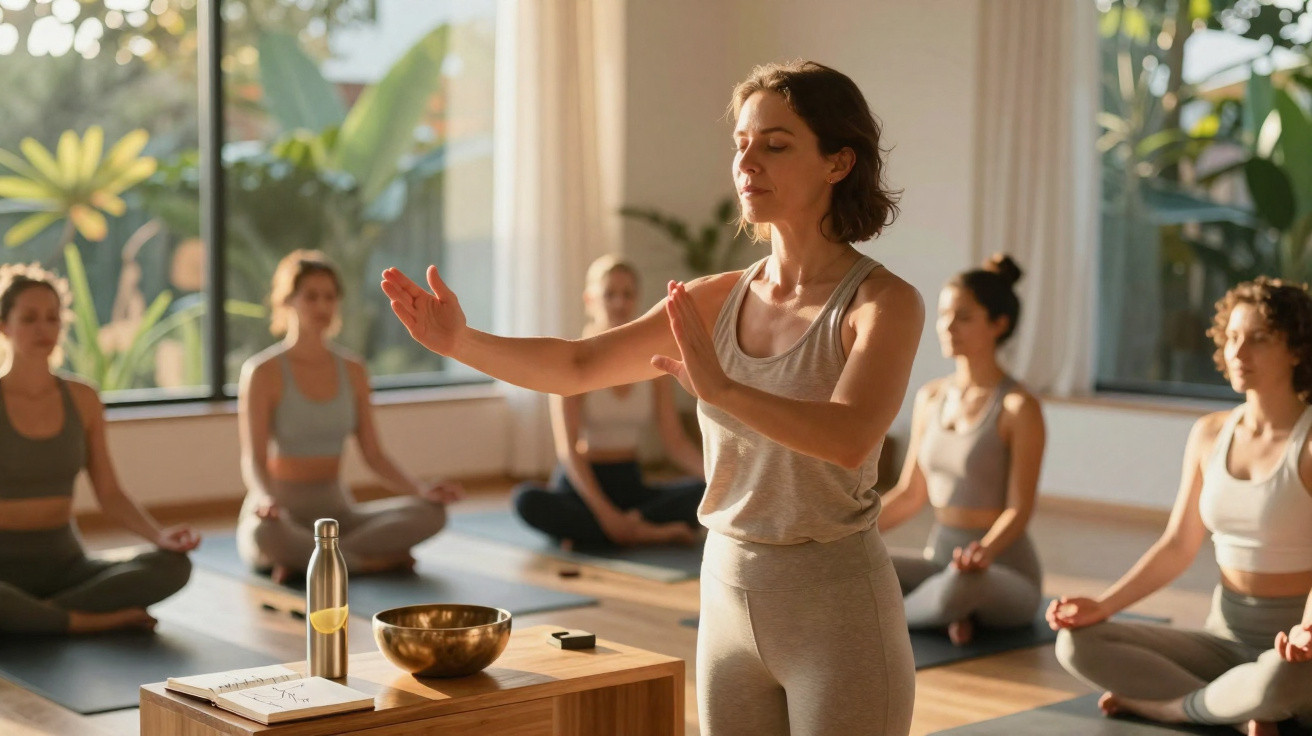
Why attend a voice coaching workshop for yoga teachers?
You probably devote a great deal of time to planning class sequences, choosing an appropriate theme and perhaps even curating the playlist. But have you considered developing the way you communicate information and instructions throughout the class?
We can support you in discovering your authentic teaching voice.
Your voice, after all, is what leads your students for the duration of the class.
From the moment they enter the room and step on to their mats, your voice sets the atmosphere and guides them through their practice.
Being able to speak with clarity and confidence is essential to a successful class.
Consider how differently you speak at the start of a class, through peak poses, and later during savasana. Every yoga class has a range of moods and paces, whatever its style or theme.
How often do you notice yourself relying on repetitive phrases or non-verbal habits such as sighing? Perhaps you frequently use words such as ‘um’ or ‘just’.
Have you ever chosen not to attend a particular yoga teacher’s class because their tone of voice or in-class dialogue did not appeal to you? I certainly have.
Can you picture a yoga class without a voice?
Your voice directs and prompts students, influencing how they feel and react. Reflect on how you would like them to feel at particular points in the class, as well as during the overall experience. Are your cues concise and carefully considered? Or do nerves take over, leaving you tongue-tied and quite literally without the words you need?
Your voice shapes how students take in messages and instructions.
Treat your voice like a musical instrument. Anybody can blow into a flute, in the same way that anybody can open their mouth and speak.
You can decide whether to play it well or badly.
Feel completely confident in your vocal ability when teaching
The workshop will explore areas including:
- An effective warm-up
- Voice projection: how to project your voice in a natural, effective way
- Ways to relax the jaw
- Breathing techniques, which are central to your overall tone and resonance
- Nervous energy
Finding it difficult to manage nervous habits and anxiety? We will cover helpful, practical measures that you can apply straight away to overcome these obstacles.
As a yoga teacher, your voice is as individual as your flow and the way you style a sequence. Rather than taking on the personas of other teachers, discover your own distinctive teaching voice.
A few tips from voice coach Clare Staniforth
1. Vary the rhythm. Consider what you want to communicate and the best way to communicate it. Is it a mindful point that is better expressed slowly? Or does it require energy, and therefore more speed and intensity?
2. Pauses create impact. Use a dramatic pause to draw attention to significant moments and strengthen the impact of your message.
3. Experiment with pitch. A higher tone can make the mood lighter, while a lower one can sound more commanding. How does this change your delivery?
4. Try different volumes. This is particularly important when teaching outdoors rather than in a private session.
5. Change your inflections and ensure they do not always fall at the end of a sentence.
REMEMBER:
Using your best teacher voice can make all the difference to your success!
Visit my online courses site to enrol in this module: Find Your Yoga Teaching Voice.




Comments
No comments yet. Be the first to comment!
Leave a Comment