
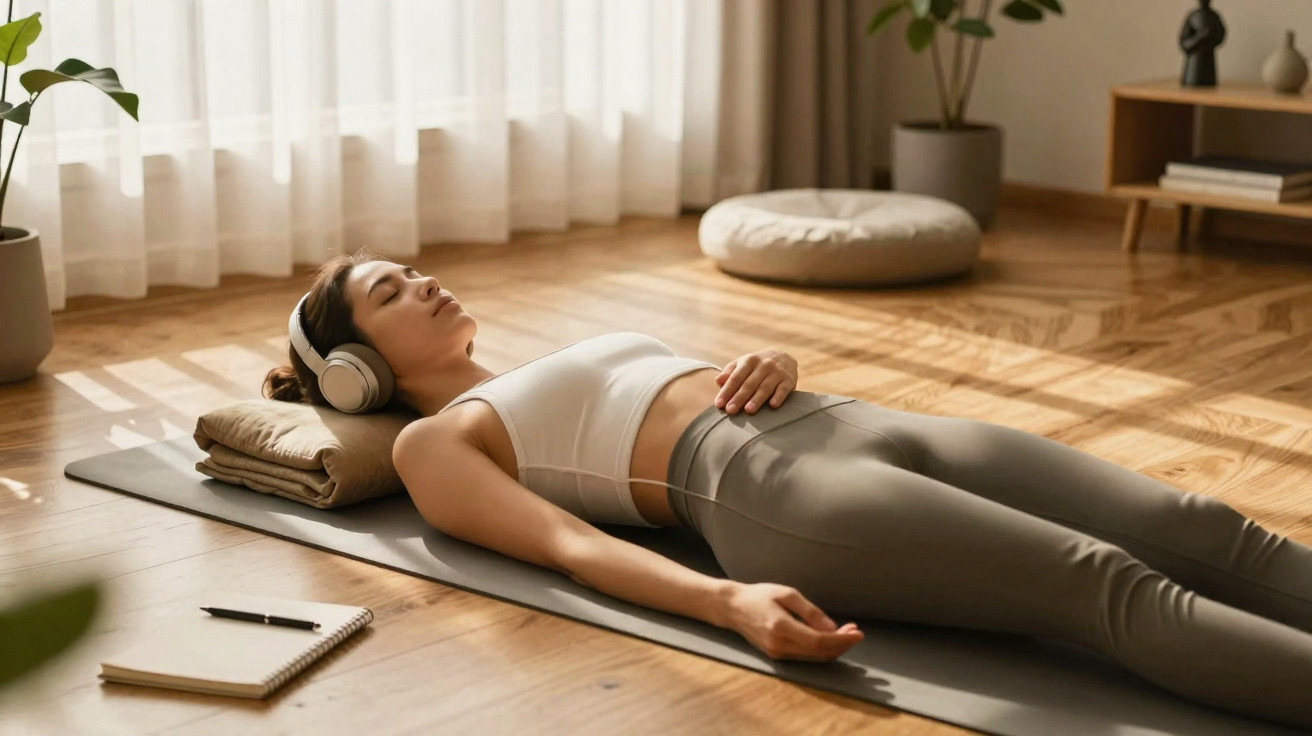
I frequently suggest Yoga Nidra to many of my clients. So, what exactly is Yoga Nidra?
What is Yoga Nidra?
Also known as Yogic sleep, Yoga Nidra is a conscious sleep state: the space between deep sleep and profound relaxation. It provides complete physical, mental and emotional relaxation.
In Yoga Nidra, the body is fully at ease. By following a sequence of spoken instructions, the practitioner is guided to become progressively and systematically aware of their inner world.
Meditation generally calls for attention to remain on one point of focus, which can be particularly difficult for beginners. During yoga nidra, the practitioner enters a gentle withdrawal of the five senses, known as pratyahara. Four senses are turned inwards, while hearing remains connected to the guidance.
Both Yoga Nidra and meditation aim to foster deep relaxation and a heightened state of intuition.
Yoga Nidra for modern-day stress
Modern lifestyles can be demanding, stressful and competitive. Yoga Nidra provides an accessible way to ease some of the symptoms caused by stress and tension.
Yoga Nidra is among the deepest states of relaxation possible while retaining full consciousness.
Yogic texts encourage us to discover peace within ourselves. Learning to relax and bring harmony to the body and mind can enhance our overall quality of life.
It can create physical relaxation in the muscular and nervous systems, encourage emotional release by settling the mind, and ease mental tension through access to the subconscious mind.
It is even better than a power nap!
Shakti Yoga teacher training courses, http://www.shaktiyoga.co.za, include Yoga Nidra. One of the practical examinations requires you to prepare and deliver a script.
Benefits include:
- Lower anxiety and tension
- Better sleep patterns
- Improved concentration
- A preparation tool for meditation
- A complementary Yoga practice alongside the physical practice of Asanas
Having tried several different Yoga Nidra options on YouTube, I could not overlook the benefits.
Choosing a Yoga Nidra practice
Ensure that any Yoga Nidra recording you choose prompts you to set an intention, resolve or Sankulpa. It should also contain a rotation of consciousness. This involves no physical movement; instead, it directs awareness to different areas of the body.
In the final stage, you can expect a visualisation intended to bring about complete mental relaxation. The session should finish with a resolve, which needs to be clear and positive.
You should then be gently guided from psychic sleep back into the waking state.
Here are links to some of my preferred Yoga Nidras:
https://www.youtube.com/watch?v=pfIikxpis9s&t=9s
https://www.youtube.com/watch?v=7H0FKzeuVVs
There are several options available. I would love to hear which ones you enjoyed and why!

Comments
No comments yet. Be the first to comment!
Leave a Comment