
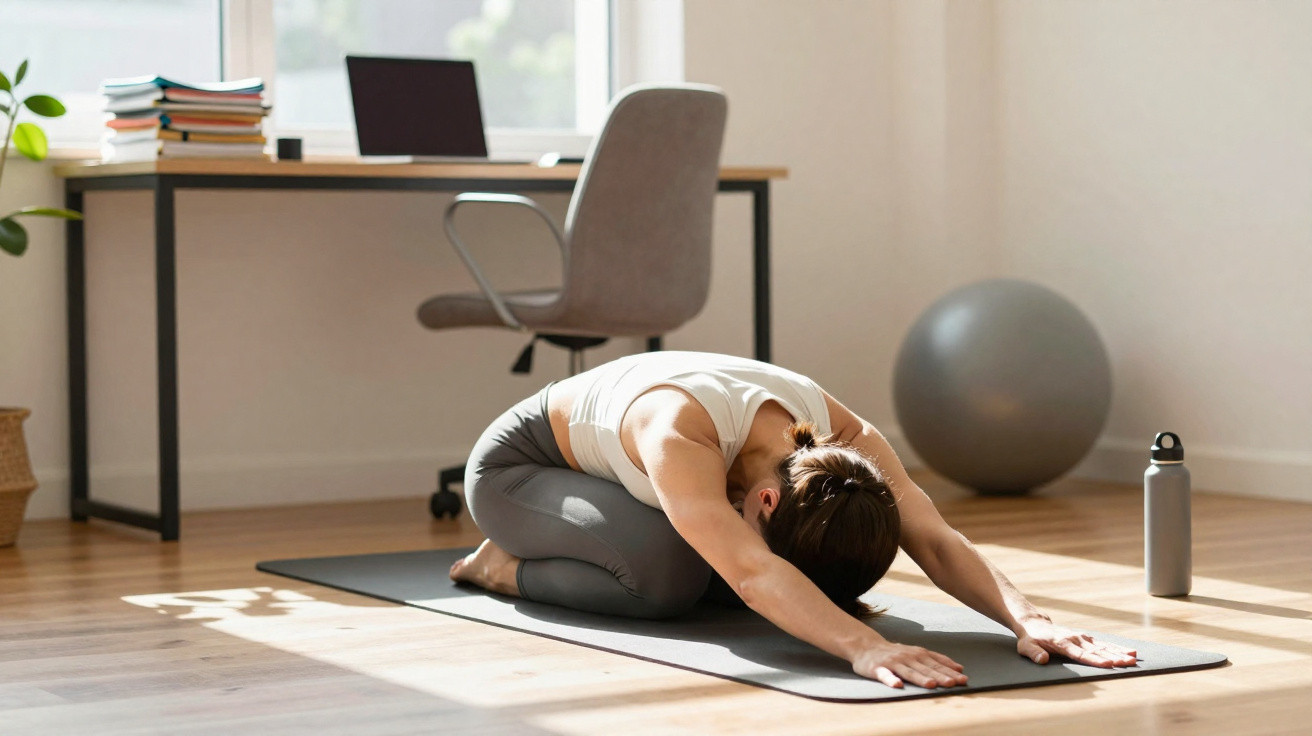
People who spend long periods sitting may develop low back pain because of hip stiffness, limited trunk endurance and too little postural variation. Mat Pilates provides a controlled form of training to strengthen the body’s core and restore mobility without relying on equipment.
Why can Pilates help people who sit all day?
Pilates is a well-researched option for non-specific low back pain, particularly when it brings together breathing, trunk control and gradual movements. It is not more effective for everyone, but regular practice can ease pain and improve function.
Walking and cycling remain beneficial for fitness, circulation and overall health, while properly supervised strength training can also be useful. Pilates differs by giving ongoing attention to segmental stability, posture and coordination between breathing and movement.
The main benefits targeted through practice include:
- Control: slow movements limit compensations and improve technique.
- Stability: training strengthens the deep muscles that support the trunk.
- Hips: mobility exercises can ease stiffness built up through sitting.
- Breathing: this coordinates effort and helps prevent breath-holding.
- Progression: difficulty and range of movement increase as the body adapts.
What does the evidence say about Pilates and low back pain?
Pilates is a method founded on control, precision, breathing and centring, developed by Joseph Pilates. Its exercises engage the deep muscles of the trunk, hips and shoulder girdle, aiming to develop greater body awareness and improved alignment in everyday activities.
Research suggests that exercise, including Pilates, can help with chronic low back pain, although no single approach is superior for everyone. The choice should take account of preference, ability and diagnosis, as commitment to the programme directly affects the outcome achieved.
How does the method engage the deep abdominals and pelvic floor?
The transverse abdominis creates a deep layer around the trunk and helps control abdominal pressure. In Pilates, breathing out during specific movements supports its activation, while the pelvic floor contributes to lumbopelvic stability.
Activation does not mean holding the body rigidly
Breathing and control work together. The deep abdominal muscles take part in movement without needing to remain contracted at maximum force.
The exercise should allow you to breathe, move your hips and keep the spine comfortable.
This contraction should neither be maximal nor held stiffly throughout the class. The aim is to coordinate breathing, the abdominals and the hips to distribute forces more effectively, preventing compensations that increase tension in the lower back or restrict natural movement.
Important principles during the exercises include:
- breathe out during the phase requiring the greatest effort;
- keep the abdominals engaged without holding your breath;
- use ranges of movement that do not worsen low back pain;
- avoid forcefully arching or flattening the spine;
- stop the sequence if radiating pain, numbness or weakness occurs.
Which mat exercises support mobility and posture?
In Mat Pilates, exercises such as the bridge, cat movement, alternating arm and leg lifts, and pelvic control can be adapted to the participant’s level. Performing them slowly makes it easier to identify compensations, improve hip mobility and build postural endurance.
Rather than claiming to physically decompress the discs, the method aims to reduce poorly distributed loads and improve movement control. Regular breaks at work, ergonomic adjustments and changes of posture remain essential for preventing prolonged overload.
An adapted class may include:
- a short bridge for the glutes and pelvic control;
- gentle spinal mobilisation on hands and knees;
- alternating arm and leg lifts with stability;
- controlled stretches for the hip flexors;
- regular breaks to stand up and walk during work.
When does low back pain need professional assessment?
Anyone familiar with a simple exercise to strengthen the core and relieve low back pain should remember that no sequence suits everybody. Persistent pain requires professional assessment before starting exercise, increasing intensity or training without suitable supervision.
Seek help more promptly if pain occurs with loss of strength, worsening numbness, fever, trauma, or changes in bladder or bowel function. When there are no warning signs, an individualised programme may combine Pilates, walking and strength work, with safety, consistency and gradual progression as priorities.
Comments
No comments yet. Be the first to comment!
Leave a Comment