
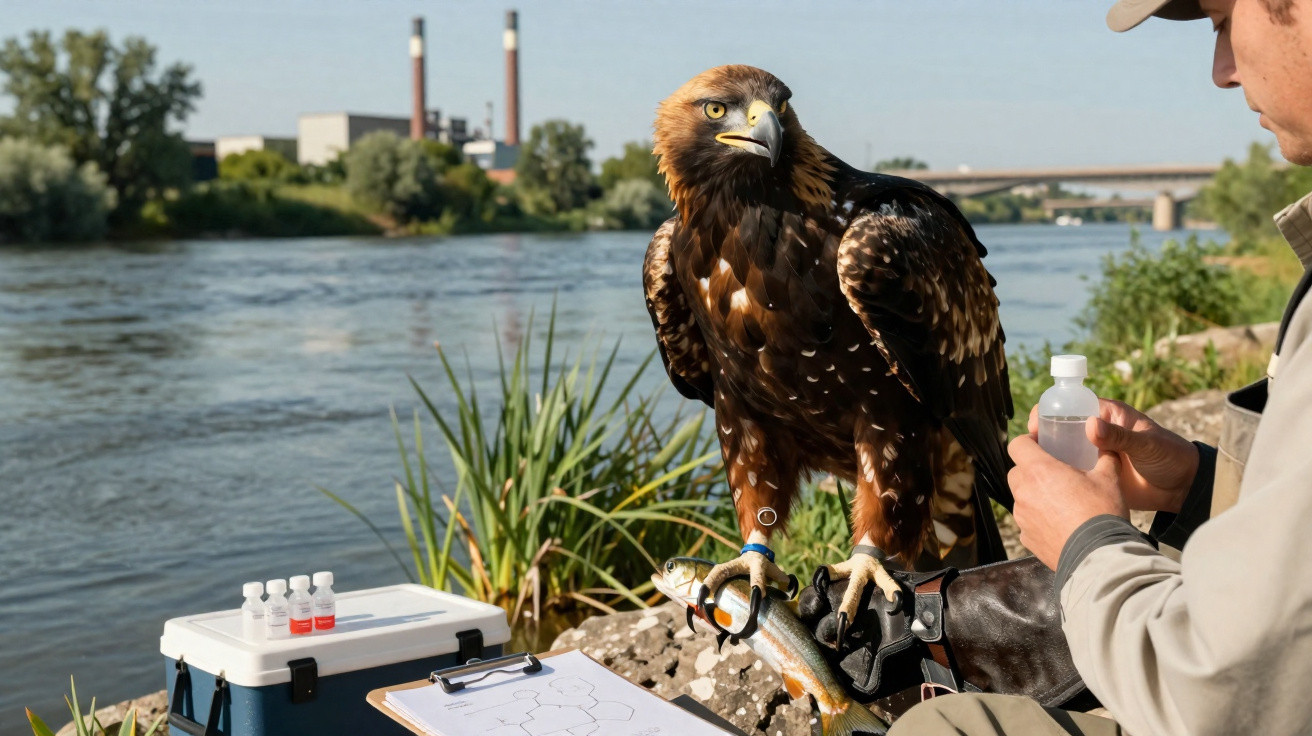
PFAS, often referred to as “forever chemicals”, are present in frying pans, rain jackets and cosmetics – and have now also penetrated deep into the natural world. An Italian research team has demonstrated how raptors can help make this invisible pollutant easier to detect. These birds therefore become living measuring instruments for contamination that has long affected people too.
What lies behind “forever chemicals”
PFAS is the collective name for per- and polyfluorinated chemicals, which are exceptionally persistent. It is precisely this resilience that makes them useful – and dangerous.
- They repel water and grease.
- They withstand heat and friction.
- They barely break down in the environment.
PFAS can be found, among other places, in:
- non-stick coatings on frying pans and cooking pots
- outdoor and performance clothing
- firefighting foams
- food packaging and pizza boxes
- certain cosmetic and personal-care products
The problem begins when these substances enter the body. The kidneys and liver can barely excrete PFAS. Instead, the compounds build up in blood and organs – a process specialists call bioaccumulation.
“PFAS practically never leave the body. Every additional intake adds another layer to an already growing chemical account.”
Studies link PFAS with, among other things, hormonal disruption, a weakened immune system and a higher risk of certain cancers. Discussion generally centres on drinking water and human exposure. The new Italian research now turns attention to wildlife – and, more specifically, raptors.
Raptors as nature’s early-warning system for PFAS
Published in the specialist journal Toxicology Mechanisms and Methods, the study evaluates data from different parts of the world. Its central question is: what role can raptors play in improving understanding of how PFAS spreads through the environment?
The answer is clear: falcons, eagles and other birds of prey are highly suitable sentinel species – in other words, biological warning systems.
“Raptors sit at the top of the food chain. What accumulates beneath them eventually ends up in their bodies – where it can be measured.”
The researchers detected PFAS in almost every tissue examined:
- blood
- liver
- eggs
- feathers
This widespread presence illustrates how deeply the chemicals penetrate an organism. Feathers and eggs can be collected comparatively gently, which is important when rare species must not be subjected to further stress.
Fish-eating raptors face a higher risk
One key finding of the study is that raptors feeding mainly on fish have substantially higher PFAS concentrations than species that hunt only on land.
This includes, for example:
- white-tailed eagles
- ospreys
- fish-hunting buzzards or kites in wetland habitats
The reason is that many types of PFAS first reach water via industrial wastewater, sewage-treatment plants and rainwater. They then accumulate in sediments, small aquatic organisms, fish and ultimately the predators that eat them.
“The food chain acts like a chemical amplifier: what starts at low levels in water ends up in raptors at concentrations many times higher.”
The study therefore highlights the severe impact of PFAS, especially on aquatic ecosystems. Long-chain compounds such as PFOS are of particular concern because they are extremely persistent and especially prone to bioaccumulation.
Why raptors are such revealing indicators
The researchers’ decision to use raptors as indicators is strategically sound. Several factors combine:
- Top of the food chain: They eat fish, small mammals or other birds that may already be contaminated.
- Long lifespan: Many raptors live comparatively long lives, giving pollutants sufficient time to accumulate.
- Large territories: They range across extensive areas and can therefore indicate contamination on a broad geographical scale.
- Easy to monitor: Breeding sites and nests have often been observed for years, so the available data are relatively strong.
Measuring PFAS in raptors therefore provides more than a snapshot of an individual body of water. It offers an integrated view of chemical contamination throughout the animals’ habitat.
Older PFAS decline while new compounds emerge
Some of the best-known PFAS substances are now heavily regulated or banned in many countries. Their concentrations are indeed falling slightly in certain regions. At the same time, new and less researched compounds are appearing to replace the older substances.
These “replacement PFAS” are often shorter-chain and are claimed to break down more quickly. However, early data indicate that they too may be problematic and can travel long distances through water, air and food chains.
“Industry is moving from known to unknown molecules, but nature sees little difference: the contamination remains, it merely changes its chemical face.”
The Italian study consequently warns against gaining a false sense of security from declining levels of individual legacy substances. Without long-term monitoring under clear standards, it is difficult to identify which new PFAS are becoming more significant in the background.
Long-term monitoring rather than a brief snapshot
The researchers argue for widespread, multi-year programmes that systematically monitor raptors. Ideally, these would be combined with other animal species, such as fish, seals or small mammals. This would make it possible to compare different levels of the food chain.
A sensible strategy could include:
- selecting sensitive species in contaminated regions
- regularly collecting samples of blood, feathers and, where possible, eggs
- using standardised laboratory methods to make results internationally comparable
- linking the data with information on drinking water, soils and food
Such programmes would not only reveal where contamination hotspots are located. They could also provide an early indication of whether bans or tighter requirements in chemicals legislation are actually working.
What PFAS mean for people in Europe
The findings from Italy are directly relevant to German-speaking countries. Germany, Austria and Switzerland also contain areas with heavily contaminated groundwater and drinking water. There, PFAS enter the environment through industrial parks, airports or former firefighting-training sites.
Raptors from these areas could show contamination patterns similar to those described in the study. Testing them would provide a clearer picture of how far PFAS have already entered local food chains.
| PFAS source | Possible route into raptors |
|---|---|
| contaminated drinking water | Fish absorb PFAS, then fish-eating raptors consume those fish |
| industrial waste | PFAS enter soils; small mammals and other prey species absorb them |
| firefighting foams | The chemicals seep into groundwater and are later taken up through aquatic food chains |
Bioaccumulation, toxicity and cancer risk – what the terms mean
Many of the key technical terms surrounding PFAS sound abstract, yet they describe very concrete processes:
- Bioaccumulation: Repeated intake of small amounts of PFAS over a long period. The body breaks down very little, so levels rise slowly but steadily.
- Biomagnification: Concentrations increase at each level of the food chain. Exposure multiplies from plankton to fish and then to raptors.
- Toxicity: Depending on the type of PFAS, the liver, immune system or hormonal system can be harmed, often even at low concentrations.
For people, this means that regularly consuming contaminated food or water builds a measurable PFAS level in the blood over the years. The same mechanism applies to raptors – but often more quickly and with higher peak levels, as they occupy the top of the food web.
Practical steps: what research, policymakers and consumers can do
The Italian study offers no simple solution, but it does identify clear starting points:
- Research: Expand monitoring programmes involving raptors and publish open databases for international comparisons.
- Policymakers: Introduce stricter PFAS limits in water, act quickly on newly suspected substances, and promote PFAS-free alternatives in industry and everyday products.
- Consumers: Shop consciously, look for PFAS-free coatings and textiles, and follow local information on drinking-water quality.
Raptors provide more than abstract laboratory figures. When high PFAS levels are detected in their feathers, eggs and organs, it demonstrates that contamination has already reached the heart of ecosystems we should be protecting – and has therefore moved closer to our own health.






Comments
No comments yet. Be the first to comment!
Leave a Comment