
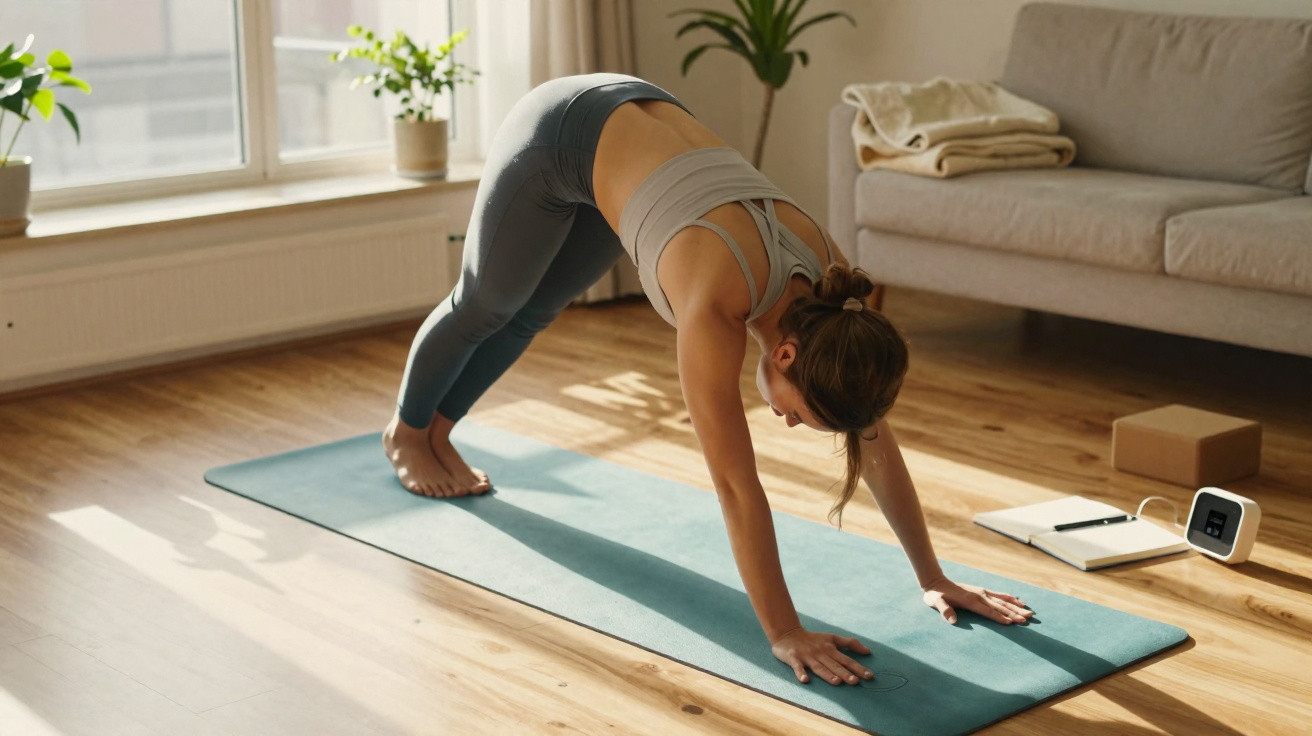
Just over three years ago, I wrote a blog about beginning a Yoga self practice. This is how it has evolved since then….
It is difficult to believe how much has changed, moved and grown over the past three years, both personally and professionally. I can see those changes clearly reflected in my Yoga self practice.
At first, my Yoga self practice centred on Vinyasa sequences: lengthy, strong holds for arm balances, plenty of sun salutations and, looking back, very little attention to my breath.
To be honest, my Yoga self practice is now almost the only Yoga time I have. On some days, it may consist solely of Yoga Nidra, five Yin or Restorative asanas, or perhaps daily chanting paired with pranayama. It can last as little as 15 minutes or, on a good day, up to 60 minutes.
It has developed into a gentler, more compassionate practice: a nourishing way to listen to what my body needs in that moment. It helps ease persistent niggles and aches, gives me energy for the day ahead, or settles me before bed.
Amongst Yoga teachers, making time for a Yoga self practice - or even simply getting to a Yoga class - is one of the biggest challenges we encounter.
Part of what made attending the recent Elysia Yoga convention in Amorgos so exciting was the chance to join Yoga classes and workshops EVERYDAY.
I would be on a geomagnetic island in the middle of the Aegean Sea, spending an entire week as a student rather than a teacher - an experience I had never previously had the pleasure of enjoying. Instead of my usual Yoga self practice, I could attend many different Yoga classes and styles each day.
Did I mention that I was looking across the Aegean Sea while taking Yoga classes every day?
As I attended the daily sessions, I soon realised that no one knows my body better than I do. As teachers, we need to keep reminding ourselves that every student is individual. Our most important responsibility should be to encourage them to ‘tune in’ more, rather than becoming dogmatic about our teaching methods or philosophies.
When students only attend classes and ‘log out’, their personal and physical development is restricted.
Our job ought to be to guide, nurture and encourage them - not just in the classes they come to, but also in developing some form of regular Yoga self practice.
Experiencing a range of styles, alongside teachers who had trained and taught around the world, was an enormously valuable learning experience. It reminded me that, for any teacher to develop, stepping outside your comfort zone is essential.
Even more humility is required as a teacher to realise that you will never know everything and in fact, you will never stop being a student yourself.
Whenever I can, I push myself to explore different forms of movement, not only within Yoga but across all types of exercise. I may not enjoy Jivamukti or Arkandha Yoga, and my body does not enjoy moving from an extended standing sequence straight into Savasana without a cool-down.
But wow!
No matter the style, nationality, age or gender of the teacher, I learn so much every time.
Once again, a huge thank-you to the organisers, teachers and presenters at the Elysia Yoga convention.
That learning then informs my own teaching approach and methodology, while also adding so much to my Yoga self practice. My week at the Elysia Yoga convention exposed the comfort zones within my Yoga self practice. It also revealed possible imbalances, along with areas in which I was stronger or more flexible than I had realised.
For instance, I took an introductory Ashtanga class at the Elysia Yoga convention. I cannot recall the last time I attended a purely Ashtanga class, yet there I was, working through Janu Sirsana (Head to toe) variations and binds which, three years earlier, had been almost impossible for my body.
The greatest benefit was that it reinforced my increasingly natural intuition. I am truly starting to understand progressions and modifications, and I am developing a sense of teaching ‘full circle’. It is about genuinely respecting the individuality of every unique body.
Without my own Yoga self practice, I do not think that the experiential learning gained from other teachers’ styles would be as effective.
Where am I going with all this?
For both students and teachers, I want to encourage a culture of learning through regular Yoga classes, but even more so through your Yoga self practice.
Tips for starting a regular Yoga self practice
1. Where to begin
- Choose a spot at home that can become your regular place for your Yoga self practice.
- Keep it as free from clutter as you can.
- You need only a small amount of room - enough space to unroll your mat.
2. Stop making excuses and simply get on your mat
- A Yoga self practice can begin with just 15 minutes.
- Once you stop overcommitting from a time-management point of view, there are really no excuses remaining.
3. Your body will remember
- Many people initially worry that they will not know what to do. They want to use a YouTube video or a written sequence. There is nothing wrong with beginning this way, but I can guarantee that the more you ‘tune in’, the more surprised you will be by how much your body remembers.
4. Bring more awareness to the classes you regularly attend
- In your usual classes, become more aware of the sequencing, warm-up, cool-down and, above all, the asanas you most enjoy.
- The asanas that your body truly enjoys are the ones that will bring you back to your mat for self practice.
5. Suyra Namaskar (Sun Salutations)
- I repeat sun salutations in every class as part of the warm-up so that you can remember them as a foundational combination on which to build your sequences.
- Even if you spend only 10–15 minutes repeating your Suyra Namaskar, you are already beginning to establish your Yoga Self Practice.
My suggestion….
Over the coming weeks, I will share some beginner-level sequences to help you create a foundation for your Yoga self practice.
This week, see whether you can use the steps above to begin your Yoga self practice:
- Choose a dedicated space in your home or garden for self practice.
- Start with 10–15 minutes. Do not focus on the time: simply get on your mat!
- Explore movement patterns that your body remembers.
- Pay attention in class! Choose your three favourite asanas.
- Include your Suyra Namaskar.
Above all, have fun with your Yoga Self Practice
Keep visiting my website for more blog posts about developing your regular Yoga self Practice.


Comments
No comments yet. Be the first to comment!
Leave a Comment