
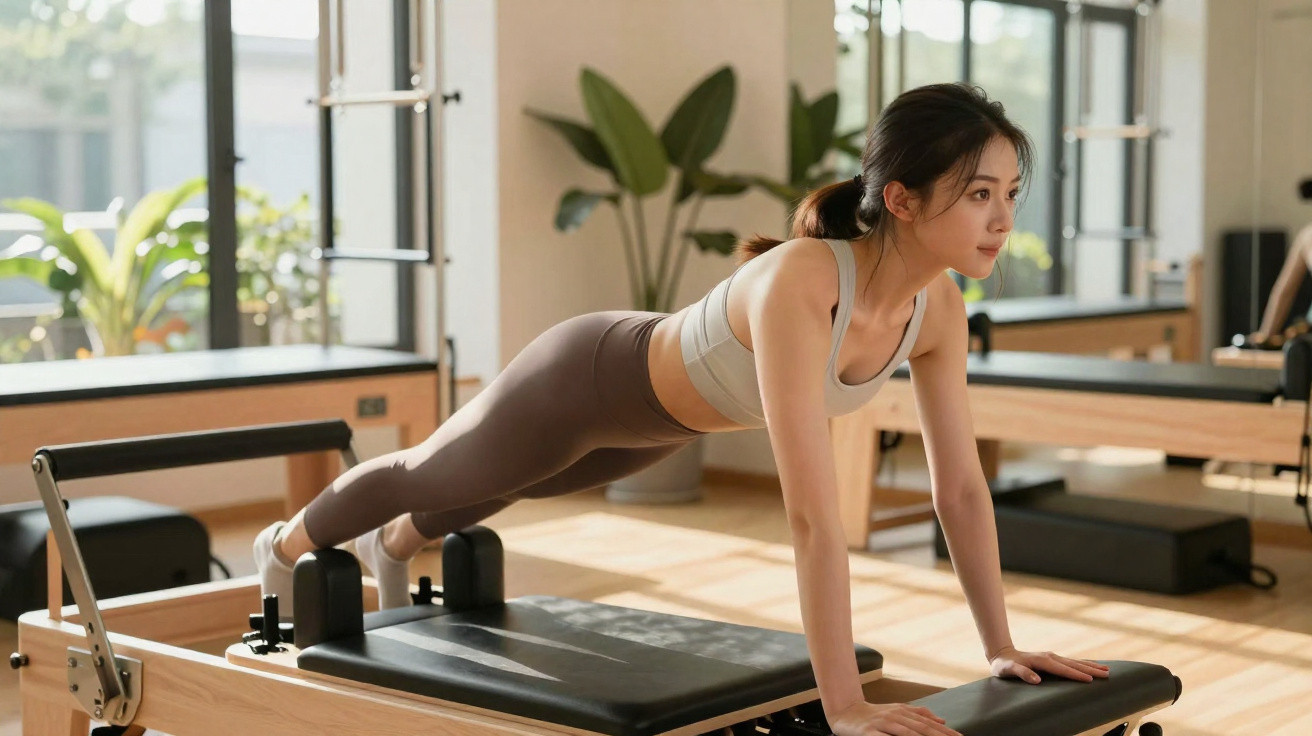
Pilates Fusion is suddenly appearing everywhere: in boutique studios, on fitness influencers’ feeds and in apps. The trend is positioned as an alternative to intense HIIT and bootcamp sessions. Rather than relentless drill, it centres on concentration, control and flowing movement. Its key appeal is the highly targeted activation of the core, without supposedly putting strain on the knees, hips or back.
What Pilates Fusion really involves
Pilates Fusion combines traditional Pilates principles with aspects of yoga and functional strength training. Sessions remain deliberate and controlled, yet feel more contemporary and dynamic than the versions many people still associate with rehabilitation settings.
The method is built around three core ideas: breathing, precision and slow, clean movement. These create sequences that can feel almost meditative at times, before becoming noticeably more strength-focused. Very little equipment is required: a mat is generally enough, with light weights or a resistance band as optional additions.
Pilates Fusion works the core from deep within, builds tension and improves posture and movement quality – without jarring impact.
A typical class alternates calm stretching sections with isometric holds and flowing combinations for the abdominals, back, glutes and legs. First-timers usually discover quickly that, although it looks gentle, it starts to burn after only a few repetitions – particularly in the deep abdominal muscles.
A flatter stomach through deep muscles: why it works
When people think of abdominal training, sit-ups and crunches often come to mind first. Pilates Fusion takes a different approach by targeting the deep core muscles that draw the stomach inwards and stabilise the spine.
In particular, the training actively engages:
- the transverse abdominal muscle, which works like a natural “abdominal belt”;
- the oblique abdominal muscles, responsible for the waist and rotation;
- the deep back muscles running alongside the spine;
- the pelvic floor, an important stabiliser.
Activating these muscles regularly can bring several changes over time: the core feels more compact, the stomach protrudes less, and it becomes easier to stand and sit in a more upright position.
A stomach can look flatter not only because fat is lost, but because the “inner corset” becomes more stable and lifts the torso.
The combination of holds and continuous flowing movement also keeps the body using energy. It is not an extreme calorie-burning machine, but many people find it more practical for everyday life than exhausting interval training that they stop, frustrated, after two weeks.
Gentle on the joints: fitness without impact
Pilates Fusion makes a major promise: to strengthen the body without placing unnecessary stress on the knees, shoulders or spinal discs. This is precisely what distinguishes it from many popular classes involving jumps and rapid changes of direction.
In practical terms, that means:
- no jumping sequences and very little impact on the knees and ankles;
- controlled movements rather than abrupt reactions;
- strong emphasis on the alignment of the pelvis, spine and shoulders;
- a pace slow enough to allow corrections at any point.
This particularly appeals to people with previous injuries, desk-related neck tension or a sensitive back: they want exercise that is challenging without causing further harm. Pilates Fusion is explicitly aimed at this group, while still suiting active people looking for a complement to running, cycling or strength training.
Pilates Fusion, focus and posture: why the mind trains too
Unlike cardio classes led by music and pace, Pilates Fusion depends on inward focus. Each exercise begins by controlling the breath. Inhaling creates length, while exhaling activates the abdominals and pelvic floor. This simple structure calms the nervous system and brings attention back into the body.
Many participants report less stress, improved sleep and a clearer sense of their body – not dramatic from the outside, but noticeable from within.
The gradual transitions between exercises make it difficult for the mind to wander. When you constantly have to count, breathe, align and stabilise, there is simply no mental capacity left for to-do lists or emails.
What a typical session looks like
Although every instructor structures classes slightly differently, a broad pattern is often repeated:
- Arriving and breathing: Brief spinal mobilisation, with attention on rib and abdominal breathing.
- Core activation: Exercises lying down or on all fours to engage the deep abdominal and back muscles.
- Flowing sequences: Standing or kneeling combinations with arm and leg movements, sometimes using light weights.
- Intensive phase: Holds for the abdominals, glutes and back, often combined with small, precise movements.
- Cool-down: Stretching, releasing tension and a short relaxation phase with calm breathing.
Intensity is easy to modify: beginners can use smaller ranges of movement and take longer rests, while more advanced participants can extend hold times or add weights and resistance bands.
Who is Pilates Fusion for – and what are its limits?
At first glance, Pilates Fusion may seem capable of doing everything. To a certain extent, that is true: the method suits many stages of life and fitness levels. Some groups benefit in particular:
- people with sedentary jobs and back pain;
- those returning to exercise after a longer break or minor injuries;
- people with a weak core or unstable posture;
- active exercisers seeking a balancing, joint-friendly element in their routine.
Even so, it cannot replace every other form of exercise. Anyone training for a marathon or competing in elite sport will still need higher training loads and discipline-specific sessions. For weight loss alone, the method is likewise only one component – diet and everyday movement remain very important.
Pilates Fusion is most effective when practised regularly and paired with clear goals – not as a miracle cure for a summer stomach.
Why posture benefits so much
Claims about improved posture are not merely empty marketing language. The continual alignment of the pelvis, ribcage and shoulders gradually establishes a new movement pattern. Many people first notice this during everyday activities: climbing stairs, carrying bags and sitting for long periods become less tiring.
Regular practice also helps people perceive their own bodies more accurately. Small imbalances, lifted shoulders or a lower back pushed into an excessive arch are noticed earlier – and can be corrected before they develop into persistent pain.
How to start sensibly – and avoid common mistakes
Anyone who is interested does not need to commit immediately to an expensive studio membership. A gradual introduction is sensible:
- An introductory studio class: Especially useful for learning the basics of breathing and alignment.
- Online classes with clear instruction: Suitable when no local option is available – ideally with camera-based corrections.
- Planning regular sessions: Training two to three times a week usually produces noticeable changes after a few weeks.
Common beginner mistakes include moving too quickly, paying too little attention to breathing and abdominal tension, and trying to copy everything advanced participants do straight away. Smaller, controlled movements performed consistently are the better approach.
Related methods and effective combinations
Pilates Fusion pairs well with other gentle formats. Runners can use the stronger core to reduce strain on their knees and back. Combined with moderate machine-based strength training, it also gives the body greater stability in everyday life.
Related options include classic mat Pilates, yoga flow classes and functional training with light weights. People who tend to feel restless or struggle to switch off often benefit from deliberately scheduling one or two sessions each week without loud music or performance pressure – Pilates Fusion is particularly well suited to this.
What matters most is whether the method fits into your own routine. Exercise that feels gentle, enjoyable and strengthens the core is far more likely to become a lasting habit – and that is the real strength of Pilates Fusion for a flatter stomach, better posture and less stress in the body.
Comments
No comments yet. Be the first to comment!
Leave a Comment