
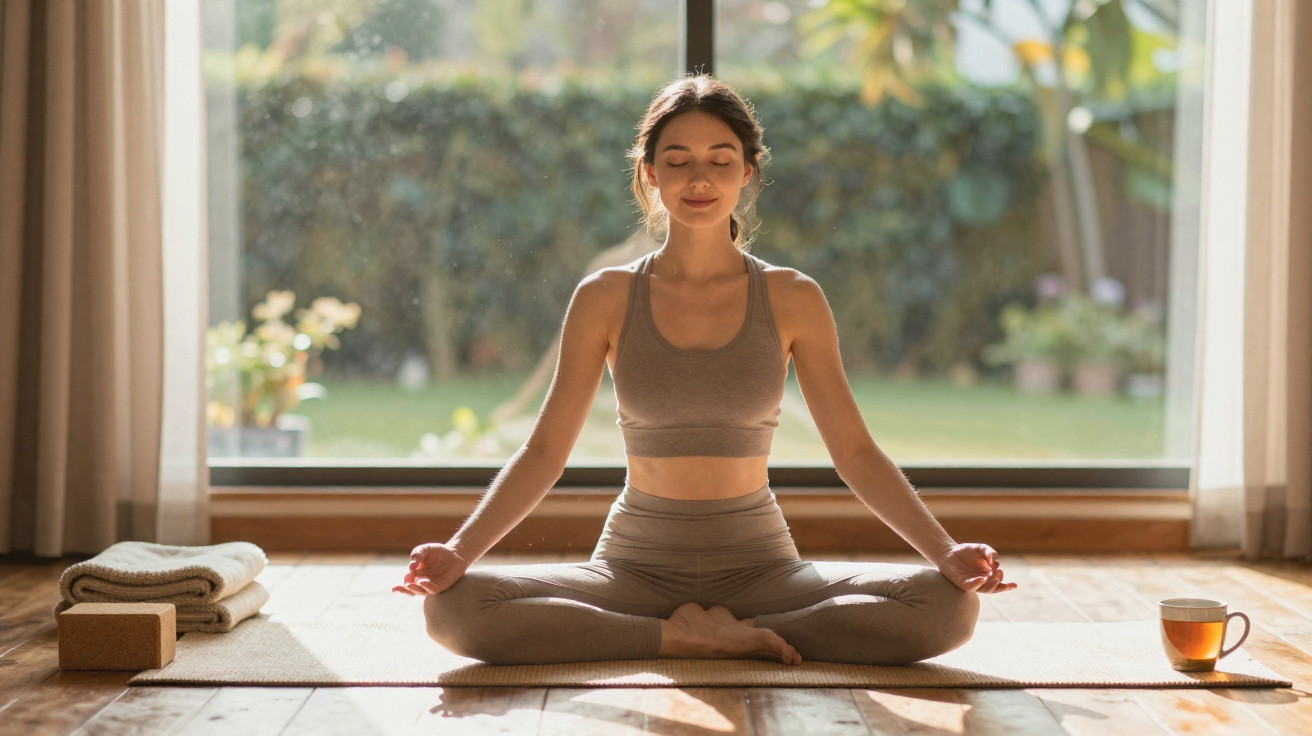
A woman in office clothes sits on her mat, shoulders slightly hunched, her attention caught somewhere between screen-induced stress and WhatsApp messages. The teacher asks her to do just one straightforward exercise: sit down, extend her legs, place her hands on the floor - and breathe. That is all. No contortion, no headstand, no Instagram-worthy yoga pose. After two minutes, her face looks different: softer, calmer, as if somebody has turned down an internal volume control. We all know that point in the day when body and mind say, “Enough.” This remarkably easy yoga exercise starts precisely there - and it is far less dramatic than you may expect.
Why one simple pose can have such a powerful effect
The exercise many instructors mention seems almost absurdly basic: Dandasana, often called Staff Pose. You sit tall, with your legs extended in front of you, feet flexed and hands pressed into the floor beside your hips. Outwardly, nothing more happens. Yet yoga teachers repeatedly describe how people feel an inner knot begin to loosen in this unassuming moment. It is not about stretching to the edge of pain, but about sitting gently and alertly - something close to what we could instinctively do as children: simply be present, without constantly thinking about the next task on the list.
One instructor from Berlin tells of a manager who arrived at her class with a migraine and wanted to “just give it a try”. He could barely remain still, fidgeted constantly and kept looking at his phone. She had him hold Dandasana for five breaths, then ten, then twenty. Nothing dramatic: simply sitting, breathing and lengthening the spine. A few weeks later, he told her that, for the first time in months, he felt his head was inside his own body rather than floating somewhere above it. Studies of body awareness indicate that even a few minutes of conscious posture and guided breathing can measurably settle the nervous system. This simple pose works at exactly that point: it is like a pause button you can take anywhere.
Why can so little movement feel so effective? Yoga teachers point to the combination of an upright spine, an engaged pelvic floor and even breathing. In Dandasana, the body has to stay present without escaping into movement. The leg muscles work subtly, the abdominal muscles provide support and the chest can lift more freely. The brain receives the message: “There is stability here.” When the body feels stable in its seat, the mind is more willing to let go. Let’s be honest: hardly anyone practises this as consistently every day as textbooks suggest. Even so, an imperfect version of the pose can be noticeable - like a quick tidy-up in your inner living room.
How to do Dandasana without any acrobatics
Sit on the floor, using a folded blanket if your hips otherwise tip backwards. Extend your legs in front of you, with your heels touching the floor and your toes gently drawing back towards you. Put your hands on the floor to the right and left of your hips, fingers facing forwards or slightly outwards. Notice your hands pressing down and helping you lengthen upwards. Allow your spine to rise, reach the crown of your head towards the ceiling and keep your chin parallel to the floor. Breathe in and out slowly through your nose for five breaths, then ten. At the beginning, you need do no more than that.
Within seconds, many people notice the backs of their legs pulling or their back wanting to round. The instinct is to stop. Yoga instructors recommend being kind to yourself at this exact point. Bend your knees slightly if the stretch is too intense. Sit higher if your pelvis rolls backwards. No one is handing out marks for perfect lines. This exercise is not a flexibility competition; it is a kind of internal check-in. You may realise how difficult it is to keep your breathing calm while your thoughts are racing. That very discomfort is often where relaxation starts - not when everything already feels easy.
Many instructors put it in almost the same way:
“Dandasana is like the unassuming entrance hall to every other pose. If you can be present here, you can be present anywhere,” says yoga teacher Lea K., who has taught for 15 years.
To turn this understated pose into a genuinely useful tool, a few small everyday anchors can help:
- Set aside a fixed two- to three-minute slot, ideally at the same time each day.
- Use a timer with a gentle sound rather than sitting “by feel”, as otherwise you will often stop too soon.
- With every exhalation, deliberately focus on releasing your shoulders and forehead.
- Do not expect a magical moment; instead, notice how tiny details shift from one day to the next.
- Once a week, stay in the pose for a little longer - around 20 calm breaths - to deepen its effect.
What changes when you truly sit down
People who try this simple pose for several days in a row often notice the physical effects first: their back feels more upright, their shoulders no longer collapse forwards as easily and the backs of their legs feel less rigid. It becomes more interesting when they pay attention to the mental after-effect. Thoughts can suddenly emerge more clearly, and some worries may seem slightly zoomed in and easier to grasp. The stillness of Dandasana is not an empty void, but a framework in which you can notice your own internal noise in the first place. Some describe it as finally closing a window after a day of having 30 tabs open in their head.
Perhaps that is the quiet luxury of this unassuming yoga exercise: it costs nothing, takes hardly any time and demands no athletic ability. It only asks you to do something we often avoid in daily life - stop. Not be productive, not quickly finish “just one more” thing. Simply sit, breathe and feel. For many people, that initially feels almost provocative. Yet instructors repeatedly report that these two or three minutes a day gradually become a kind of personal ritual: a quiet appointment with yourself that no algorithm will appreciate, but your nervous system certainly will.
| Key point | Detail | Benefit for the reader |
|---|---|---|
| A simple pose rather than complex flows | Dandasana requires only sitting with extended legs and conscious breathing | Can be done immediately without yoga experience; ideal on stressful days |
| Physical and mental effect | Lengthening the spine, activating the muscles and calming the nervous system | Better body awareness and noticeable relaxation within minutes |
| Ritual rather than perfection | Short, regular practice matters more than flawless form | A realistic approach that is easy to establish in everyday life |
FAQ:
- How long should I stay in Dandasana? Begin with five calm breaths and gradually build up to 10–20 breaths. Consistency matters more than the duration on your first day.
- What if the backs of my legs pull too much? Bend your knees slightly or sit on a blanket. Keeping the spine upright matters more than having perfectly straight legs.
- Can I do the exercise on a chair as well? Yes. Sit near the front edge of the chair, place your feet hip-width apart, lengthen your spine and rest your hands beside your hips or on your thighs.
- What is the best time of day? Many instructors recommend the morning after getting up or the evening after work. If you often get stuck on your phone, “before scrolling” can also be a useful fixed cue.
- Is this one exercise enough to become more relaxed? It is not a cure-all, but it is a surprisingly effective starting point. Many people find that this pose alone is enough to experience the day more consciously and calmly.


Comments
No comments yet. Be the first to comment!
Leave a Comment