
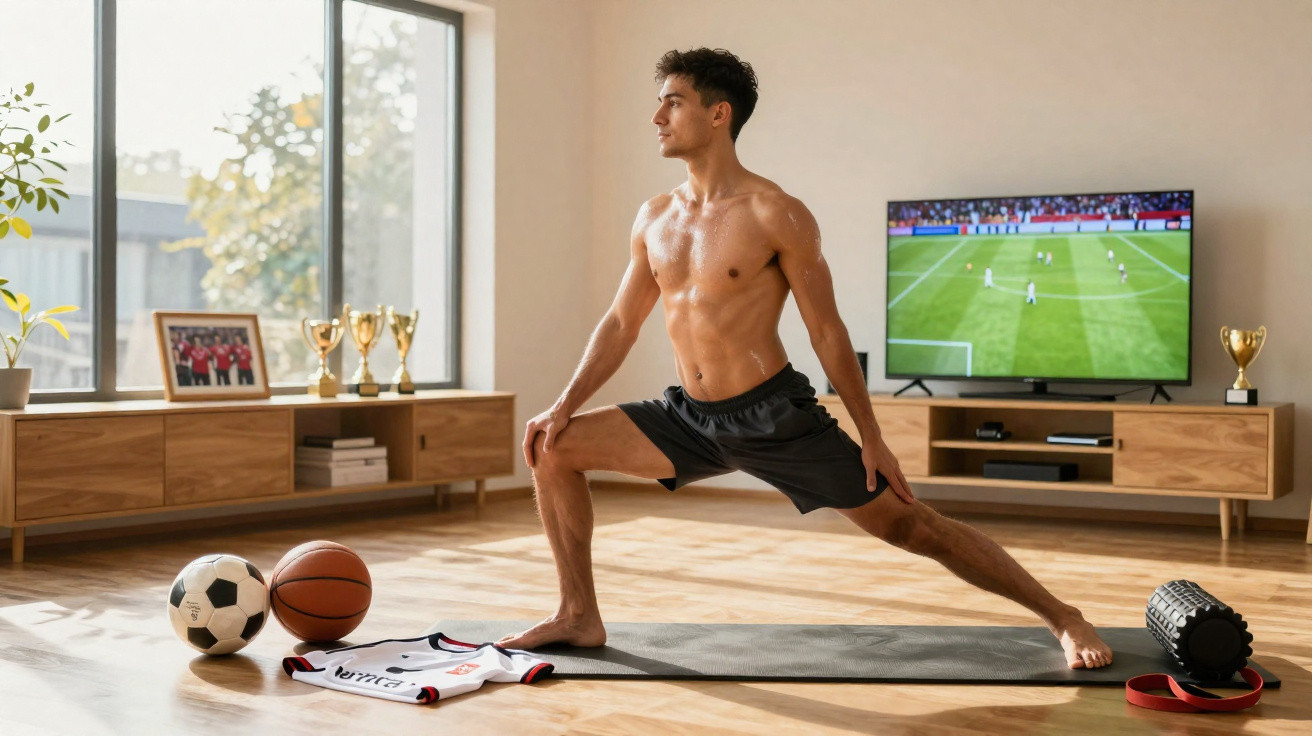
Eleven powerfully built men sit in a circle – but instead of a tactics board and video projector, there is a yoga mat in the middle. The fitness coach closes his tablet and simply says: “Shoes off, mats out.” One player laughs awkwardly, another rolls his eyes, and the centre-back whispers: “If the fans knew about this …”
Then the room falls quiet. Knees crack as they move into downward dog. The burly striker – 1.90 metres tall and 90 kilograms – shakes more in Warrior II than he did in the penalty area yesterday. Yet something is clearly changing. Not merely in their muscles, but in their minds too. Somehow, this calm amid floodlights, pressure and data analysis suddenly makes sense. And nobody is filming it for Instagram.
We all know that moment when something supposedly “soft” collides with a very hard-edged everyday reality. A quiet revolution is beginning here.
Why Bundesliga professionals are suddenly doing yoga – and nobody talks about it
Something has been shifting in Bundesliga performance centres for a long time. Alongside sprint tests, GPS vests and weight rooms, an unassuming appointment is appearing on weekly schedules more and more often: “Mobility & Mind”. At many clubs, that simply means yoga – occasionally under a different label, sometimes openly. Players initially arrive sceptical, then become curious. Some stick with it because they genuinely believe in it.
The reason is unglamorous yet radical: clubs have realised that muscle alone does not win seasons. A mobile hip flexor can determine whether a career ends. Calmer breathing in the 85th minute can decide a penalty. Yoga has suddenly become a surprisingly good fit for this sober, data-led world.
At FC Bayern, in Leverkusen and with Bundesliga basketball teams such as Alba Berlin, these sessions often take place behind closed doors. There is no social media content and no “Zen image”. Away from the cameras, one Bundesliga professional once told me that he felt freer in the yoga room than on the pitch. “Nobody expects me to be the toughest one in there,” he said. That reveals a great deal about the mental pressure these players carry. It also explains why men who appear especially hard-edged make such a consistent commitment to the mat.
Look more closely and the figures quickly become part of the conversation. Performance specialists observe that players who practise yoga regularly sustain fewer muscular injuries. Their ankles are more stable, their posterior chain is more supple and their recovery indicators improve. A fitness coach at a top-flight club told me that absence days among some of his players had “noticeably reduced” since yoga became part of the programme. Nobody officially wants to provide exact percentages, but internal spreadsheets are said to paint a fairly clear picture.
There is also a mental benefit that cannot be dropped so easily into an Excel sheet. Players say they sleep better after yoga sessions, are less provoked by social media criticism and come across more calmly in interviews. In a league where every second is dissected on television and every misplaced pass can spark a storm of online abuse, a stable inner anchor is almost a secret weapon. Let us be honest: nobody can sustain that indefinitely on protein shakes and ice baths alone.
The yoga poses that genuinely help footballers and basketball players
When you picture a yoga session for professionals, you may imagine candles and mantras. In reality, it is usually highly practical. There is a short warm-up, followed by straightforward, sport-specific positions that target the areas footballers and basketball players struggle with most: hips, hamstrings, ankles and core. Coaches often use variations of downward dog because it works the back, calves and shoulders at once – an all-in-one movement for players who sprint, jump and stop sharply for 90 minutes.
Warrior II appears in almost every one of these sessions. With its wide stance, bent knee and open hip, it both strengthens the leg muscles and encourages knee stability. That is particularly valuable for basketball players, whose knees are tested on landing on the court every other evening. It is just as useful for full-backs, who constantly rotate from the hips. Poses such as pigeon for opening the hips and the reclining twist for the spine are added too. They may look unremarkable, but they feel like a reset button for overworked joints.
One aspect many people underestimate is breathing. During professional yoga sessions, it is often counted very simply: inhale for four seconds, exhale for six. In downward dog, plank and seated positions. This is not an esoteric detail but an enhanced tool for managing exertion during a match. Anyone who has learned to keep breathing steadily through a demanding pose is less likely to fall apart internally during an all-out sprint. In confidential conversations, that is exactly what many coaches report: players who practise yoga consistently do not “fall apart” mentally as easily when a game starts to turn.
How to bring these professional routines into your living room
The move from a Bundesliga changing room to your own living room is smaller than you might think. You do not need a specialist mat or a studio membership; above all, you need a clear mini-plan that you can repeat. Three poses are enough to begin: downward dog, Warrior II and pigeon. Hold each for one to two minutes, warm up briefly beforehand, then lie quietly for two minutes afterwards. That is it.
Try three rounds, for example: take 5 deep breaths in downward dog, move into Warrior II on the right, hold it briefly, switch sides, then settle into pigeon on each side. It might take 12–15 minutes in total. There is no need for an elaborate ritual or a promise that you will do an hour every day from tomorrow. Keep it modest and realistic instead. The Bundesliga professionals I have spoken to rarely do long sessions outside team training – but they return to short blocks with remarkable consistency.
A typical mistake is that men approach yoga far too intensely. They want to perform the pose “perfectly”, touch the floor, place the heel down and hold their back straight as it is in the textbook. After two attempts, they lose interest because it “doesn’t look like it does on YouTube”. If you come from sport, you know that voice: the one inside your head that constantly judges. On the mat, that voice is allowed to take a break. Focus instead on whether you can feel a little more space in your hip joint or lower back, rather than whether it “looks good”.
The other major stumbling block is embarrassment. Many men tell me they would like to try yoga but do not dare go to a studio because they expect to find only highly flexible women and ultra-relaxed men. The reality is that real people there are breathing heavily too, dealing with shortened hamstrings and tight shoulders from office work. If going to a studio still feels like too big a step, start in your living room. A quiet Sunday evening, headphones and a short YouTube video: job done. Your body will understand the invitation, even if your ego is still complaining.
“At the start, I was stiffer than the physio table,” a Bundesliga professional told me with a laugh, “and now, before every match, I notice in downward dog just how ready my body really is.”
Comments like that show what this is truly about: an honest assessment without performance, showmanship or pressure. If you want to take something from it, a short checklist can help:
- Begin with 10–15 minutes and no more than three poses.
- Let your breathing set the rhythm, rather than the stopwatch.
- Stop if you notice that you are fighting against yourself internally.
- Briefly check in the following morning: does anything feel freer, clearer or more awake?
- Give yourself four weeks before deciding whether yoga “works for you”.
What changes when men stop seeing their body only as a machine
Anyone who watches professional footballers or basketball players for long enough soon notices that these bodies are high-performance machines – and, at the same time, highly vulnerable. Behind every muscle is a story of overload, missed summer holidays and pain that was carried for too long. Yoga introduces a quiet, almost understated counter-movement. Suddenly, the focus is not only on output but also on awareness. It may sound gentle, but it is actually hard-nosed prevention.
For amateur footballers and recreational basketball players, this offers an interesting reflection. Many of us treat our bodies like a car that can simply be revved up when needed – the pitch at the weekend, the sofa during the week. Only when the knee, back or Achilles tendon begins to protest does the major confusion set in. Yoga can serve as an earlier warning system. A hip that “closes up” in Warrior II tells you a lot about your technique when changing direction. A calf that burns in downward dog reveals something about the strain created by your jumping load.
Perhaps that is the real reason Bundesliga professionals now lie down on the mat without making a fuss about it: they understand that a career is not made only of highlights, but also of the many small, unseen moments in between. The restorative breaths. The quiet minutes with closed eyes in the room next to the weights area. When men begin to view their bodies not merely as tools for performance, but as allies in a long game, new stories emerge. Some play out in the stadium. Many take shape quietly on a mat, somewhere between grass and reality.
| Key point | Detail | Benefit for the reader |
|---|---|---|
| Yoga reduces injuries | Mobility in the hips, knees and ankles improves, while muscular imbalances are balanced out | Fewer absences, a longer sporting career and fewer frustrating periods |
| Targeted poses for ball-sport players | Downward dog, Warrior II and pigeon form a basic set for footballers and basketball players | A practical mini-programme that is easy to fit into everyday life or training |
| Mental stability through breathing | Calm breathing patterns under exertion transfer to stressful match situations | More composure in high-pressure moments, better self-regulation and less internal “collapse” |
FAQ:
Question 1: Does yoga benefit me at all if I already spend a lot of time in the weights room?
Yes, because strength training often shortens muscle chains, while yoga helps restore their length and function. Combining the two provides greater stability and mobility rather than simply “more power”.Question 2: How often should I add yoga as an amateur footballer?
Two short sessions of 15–20 minutes per week are entirely sufficient at the beginning. For example, do one on a rest day and one directly after a lighter training session.Question 3: I am extremely inflexible – is it still worth doing?
Especially then. The professionals who gain the most are often the stiffest. The aim is not to become acrobatic, but to gain a few more degrees of freedom in key joints.Question 4: Which pose should I learn first if I only have time for one?
Downward dog. It combines a stretch for the calves, hamstrings and back with gentle shoulder strengthening, while also supporting breathing.Question 5: Do I need a class, or is YouTube enough?
A good video can be enough to get started. If you are in pain, have existing injuries or want to explore it more deeply, a guided class with someone experienced in working with athletes is worthwhile.

Comments
No comments yet. Be the first to comment!
Leave a Comment