
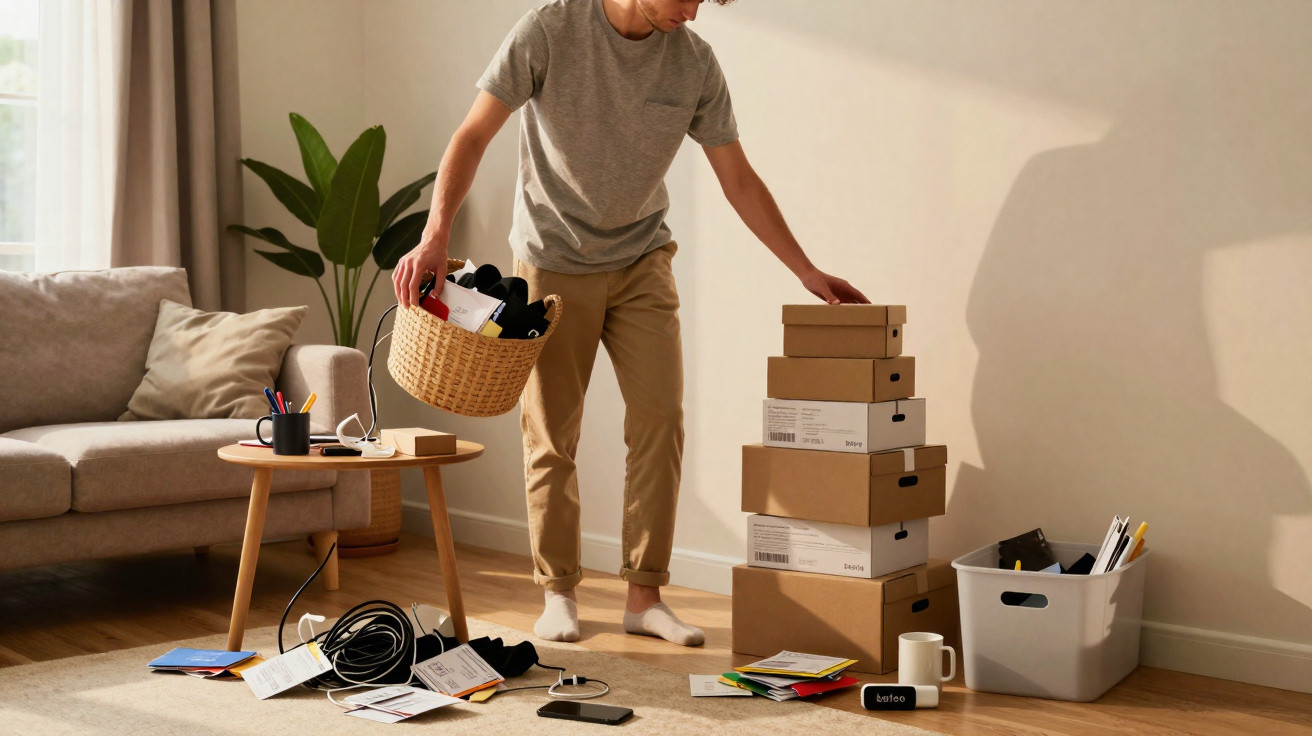
You are at the kitchen counter with your phone in one hand, keys in the other and a bag slipping from your shoulder. You are already five minutes late. Looking quickly for your headphones, your gaze falls on one familiar place: the “drop zone” beside the door. There is a stack of unopened post, stray receipts, sunglasses you no longer use and a knot of lanyards from conferences you can scarcely recall.
You assume you are tuning it out. You tell yourself there is no time to deal with it now. Still, your shoulders rise half an inch and your jaw clenches a fraction more.
You take what you need and head out. That small untidy corner remains, quietly buzzing away in the background.
The messy place you insist you do not notice
Every home has a particular area where clutter gradually accumulates. It might be the hall table, the bedroom chair that has become a mountain of clothes, or the desk corner where cables seem to multiply like rabbits. We laugh about it, pass it repeatedly and claim we are “blind” to it by now.
Even if your eyes pass straight over it, your nervous system does not. It repeatedly receives the message “unfinished task, unfinished task, unfinished task”, like a quiet alarm that never entirely turns off. Although you may turn away from the clutter, the strain remains somewhere beneath your ribs.
Picture a shelf in the hallway beside the front door. Initially, it contains your keys and one dish for loose change. A few weeks on, it is home to a partly read book, three masks, an old delivery card, two chargers, a dog lead and a screwdriver that never made its way back to the toolbox.
You tell yourself you have stopped “seeing” it. Visitors, however, often notice it as soon as they enter. You may find yourself saying sorry for the mess before anyone has mentioned it. In truth, that apology is not really for them; it is a small release of stress you have been carrying.
Psychologists refer to this as “visual noise”. The brain is designed to seek out patterns and order, while clutter is effectively a scrambled message. Every additional object creates another detail for your mind to process or block out. That uses energy, even when you are not consciously focusing on it.
In time, that cluttered area can resemble a browser tab that remains open. You are not looking at it, but it continues to slow everything else down. The stress is not loud; it simply hums.
How to calm a stressful corner in 10 focused minutes
Choose one defined cluttered area. Do not tackle the entire house or “the office”; select the shelf, drawer or chair that quietly gets on your nerves. Set a timer for 10–15 minutes. This is a stress reset, not a complete transformation.
Start by taking every item away and cleaning the surface. Let it be bare for a moment. Next, ask one straightforward question about each object: “Does this live here?” If the answer is no or “eh, sort of”, move it to its proper place or get rid of it.
Assign the space one distinct function: “keys and mail only”, “skincare only” or “laptop and notebook only”.
The main pitfall is allowing this to become a perfectionist project. Before long, you can be sitting on the floor three hours later, surrounded by boxes, looking through old birthday cards and questioning why you began. The goal is relief rather than reinvention.
Show some compassion to the version of yourself who put those things there initially. They were exhausted, had too much to manage and chose getting through the day over appearances. That is not laziness; it is being human.
Honestly, no one manages this every single day. Consistency comes from small resets that allow for forgiveness, not strict rules you will give up by next Tuesday.
Sometimes the real self-care isn’t a bath or a walk. It’s clearing the one messy corner your brain trips over ten times a day, even when your eyes pretend not to notice.
- Select one place you pass every day, such as a desk corner, bedside table or hall table.
- Clear it fully, then choose its single purpose.
- Leave only the items that support that purpose within easy reach.
- Create a small ritual: spend 2 minutes resetting the spot before bed or after work.
- Pay attention to how your body feels as you walk past it next time. That change is your quiet reward.
Less background noise at home
After you have dealt with one stressful corner, a subtle change takes place. You start to recognise how closely your surroundings and mind communicate. Your morning will not suddenly turn into a slow-motion coffee advert. But there may be slightly more room to breathe and a little less unseen friction.
Perhaps you look at the newly clear surface and experience a small sense of relief. Your brain is adjusting its idea of what feels “normal”. This is the kind of quiet victory that rarely shows up on social media, but absolutely shapes your day.
| Key point | Detail | Value for the reader |
|---|---|---|
| One spot at a time | Concentrate on one clutter zone rather than the whole home | Makes change manageable and reduces overwhelm |
| Visual noise = mental load | Clutter repeatedly sends “unfinished tasks” signals to your brain | Clarifies the hidden stress and guilt you might experience at home |
| Simple reset ritual | A 2–10 minute routine for regularly clearing that particular area | Builds lasting calm with little time or effort |
FAQ:
- How can I tell which clutter spot stresses me most? Look for the place your eyes dart away from, the one you apologise for when guests arrive, or the one that gives you a small feeling of “ugh” whenever you pass it. That is usually the area to start with.
- What if I genuinely don’t have time to declutter? Begin with a 3-minute rule. Set a timer and clear only what you can in three minutes from one small surface. Stop as soon as the timer ends. Even very small wins reduce background stress.
- My partner/roommate causes most of the clutter. What do I do? Begin with an area that is mainly within your control, so you can experience the benefit yourself. Afterwards, discuss making one “calm zone” that you both maintain, instead of arguing about the entire home.
- Should I buy storage boxes and organisers first? No, not initially. Empty the area, decide what it is for and remove anything that does not belong there. Then consider whether you genuinely need a container, or whether owning fewer things was the actual answer.
- Why does a tiny corner matter when the rest of my home is fine? Your brain responds to frequency rather than square metres. One small untidy area you see ten times daily can be more draining than a large room you hardly ever enter.





Comments
No comments yet. Be the first to comment!
Leave a Comment