
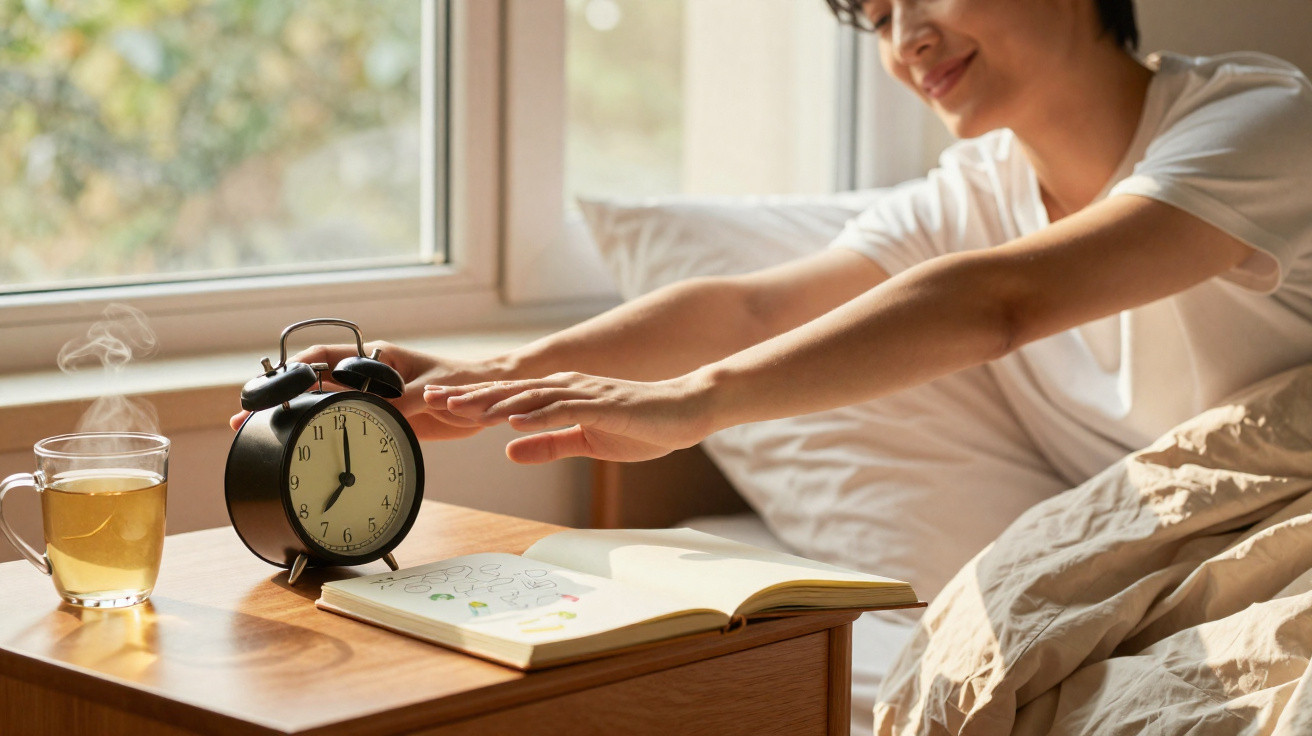
The alarm goes off, you press snooze, and your thumb is already moving towards the screen. Before you have even got out of bed, your mind is flicking through headlines, notifications and red dots demanding a tap. Coffee is secondary. Breathing is secondary. The day begins with a feed rather than a feeling.
Now imagine a slightly different start. You wake without a buzz or blue light. A gentle lamp comes on, the room becomes a little warmer and the blinds slowly open. Your watch discreetly tells you: “You slept 7h43, stress markers are low, best time to start deep-focus work is in 42 minutes.” There is no drama and no dopamine rush. It is simply a calm prompt tailored to your biology.
Researchers suggest this move - away from a clock-led life and towards a body-led one - could be the next genuine lifestyle revolution.
It is less spectacular than flying cars, but perhaps far more significant.
The shift researchers believe could transform our routines
An increasing number of neuroscientists and chronobiologists are highlighting an idea that is straightforward but radical: live by your rhythms, not by the clock.
Rather than making the brain and body conform to rigid timetables, they say our days may increasingly be organised around individual biological information - sleep patterns, periods of concentration, glucose fluctuations and stress signals.
For decades, the default model has been 9 to 5, three meals, one bedtime and the same routine for everybody. That is industrial reasoning rather than human reasoning. This newer body of research indicates that each person’s body follows its own, quieter timetable.
The technology needed to hear it is already sitting on millions of wrists.
Consider developments in some leading workplaces. At a European design firm examined by researchers in 2023, employees wore wearable devices for eight weeks to monitor sleep, heart rate variability and concentration windows.
The firm then tried one simple approach: staff planned deep work for their own focus peaks, while emails and meetings moved into lower-energy periods.
There was no salary increase, no change of office and no change to the projects. Even so, reported burnout fell by almost a third within two months, while output on complex tasks increased by more than 20%. One employee said it felt like “finally working with my brain instead of against it.”
It was not magic. It was timing.
The central point is stark: our brains do not operate at a constant level. They move in cycles.
We have chronotypes - early birds, night owls and everyone between them - alongside ultradian periods of concentration and tiredness that recur every 60 to 90 minutes. There are also hormones, shifts in blood sugar and social jet lag caused by late evenings followed by early alarms.
Researchers say that disregarding these rhythms can result in mental fog, impulsive choices and a low-level anxiety running beneath daily life. Life turns into a collection of minor irritations that seem “normal” only because everyone is exhausted.
Change the approach, they argue, and daily life may feel less like a struggle and more like riding a current that was there all along.
From theory to a Tuesday morning: what the change looks like
What, then, does “living by your rhythms” mean when you still have a manager, children, deadlines and rent to pay?
Researchers in this field describe a notably practical starting point: monitor first, then alter one thing at a time.
Spend a week noticing when your concentration naturally peaks. You can use a smartwatch, an app or an ordinary notebook. At what times do you feel alert without having to push yourself? When does every task seem difficult?
Once you have roughly identified your two strongest focus windows, protect one as if it were a meeting with the most important person in your life.
In a sense, it is.
Most of us know the experience: you are looking at a screen at 3 p.m., but nothing stays in your mind. You read the same sentence four times. Your brain effectively left the room an hour earlier.
Then, at 10:30 p.m. that night, ideas begin to appear, or you suddenly want to reorganise the entire kitchen.
This disconnect is precisely what researchers are studying. In one US university study, “night owls” made to follow early timetables did less well in tests, whereas the same students achieved dramatically higher scores when tested during their natural evening peak. The people were the same and the material was the same; only the timing changed.
More alarmingly, their brain scans showed patterns resembling mild intoxication during their “off” hours.
So where does that leave everyday life now? Somewhere between the industrial clock and a fully personalised day.
Workplace-trend analysts anticipate more hybrid arrangements: set periods for co-ordination alongside flexible blocks for biologically-informed work. Schools are also gradually experimenting, including later starts for teenagers, whose natural rhythms move later during puberty.
The reasoning is blunt but straightforward. Persistently ignoring our rhythms is not discipline; it is inefficiency. Let’s be honest: nobody truly manages this every single day.
Still, every modest adjustment - one protected concentration block, one achievable bedtime or one rescheduled meeting - becomes a small act of resistance against a timetable we never really selected.
Practical ways to align your day with your natural rhythm
Researchers recommend beginning with three foundations: sleep, focus and recovery.
First, choose a “good enough” sleep window and keep it on most nights of the week - not perfectly, but consistently. Next, identify your first natural wave of concentration: does it arrive in mid-morning, early afternoon or later? Put your most difficult task there, even if you have only 45 minutes.
Finally, make room for micro-recovery in your timetable. Brief walks, two-minute breathing breaks and phone-free coffee may sound insignificant. They are not.
See the day not as an unbroken line of effort but as a series of waves: rise, work, pause, repeat. This is less about self-optimisation and more about giving yourself permission.
A frequent mistake is to hear this advice and immediately attempt a complete life reset: a new app, a new planner and a fantasy of joining the 5 a.m. club. Then ordinary life intervenes, the whole system collapses by Thursday and they feel worse than they did before.
Researchers who genuinely examine behaviour change point towards a kinder method: change your environment before relying on willpower.
That might involve muting non-urgent alerts during your strongest focus period, leaving your phone in another room overnight or asking your team for one “no meeting” hour each day. These are small, unglamorous changes that remove friction.
You are not failing if you cannot live like a productivity influencer. You are simply living in the real world.
One research psychologist I spoke to described this as “compassionate structure.”
She told me:
“The goal isn’t to squeeze more out of yourself. It’s to stop wasting energy fighting your own biology. When people experience that, they describe it less as being productive and more as finally feeling like themselves again.”
To make the idea more concrete, readers often begin experimenting in these ways:
- Reserve one 45–60 minute focus period at the time you naturally feel sharpest.
- Move one demanding task into that period for a week.
- Keep one straightforward evening wind-down ritual (no screens, dim lighting, a dull book).
- Plan one micro-break every 90 minutes: stand, stretch and breathe.
- Reflect on Sunday: what felt easier, rather than only what was completed?
None of this is flashy, which may be exactly why it works.
A quieter revolution than AI - and perhaps a deeper one
When people discuss the “future of life”, they usually leap to robots, self-driving cars and smart fridges ordering their own milk. Yet researchers examining rhythms are pointing towards something more personal: a future in which the greatest improvement is not outside us, but within the structure of our day.
Imagine children attending school at times suited to teenage biology. Imagine offices arranging creative sessions when most brains are genuinely creative. Imagine cities whose public spaces reflect real human energy curves, rather than only traffic congestion and office blocks.
In that world, your morning may still begin with an alarm and your phone may still buzz. Yet the quieter layer beneath it - how you arrange effort, rest and attention - could feel profoundly different.
The next major lifestyle revolution may not involve new technology at all, but a new agreement with our bodies. It is a story we are only beginning to write.
| Key point | Detail | Value for the reader |
|---|---|---|
| Biological rhythms influence performance | Concentration, memory and mood rise and fall through daily cycles that are individual to each person | Helps you stop blaming yourself and instead adjust your timing |
| Small timetable changes outperform complete overhauls | Protecting one concentration block or one sleep window can alter how an entire day feels | Keeps change realistic, even with work, family and social limitations |
| Environment has greater influence than willpower | Notifications, meeting schedules and light exposure can move you towards or away from your natural rhythm | Offers practical controls without turning into a “productivity robot” |
FAQ:
- Question 1 What do researchers mean by “living by your rhythms”?
- Question 2 Can I do this if my job has fixed hours?
- Question 3 Do I need an expensive smartwatch to start?
- Question 4 How long before I notice any change?
- Question 5 What if my natural rhythm clashes with my family’s?


Comments
No comments yet. Be the first to comment!
Leave a Comment