
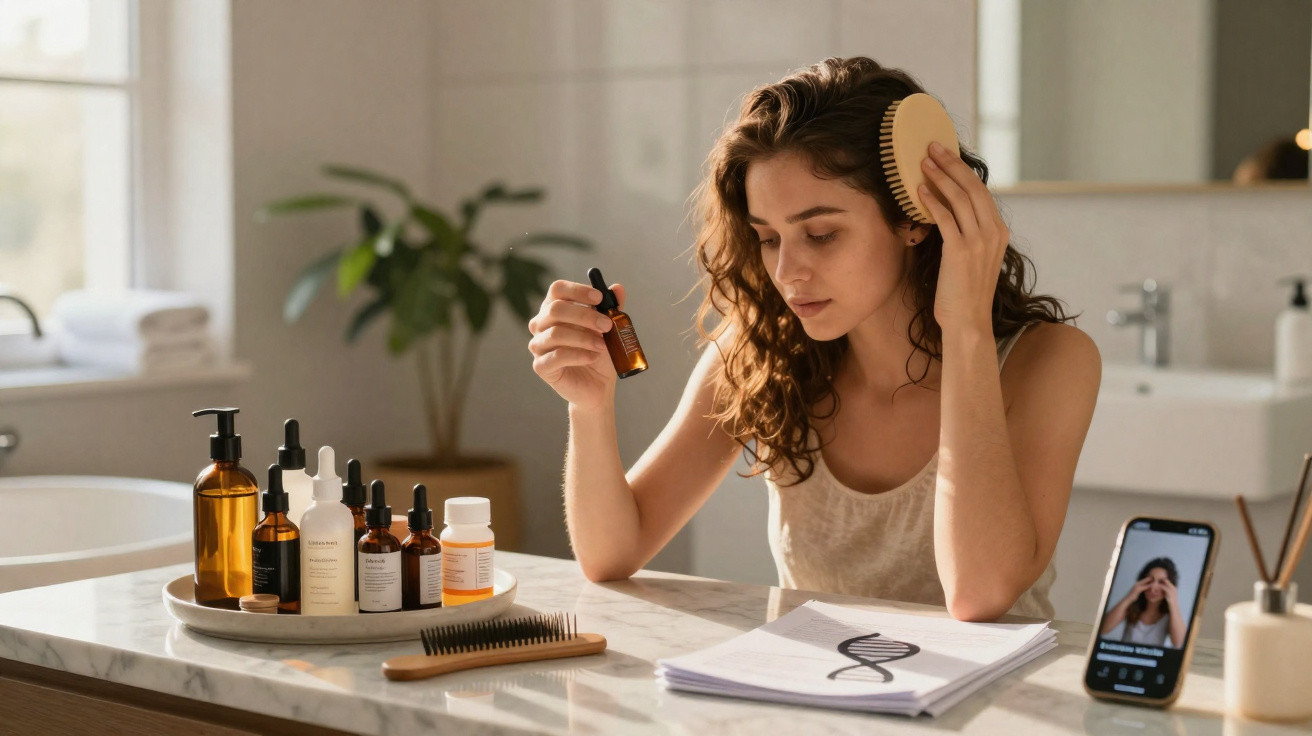
The first time I watched a “scalp spa at home” video, its creator was sitting in a candlelit bathroom, wearing a white robe and holding a glass of cucumber water. She worked a silicone brush along her hairline as though she were soothing a tiny, highly stressed cat. The caption claimed: “Fix your scalp, fix your hair loss.” There was no reference to age, hormones, stress, or the possibility that your father is bald and your mother’s parting is getting wider. Only a foaming scrub and the illusion of complete control.
We all know that feeling: when a small hope seems easier to purchase than book a medical appointment for.
This trend is not simply about foam and brushes.
It is about blame.
Why scalp spa at home has suddenly become the answer to everything
Search “scalp spa” on TikTok or Instagram and your feed becomes a slow-motion shampoo advert. You see magnified flakes of skin followed by dramatic “after” transformations. Influencers insist their hair is “thicker” and that their “shedding stopped”, all because they added a weekly exfoliation ritual to their shower routine.
The implication is subtle: if your hair is shedding, you must have “neglected” your scalp. The solution appears so straightforward that you can almost feel at fault for not doing it already. Buy this scrub, that detox serum and a vibrating brush. It is a little ritual offered as an answer to a major fear.
A 27-year-old London creator recorded her “90-day scalp spa journey”, sharing striking before-and-after images. Hundreds of commenters asked for product links and echoed one another’s fear: “I’m losing hair in the shower and I’m terrified.”
Further down, a single trichologist commented that anyone losing more than 100–150 hairs daily, particularly in clumps, should consider blood tests for iron levels, thyroid function or hormonal changes. Her reply received only a few likes, while the video accumulated millions of views. Fear travels quickly; nuance does not.
The appeal of the trend rests on an enticingly neat idea: a healthy scalp means healthy hair, so a shedding problem must mean the scalp is to blame. It is only partly true, which is exactly why it sounds entirely persuasive.
A clean scalp, balanced oil production, no ongoing irritation and no product build-up can certainly create better conditions for hair growth. Yet that is just one part of a far broader picture. Genetics, hormones, autoimmune conditions, childbirth, extreme dieting, long COVID and chronic stress can all play substantial roles in hair loss.
Holding the scalp solely responsible is like blaming the soil when a tree dies in a storm.
Where scalp care helps… and where it can quietly become a distraction
A truly helpful scalp routine is much less glamorous than the spa reels suggest. It means choosing a mild shampoo for your hair type, avoiding five-day gaps between washes if your scalp is very oily, and spending one or two minutes massaging the scalp to encourage local blood flow.
If you regularly use dry shampoo or styling products, you could include an exfoliating treatment once a week. A few drops of a dermatologically tested serum may ease mild dandruff or itching. That is enough. You do not need ten stages, three brushes and a steamer resembling a kettle designed from a mood board. Your scalp benefits more from consistency than theatrics.
A mistake many people admit to in comment sections is doing everything at once. They exfoliate every day, buy an acid exfoliant, a minty scrub and a clarifying shampoo, then layer them as if they were skincare products. Their scalp starts to sting, their hair gets drier, and shedding can seem worse simply because the strands have become more fragile.
There is also a more subtle error: relying on these rituals to sidestep difficult questions. Could my thyroid be affected? Am I not eating enough? Does everyone in my family start thinning at the crown by 30? Those possibilities can feel less confronting to ignore when your bathroom shelf is packed with glowing promises. And honestly, nobody truly keeps up this routine every single day.
“People come to me after trying every scalp gadget on the internet,” a dermatologist told me. “They’ve spent hundreds, sometimes thousands, and they feel like they failed. Often, the real issue is hormonal or genetic. No brush can override that.”
Even so, there is a reason these rituals are so enjoyable. They offer a feeling of control over something that can feel intensely personal and visible. There is nothing wrong with taking pleasure in that, provided the spa ritual does not take the place of proper care.
- Keep scalp exfoliation to once weekly, or once every two weeks if your scalp is sensitive.
- Use your fingertips or a soft tool rather than long, sharp nails that can scratch the skin.
- Look out for warning signs, including sudden shedding, bald patches, pain or severe itching.
- Think about blood tests when hair loss is new, fast or accompanied by fatigue or changes in weight.
- Consult a dermatologist or trichologist when hair loss is common in your family or continues for longer than six months.
The truth no scalp spa video really wants to tell you
When you look beyond the foam and filters, the scalp spa trend says something more profound about how we respond to hair loss. We are encouraged to believe every problem is a lifestyle decision: something that can be scrubbed away if we are sufficiently disciplined and “clean”.
That story works well for brands but is punishing for real people. When your hair continues to thin despite an impeccable routine, the implied judgement is that you did not work hard enough, choose the correct product or adopt the right mindset. But hair biology is stubbornly non-negotiable. Genetics do not read marketing copy, and hormones are indifferent to how attractive your shower caddy appears.
Perhaps the next version of “self-care” should not be a more indulgent scalp spa, but a more truthful one. You can enjoy warm water, a massage and the pleasant scent of your shampoo while also acknowledging: my body is getting older; my hormones are changing; I may need medical support rather than only minty foam.
An at-home scalp ritual can offer comfort, create a moment to check in with yourself and help you spot changes sooner. It becomes harmful only when it is treated as a one-person fight that you are expected to win using products and determination alone.
The contentious issue is not caring for your scalp itself - done gently, that is largely harmless. The real problem is how the trend quietly shifts responsibility. Health services are overstretched, specialist appointments take time, and blood tests are costly or difficult to access in many areas. The beauty industry steps into that gap with “solutions” that are faster, more attractive and easier to share online.
Between the foam and the fear, there is a more balanced approach: look after your scalp, yes. Brush it, wash it and treat it kindly. But if your hair is falling out and your instincts tell you there may be something deeper happening, listen to that feeling as well. The comments section cannot diagnose you. A professional may be able to. Your reflection deserves both reassurance and honesty.
| Key point | Detail | Value for the reader |
|---|---|---|
| Scalp care has limits | Good hygiene and gentle massage help, but cannot reverse genetic or hormonal hair loss | Lowers guilt and unrealistic expectations about what a routine can achieve |
| Overdoing trends can backfire | Excessive scrubs, acids and tools can irritate the scalp and make hair weaker | Helps protect scalp health and prevents spending on unnecessary products |
| Medical checks matter | Blood tests and specialist guidance can uncover hidden causes, such as deficiencies or thyroid problems | Provides a clearer route to effective, lasting solutions beyond cosmetic fixes |
FAQ:
Is a scalp spa at home completely useless for hair loss?
Not useless, but its benefits are limited. A gentle routine can remove build-up, soothe irritation and support hair that is already growing. With genetic, hormonal or medical hair loss, it is a complement rather than a cure.How often should I exfoliate my scalp?
Once a week is enough for most people. If your scalp is dry or sensitive, every two weeks is the safer option. Daily or very frequent exfoliation may inflame the skin and worsen the problem.What are red flags that my hair loss isn’t just “dirty scalp”?
Sudden shedding, obvious bald patches, pain, burning or itching, as well as symptoms such as fatigue, weight changes or irregular periods. Hair loss that keeps progressing for over six months warrants medical attention.Can scalp massage really help with hair growth?
Gentle massage can increase local blood flow and might offer slight support for growth conditions, particularly alongside proven treatments. It is relaxing and low risk if done carefully, but cannot overcome strong genetic or hormonal influences.Should I stop scalp spa routines if I start medical treatment?
Not automatically. Many dermatologists are comfortable with straightforward, gentle scalp care alongside treatments such as minoxidil or prescription medication. What matters is avoiding harsh scrubs or products that might irritate the skin or interfere with your doctor’s prescription.





Comments
No comments yet. Be the first to comment!
Leave a Comment