
On a wet Wednesday underground, a young woman in a graphite-coloured coat fixed her gaze on her phone case. It was grey. Her tote was grey too. Even the trainers that had once been neon pink had become a faded “stone”. Browsing an online shop, she had opened the filter: “colors – black, white, beige.” The rest of the colour spectrum remained untouched, like far-flung relatives at a wedding.
For a moment, she paused over a red jumper before abruptly closing the tab. “Too much,” she murmured.
Scenes like this are increasingly familiar: wardrobes resembling copies of one another, interiors drowned in greige, and phones set permanently to “dark mode only”.
Behavioural psychologists are beginning to suggest that this change may be more than a design preference.
When your world slowly fades to neutrals
Ask a stylist who works with stressed clients and they will often tell you that colour is among the first things to go. When people are under strain, they tend to “simplify” their decisions, and colour is an easy element to remove.
Someone leaving an exhausting job may suddenly notice that their wardrobe resembles a corporate-uniform catalogue. A new parent surviving on two hours’ sleep may find that she only buys black leggings because “it’s just easier”.
One or two neutral items are unremarkable. But when your everyday surroundings shift from a varied palette to three dependable shades, there may be something more significant beneath it.
Behavioural psychologists call this a subtle “narrowing of self-concept”. One therapist described clients who once adored bold prints but now claim they “can’t pull that off anymore”. Their bodies have not changed; only their sense of who they are permitted to be has altered.
With continuing psychological strain - chronic workplace stress, prolonged illness in the family, or a subdued yet draining separation - choices carrying even a little risk can begin to feel intolerable.
Colour is often lost in the process. People slowly discard anything that seems “too visible”, as though making themselves less noticeable might shield them from the next setback.
There is a rationale to this. When the brain enters survival mode, it reduces complexity: fewer decisions, fewer ways to get things wrong, and fewer chances to be judged.
That is why people fall back on shades that seem secure: black, grey and navy. “Timeless.” “Classic.” “Professional.” Such words can sound reassuring when life is anything but.
Psychologists describe this as a feedback loop. Feeling exposed, you select neutral colours to “blend in”. Looking in the mirror then presents you with a subdued version of yourself, quietly reinforcing the message: I am someone who must not draw attention.
Eventually, the colours in your wardrobe begin to reflect the colours of your self-concept.
Using colour as a quiet psychological signal
If you feel your colours have gradually vanished, begin with the smallest possible experiment. This does not require a complete wardrobe transformation, only one small act of defiance.
The next time you purchase something practical - socks, a mug or a phone case - choose the option containing a little life. It might be a stripe, soft green or muted coral. You need not leap from black to neon; treat it as “turning the dimmer up one click”.
Use that small coloured item on a day with no major plans. Keep the stakes and pressure low. Give your nervous system the chance to discover that a restrained flash of blue does not put you on trial.
Many people believe they are “too old” or “too serious” for colour. Psychologists often hear another thought behind those claims: I’m too tired to risk feeling ridiculous.
The gentler route back is therefore not forcing yourself into an extravagant pattern you will dislike. It means recognising where you are over-editing yourself. Do you instantly remove “bright” from every search filter? Do you decide “this is not me” before you have even tried something on?
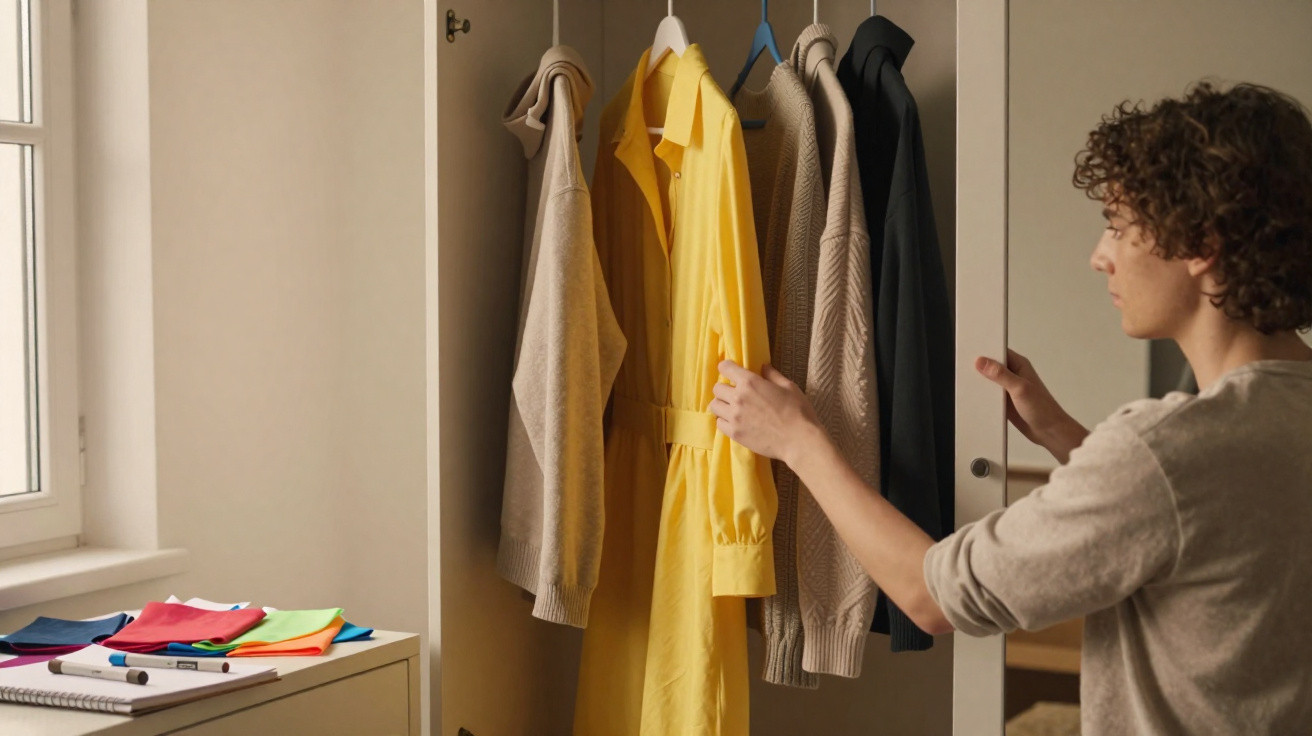
Let’s be honest: nobody really does this every single day. Most of us settle into habits without realising it. Then, one afternoon, we open the wardrobe and see that the person who loved sunflower yellow has not appeared for years.
Behavioural psychologist Dr. Lena Ruiz told me, “When color choices collapse into a narrow band over months or years, I look at what else has collapsed – hobbies, friendships, personal risks. Color is rarely the root problem. It’s the visible symptom.”
- Start micro
Choose one coloured accessory, playful nail varnish or patterned cushion. The aim is a signal rather than a shock. - Track your reactions
Pay attention to whether a coloured item brings shame (“too loud”) or relief (“there I am”). Either response offers a clue about your present self-story. - Link colour to context, not identity
Rather than saying “I’m not a red person,” try “Red scarf for days I need extra courage.” It is a tool, not a label. - Watch for all-or-nothing thinking
If you think you must remain entirely neutral or embrace a full rainbow, that is pressure speaking rather than your taste. - Ask someone who remembers you “before”
A friend or sibling can often remember which colours you loved when you were not always bracing for impact.
When your colour palette becomes a mirror
The colours surrounding us can hold a quiet honesty. A teenager covering her bedroom in fierce red may be demanding room for herself. A middle-aged man dressed entirely in navy may conceal exhaustion behind “reliability.” Neither response is wrong.
Colours are not moral choices, they’re emotional weather reports.
Psychologists are not claiming that “if you love neutrals, you’re broken.” Instead, they ask another question: did you select those colours freely, or did stress select them for you?
When you next enter your home, allow your eyes to move slowly over the bedding, dishes and coat by the door. If your surroundings appear to have been run through “low battery mode”, your inner life may be expressing itself.
| Key point | Detail | Value for the reader |
|---|---|---|
| Colour narrowing can reflect self-narrowing | During persistent stress, people often retreat into a very limited group of “safe” shades | Provides a concrete, visible sign that your self-concept may be contracting |
| Micro-experiments are safer than major overhauls | Add small touches of colour through low-stakes objects and on low-stakes days | Makes change seem manageable rather than overwhelming or performative |
| Link colour to states, not identity labels | Treat particular colours as tools for moods or situations | Supports the recovery of choice and nuance rather than rigid “I’m not that type” stories |
FAQ:
- Question 1 Does liking black or neutrals automatically mean my self-concept is damaged?
- Question 2 How long does colour narrowing need to last before psychologists see it as a warning sign?
- Question 3 Can reintroducing colour really change my mood, or is that just a placebo effect?
- Question 4 What if my job dress code forces me to wear mostly dark, neutral clothes?
- Question 5 I feel silly in bright colours now. Is that resistance or just growing up?






Comments
No comments yet. Be the first to comment!
Leave a Comment