
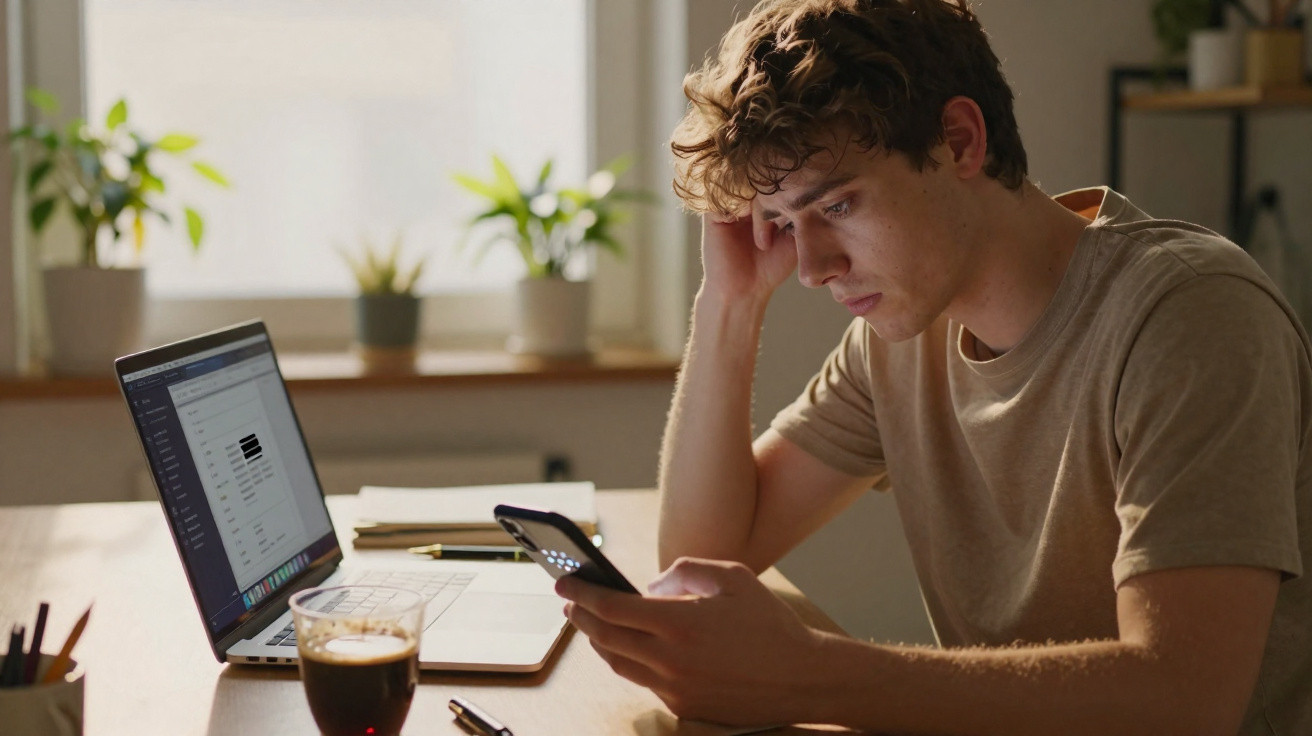
The queue for coffee was quiet, yet everyone’s thumbs were busy. Eyes were locked on small illuminated screens: scroll, tap, scroll again. A young woman wearing a navy blazer refreshed her inbox three times in under a minute, despite there being no alert for a new email. Her jaw was clenched and her shoulders were gradually rising towards her ears. Beside her, a man in a hoodie unlocked his phone, opened Instagram again, skimmed through three posts he had already viewed, then locked it with a sigh that sounded far older than him.
No one seemed especially unhappy. No one appeared “burned out” in the dramatic form we tend to picture.
Still, the atmosphere felt unexpectedly heavy.
A single, small behaviour was repeating around the room like ambient noise. And it was revealing a far larger story.
The everyday habit that quietly drains your mind
Look almost anywhere - on a train, in an office lift or on the sofa at home - and the same routine appears. People absent-mindedly unlock their phone or open another browser tab, not because they need anything in particular, but because they do not want to sit with one thought.
It seems innocuous, even modern and productive. A brief check, a short scroll, a quick look at the inbox “just in case”.
But this continual micro-checking - jumping between apps, tasks or tabs - can often point to hidden mental fatigue that your body has not yet had a chance to identify. Your brain wants rest, but its only way of requesting it is through more stimulation.
Take a normal working day for somebody like Lea, a project manager in her thirties. She wakes and checks Slack before she has even said good morning to herself.
During her commute, she moves through news alerts, WhatsApp groups and notifications from three separate social media apps. At her desk, she cannot complete a document without switching to email “for a second”, checking her phone when it buzzes, then looking at the team chat.
By 3 pm, she feels oddly worn out, though not sleepy. Her thinking feels sluggish. She reads the same line three times, while continuing to open fresh tabs, pulled by a vague sense of restlessness.
On the surface, she has not done anything extreme. No sleepless night, no crisis. Only hundreds of tiny attention shifts that have silently depleted her mental battery.
That restless impulse to check something - anything - is more than a bad habit. It is your brain attempting to soothe its tiredness with easy bursts of novelty.
Whenever you change tasks, your prefrontal cortex makes a small “gear change”. That comes at a cost. Those tiny costs accumulate, like spending a penny each time you turn a switch.
When you are well rested, you are unlikely to notice. When mental tiredness sets in, the price can show up as irritability, fragmented concentration and a strange urge to keep grazing on information.
Honestly, nobody does this every day because they are truly thrilled by their email. More often, it is a quiet warning signal. Your mind has had enough, but you continue expecting it to act as though it has not.
How to interrupt the “micro-checking” spiral
You do not need to transform your whole life to begin reducing this hidden fatigue. You need one straightforward micro-ritual that does the opposite of checking: an intentional pause.
Test this small approach for one day. Whenever you feel like reaching for your phone or opening a new tab without a definite reason, take three breaths before doing anything.
With the first breath, observe: “I want to check something.” With the second, ask: “What am I actually feeling?” With the third, choose deliberately: “Do I really need this right now?”
Most impulses last only seconds. Letting them pass once or twice is often enough for their hold to start weakening.
People commonly assume they need flawless self-control or a digital detox in the middle of the woods. That idea can feel reassuring, but it can also leave you stuck.
Small, realistic changes within everyday life work better. Put one minor obstacle between yourself and automatic checking. For some people, that means moving social media apps into a folder on the second screen. For others, it means muting non-urgent notifications for two afternoon hours.
You will slip up. You will notice yourself doom-scrolling again.
Treat yourself kindly when it happens. Your nervous system has been trained for years to find safety in constant stimulation. You are not “weak”; you are rewiring.
“When I finally realized I was checking my email to avoid my own thoughts, not to be productive, everything shifted,” a reader told me. “I wasn’t lazy. I was tired and scared of stopping.”
- Rename the habit
Describe it honestly: “mental fatigue scrolling” or “automatic checking”, rather than “just staying updated”. - Add a small amount of friction
Put a note on your lock screen saying: “What am I actually needing right now?” before you unlock your phone. - Protect one “no-switch” zone
Pick 20 minutes each day - during breakfast, the first few minutes after work or an evening walk - and commit to no app-switching whatsoever. - Monitor your mental battery, not only your steps
Give your mental energy a score from 1 to 10 once a day.
See which days make the checking habit most intense. - Tell one person
Let someone know that you are trying less micro-checking.
This small social commitment quietly helps support you.
Rethinking what tired really looks like
Mental fatigue does not often resemble somebody dramatically collapsing over a keyboard. It can look like sitting on the sofa after work with your phone in hand, moving aimlessly between apps and saying, “I don’t have the energy to watch a whole movie”, while somehow spending 90 minutes watching random clips.
It can look like reading the same paragraph of a report again as your fingers are already reaching for the inbox icon. It can look like opening your shopping basket, weather app or favourite news website once more, despite there being nothing urgent there.
The everyday routine of constant checking is often a quiet admission: “I don’t know how to rest anymore.”
| Key point | Detail | Value for the reader |
|---|---|---|
| Micro-checking signals fatigue | Repeated, unfocused checks of phones, tabs or inboxes commonly occur when the brain is overloaded | Helps you spot early signs of mental tiredness before full burnout |
| Small pauses change the pattern | Three deliberate breaths before checking interrupt automatic behaviour without requiring extreme discipline | Offers a practical, achievable tool for everyday life |
| Redefining “rest” is crucial | Genuine rest comes from mental stillness and fewer switches, rather than passive scrolling | Directs you towards habits that genuinely restore energy |
FAQ:
How do I know if my checking habit is a problem?
Consider how you feel afterwards.
If a scroll or inbox check leaves you feeling hazier, emptier or more unsettled, it is not “just catching up”; it is probably a sign that your brain is overloaded.Isn’t multitasking a good skill for modern life?
Genuine multitasking is uncommon.
Usually, you are simply switching quickly between things, and that depletes your focus.
Frequent switching is strongly associated with reduced productivity and greater mental fatigue.Do I need to delete my social media?
Not necessarily.
For many people, cutting notifications, moving apps away from the home screen and limiting periods of “aimless scroll” can already make a significant difference.What if my job requires constant checking?
In that case, aim to create islands of single-tasking.
Even blocks of 15–20 minutes, when you close extra tabs, mute alerts and concentrate on one task, can help your brain recover.When should I worry about burnout?
If hidden fatigue is accompanied by ongoing sleep problems, constant irritability, hopelessness or physical symptoms (headaches, stomach issues), speak to a health professional.
Hidden fatigue is a whisper; burnout is when the whisper turns into a shout.





Comments
No comments yet. Be the first to comment!
Leave a Comment