

Schizophrenia can alter the way someone experiences reality, thinks and communicates. It may involve hallucinations, delusions, disorganised thought, lower motivation and cognitive problems.
Bipolar disorder is chiefly characterised by periods of dramatic shifts in mood and energy, including mania and depression. Because some people with bipolar disorder also experience psychosis, distinguishing between the two conditions can sometimes be challenging.
A study published in Frontiers in Psychiatry has now identified a further point of similarity.
Schizophrenia and bipolar disorder brain scans
Brain scans showed that people with either diagnosis had less co-ordination between distant brain regions than people with neither condition. In schizophrenia, these differences extended across more areas of the brain.
Li Zhang, a psychiatrist at Anhui Medical University in China, and colleagues compared resting-state functional MRI scans from 89 people with schizophrenia, 57 people with bipolar I disorder and 45 healthy controls. Every participant was aged between 18 and 50.
No task was required during scanning. Instead, researchers tracked changes in activity throughout each participant's brain while they were resting.
The researchers split the brain into 90 regions, then examined whether activity in particular regions increased and decreased at similar moments. Regions with activity that is co-ordinated over time are described as functionally connected.
Functional connectivity does not show the brain's literal 'wiring', such as the physical nerve fibres linking regions. It also cannot demonstrate that two regions communicate directly.
Reduced network synchronisation
Looking at the brain overall, both patient groups had lower network synchronisation than the control group. In other words, activity in far-apart regions was less likely to occur in unison.
This should not be interpreted as meaning that their brains were simply less active.
Synchronisation refers to co-ordination rather than the overall amount of brain activity. Although reduced co-ordination might make it more difficult to integrate information handled by separate parts of the brain, the study did not directly examine this possibility.
Both groups further displayed changed communication between regions associated with memory, emotion, attention, vision and sensory processing. Connections linking systems that guide attention with those involved in memory and emotion were stronger than those in the control group.
Among people with schizophrenia, the pattern was more extensive. Communication within systems responsible for sensation and movement was reduced, whereas certain connections within memory and emotion systems were increased.
The schizophrenia group also had differences in regions that play key roles in processing sound and language, as well as recognising faces. These changes were not found in the bipolar disorder group.
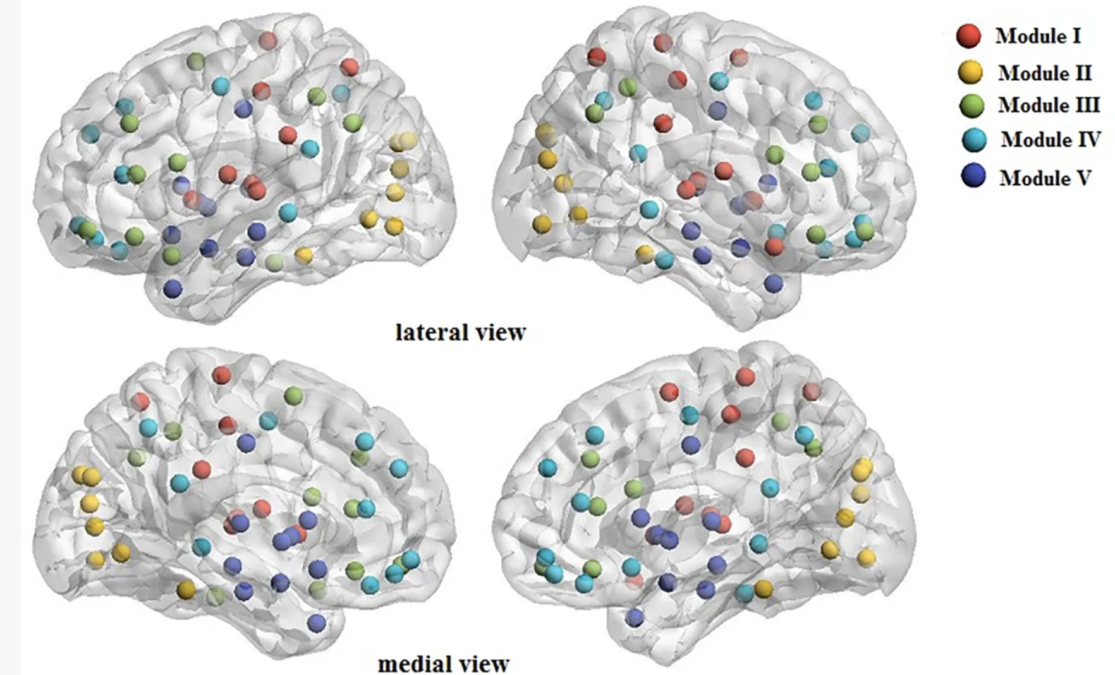
The researchers defined five modular structures of brain functional networks. (Zhang et al., Front. Psychiatry, 2026)
Taken together, the findings indicate that the conditions may have certain disrupted brain-communication patterns in common, though schizophrenia is linked with more widespread alterations. They do not establish that either condition has one single 'wiring fault', or that these observed brain patterns cause the disorders.
What the findings can and cannot show
The results align with evidence that psychiatric diagnoses do not necessarily sit in entirely distinct biological categories. A recent large genetic analysis concluded that schizophrenia and bipolar disorder have about 70 percent of their genetic influences in common.
Earlier research has also identified abrupt waves of shifting brain connectivity, called 'brainquakes', in people with schizophrenia and bipolar disorder. This study offers a different view of functional networks that may overlap between the diagnoses.
"Underlying network abnormalities may function as biomarkers for diagnosis, prognosis, treatment guidance, and ongoing treatment evaluation," the researchers write.

At present, however, these scans cannot diagnose an individual. Since the study recorded brain activity at a single point in time, it cannot determine whether the differences were present before illness started or instead developed because of the conditions or their treatment.
After statistical correction, the network measurements did not significantly correlate with the severity of participants' symptoms. The sample was relatively small, participants were at varying stages of illness, and medication may have affected their brain activity.
The analysis also used a relatively broad brain map and assigned networks using categories selected beforehand. Such methodological choices could have influenced the patterns identified by the researchers.
Related: Unprecedented: Scientists Have Built Miniature Brains That Experience The Passage Of Time
Future larger studies will need to track people from their first episode, preferably before medication starts, to establish whether these brain signatures are stable, vary with symptoms or predict responses to treatment.
For the moment, the findings suggest a shared decline in co-ordination across the brain's communication networks, alongside more extensive differences in schizophrenia. This could help account for some biological overlap between the two diagnoses, but it is not yet a clinical test.
The study was published in Frontiers in Psychiatry.
This article was fact-checked and edited by Rebecca Dyer. While we pride ourselves on our process, we are only human. If you spot a mistake, please let us know.






Comments
No comments yet. Be the first to comment!
Leave a Comment