

Your phone probably contains thousands of photographs right now – and you may scarcely ever revisit them.
There are party selfies, brunch plates arranged just so for Instagram, and your cat asleep in marginally different poses. Then come sunsets, supermoons, and holiday pictures.
How taking photos can affect memory
We often take photographs to help preserve an event or experience in our minds. Yet pausing to take a selfie may actually undermine your memory of what happened.
It seems unintuitive: a visual prompt should surely make an experience easier to remember in detail. However, a growing body of research repeatedly indicates otherwise.
New research published in Memory & Cognition provides further support for this finding. Across seven experiments, taking screenshots consistently weakened participants' memories.
"The results of the current study suggest that we are likely harming our memory for information and experiences with the press of a button, and that this impairment may even extend beyond what is captured," says Sophia Fabrizio, a psychologist at Binghamton University.
The notion that taking photographs can diminish our capacity to remember is not new; studies have observed the effect for decades. Precisely why this so-called 'photo-taking impairment effect' happens, however, is still uncertain.
Researchers have put forward several possible reasons. Under one explanation, operating a camera or phone splits your attention, or distances you from the activity around you. As a result, your brain may devote fewer resources to encoding the event itself as a memory.
The principal theory, however, is known as cognitive offloading. In short, the brain may invest less effort in retaining something when it recognises that the memory has already been saved as a photograph.
It appears not to matter whether that choice is conscious or unconscious.
This resembles the 'Google effect': why store information mentally when it can be found online within seconds? It is also why many people no longer properly memorise telephone numbers, relying instead on the contacts stored on their phones.
Screenshotting experiments and memory tests
To examine these possibilities, the Binghamton researchers studied 892 participants in seven experiments, separating out different elements of the effect. Nevertheless, the overall findings were similar in every experiment.
After taking images, participants repeatedly did worse in memory tests.
For the first experiment, participants viewed 44 images of artworks on their phones. For each image, they were instructed either to take a screenshot or simply to look at it. Following a 10-minute distraction task, they completed a memory test that required them to pick out the original image they had seen from three similar versions.
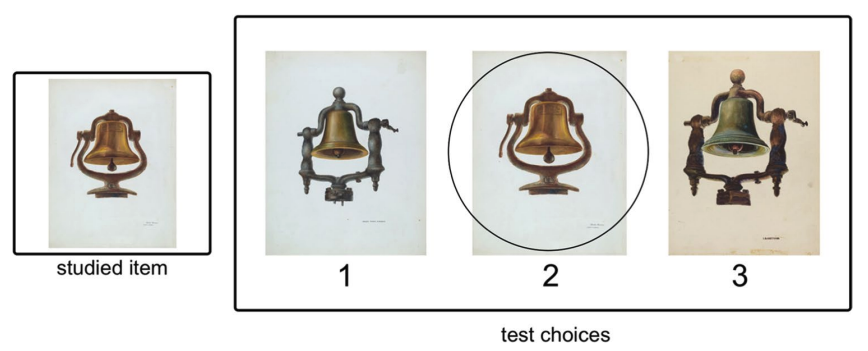
An example of a question on the memory test portion of the experiment. (Fabrizio et al., Mem. Cogn. , 2026)
Participants performed consistently less well for images they had screenshotted than for those they had only viewed.
The second experiment examined whether there might be a trade-off: some advantage that offset the poorer memory. At the end of the memory-test stage, researchers added a question asking participants whether they remembered viewing or screenshotting each image.
Once more, participants retained less information about screenshots than about images they had merely viewed.
Several subsequent sets of experiments considered whether those cognitive resources might instead have been directed elsewhere. The scientists asked participants to complete maths problems or memory tasks that had no connection to the images.
Yet there was little evidence that people who took screenshots performed better than people who only viewed the images.
Does cognitive offloading explain the screenshot effect?
In later experiments, the team investigated the outcome when participants were explicitly told that their memory of the images would be tested, and that they would be able to review their screenshots.
Some participants were informed that the test would take place within 30 minutes, while others were told they would return a month later to complete it. In fact, both groups took the test 10 minutes after their image-viewing session.
The researchers predicted that participants expecting a longer wait before the test would depend more heavily on cognitive offloading than those anticipating an immediate test.
Interestingly, though, the two groups showed little difference. Participants in both continued to display poorer recall of screenshotted images than of images they had viewed.
"In sum, the present study suggests a pronounced memory impairment associated with screenshotting, with only modest benefits to subsequent learning observed under very circumscribed conditions and measures of memory performance," the study authors conclude.
Related: Ghosts of 'Forgotten' Memories May Linger in The Brain, Study Suggests – And Could Even Be Restored
It is a complex field of research. After all, other studies suggest that taking photographs can help memory.
Still, the findings may be enough to make you pause the next time you reach for your phone to take a photograph.
Few people are likely to mourn the loss of memorising telephone numbers. But the possible cost seems far more personal if excessive picture-taking impairs our ability to recall life milestones such as weddings, birthdays, and holidays.
The research appeared in Memory & Cognition.
This article was fact-checked by Rachel Garner and edited by Rebecca Dyer. Although we take pride in our process, we are only human. If you notice an error, please let us know.






Comments
No comments yet. Be the first to comment!
Leave a Comment