

The Flemish APP mutation and Alzheimer's disease
Alzheimer's disease is exceptionally difficult to investigate, owing both to its complexity and to the many ways it can differ from one patient to another.
One form of Alzheimer's has been identified in just two families and two additional people. It is linked to the Flemish amyloid-beta precursor protein (APP) mutation.
This genetic variation affects the amyloid-beta (Aβ) protein plaques that build up in the brains of people with Alzheimer's.
The mutation results in an unusually pronounced build-up of Aβ in and around the brain's blood vessels.
For those with the mutation, these deposits produce a condition known as cerebral amyloid angiopathy (CAA), which is linked to brain haemorrhages and usually death in the late 50s.
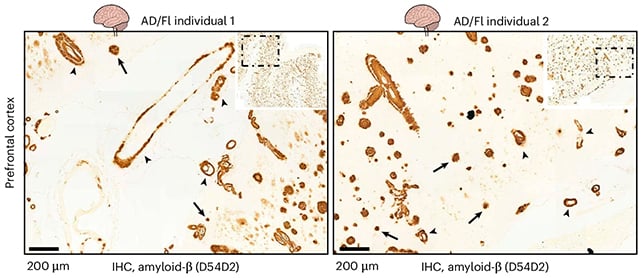
The researchers began with brain samples from two Alzheimer's patients; arrows identify amyloid-beta filaments. (Khaki et al., Nat. Struct. Mol. Biol. , 2026)
An international research group has now established the distinctive manner in which Aβ filaments fold in people with this Alzheimer's variant, reporting the findings in Nature Structural & Molecular Biology.
The scientists also found how these folded forms influence the disease, potentially opening up fresh possibilities for targeted therapies.
"Together, our structural and cellular data define a familial Alzheimer-disease-associated amyloid fold and provide insight into the molecular basis of Flemish-type dementia and cerebral hemorrhage," write the researchers in their published paper.
How the Flemish APP mutation changes Aβ filaments
The team examined post-mortem brain-tissue samples from two people who had died with Alzheimer's: one person from each of the two Flemish families known to have this dementia type.
Using cryogenic electron microscopy (cryo-EM), an imaging method with resolution approaching the ability to view individual atoms, they uncovered the folding pattern caused by the Flemish APP mutation.
In this instance, the proteins took on a particular Z-shaped fold never previously observed. This helps account for why its Aβ filaments gather around blood vessels: the configuration exposes a particular amino acid, the F20 residue, which the researchers believe enables the filaments to interact with components of blood-vessel walls.
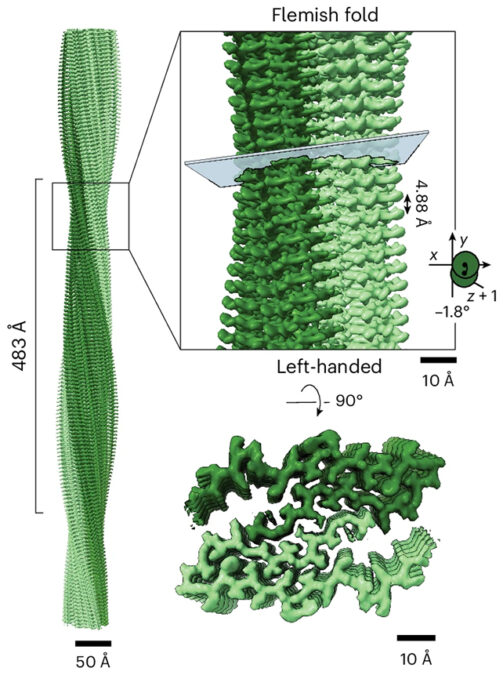
The protein's distinctive folding arrangement changes the filaments it produces. (Khaki et al., Nat. Struct. Mol. Biol. , 2026)
The researchers further determined how this shape emerges. The mutation eliminates one methyl group from Aβ, apparently making formation of this fold more likely.
"Our results reveal how loss of a methyl group at residue 21 gives rise to an Aβ fold with vascular tropism and provide structural insight into the mechanisms underlying Flemish-type progressive dementia and cerebral hemorrhage," write the researchers.

Earlier research has found that the Aβ protein forms generated by this mutation are less prone to clumping than other kinds. Yet, once they begin accumulating, they inflict damage equal to that seen in typical Alzheimer's – perhaps because of their interactions with blood vessels.
"Despite its reduced aggregation propensity in vitro, the Flemish (A21G) mutation produces Aβ assemblies that are as neurotoxic as those formed by wild-type Aβ and, in vivo, leads to the largest and most stable plaque cores observed in Alzheimer's disease," write the researchers.
What the findings could mean for Alzheimer's research
There is much to unpack, but the work marks significant progress in understanding this uncommon form of Alzheimer's: specifically, how the associated genetic variant alters the way Aβ proteins collect and subsequently damage the brain in this highly particular manner.
The implications may extend further. Understanding the protein clumps so characteristic of Alzheimer's – their forms and their actions – is essential for developing treatments for every form of the condition.
Next, scientists need to determine precisely how this newly identified fold may contribute to the brain damage that results in dementia, which biological mechanisms are involved, and how these processes may connect with Alzheimer's disease more broadly.
Related: The Tragic Case of The Youngest Person Ever Diagnosed With Alzheimer's
"Future studies should address whether the Flemish fold alters seeding, propagation or neurotoxicity in cellular or animal models, and whether similar structural principles underlie other hereditary and sporadic forms of Alzheimer's disease," write the researchers.
The study appears in Nature Structural & Molecular Biology.
This article was fact-checked and edited by Peter Dockrill. Although we take pride in our process, we are only human. If you notice an error, please let us know.





Comments
No comments yet. Be the first to comment!
Leave a Comment