

Alzheimer’s disease, sleep and microglia
Alzheimer’s disease is exceptionally difficult to investigate, presenting scientists with an intricate web of risk factors, causes and symptoms that must be disentangled. Sleep is a clear example of this complexity.
Poor sleep is known to increase the risk of Alzheimer’s, while the condition itself disrupts ordinary sleep processes. Working out precisely which factors contribute to these effects, and which result from them, remains challenging.
A new study led by University of Kentucky researchers, published in Alzheimer’s & Dementia, may bring greater clarity to the relationship between Alzheimer’s and sleep.
The team identified microglia, the brain’s immune cells, as possible drivers of sleep loss in people with Alzheimer’s. As the disease progresses, these cells may place the brain in a heightened state of alertness that interrupts natural rest.
This moves attention away from the toxic amyloid-beta protein clusters that accumulate in the brain as Alzheimer’s disease advances. In terms of disturbed sleep, the plaques may be the spark that starts the process rather than the source of the direct harm.
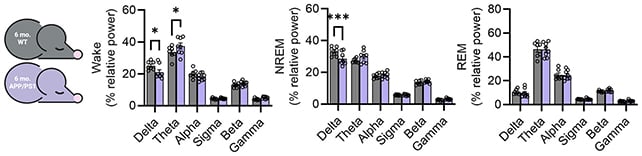
The researchers examined how amyloid-beta plaques (purple) influenced sleep quality via brainwave frequencies. (Constantino et al., Alzheimer’s & Dementia, 2026)
"Basically, we showed that it is not the plaques themselves, or solely dysfunctional neurons, that cause sleep loss but actually microglia," says physiologist Shannon Macauley from the University of Kentucky.
"Microglia are immune cells that, when they respond to plaques, kick off this elaborate cascade of inflammation, as if the microglia are partying all night, and keeping the brain awake."
How the Alzheimer’s mouse study tracked sleep
For the research, the scientists compared two groups of mice: one genetically modified to develop amyloid-beta plaques similar to those seen in Alzheimer’s patients, and a healthy control group.
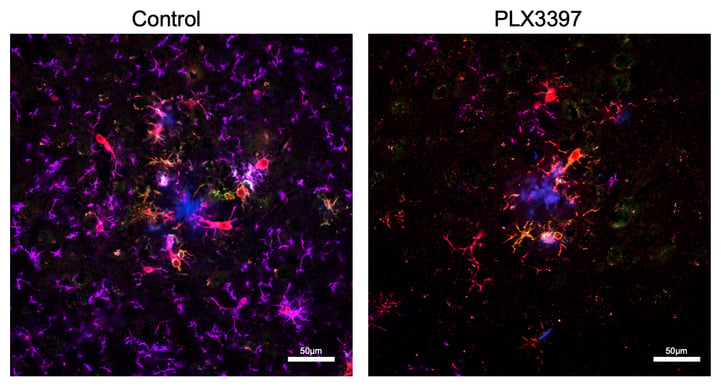
Brain-tissue scans showing the impact of switching off immune cells (right) on microglia and amyloid plaques. (Nicholas Constantino)
The animals’ sleep cycles, brain activity and amyloid-beta plaque accumulation were tracked at six months of age, when the disease was only beginning, and again at 18 months, when it was well established.
The results indicated that the onset of plaques immediately deprived the mice of 1.5-2 hours of sleep each night. The effect remained the same from six to 18 months, despite a substantial increase in accumulated plaque during that period.
"I expected that as plaque burden became more severe, sleep disruption would also worsen," says neuroscientist Nicholas Constantino from the University of Kentucky.
"The disruptions in sleep and cortical EEG activity that occur at six months, when plaques first emerge, did not worsen by 18 months, despite more than double the amount of plaque burden."
In a follow-up experiment using another group of mice and a similar approach, the researchers administered doses of drugs that block microglia.
This produced the study’s key result: stopping the microglia response provided the Alzheimer’s mice with an additional two hours of sleep each night, lengthening their restorative sleep periods.

"That restorative sleep is super important for physical repair, learning and memory and washing out the toxins of the day," says Macauley.
"When Alzheimer's patients lose this stage, they lose their brain's primary cleaning cycle, creating a feed-forward loop that may drive further damage."
The drug doses did not alter the amyloid-beta plaques, which remained unchanged. Previous suggestions have held that poor sleep in Alzheimer’s patients is caused by either the death of brain neurons or the build-up of amyloid-beta proteins.
Microglia as a possible Alzheimer’s treatment target
Addressing sleep disruption via microglia could offer some progress towards slowing or limiting Alzheimer’s.
Much work is plainly still required: the approach has so far been tested only in mice, and eliminating an entire population of immune cells in the brain is not a realistic option. Any prospective treatments would probably aim to settle microglia down, rather than remove them.
Related: Alzheimer’s Brains Contain a Previously Unknown Plaque, Study Finds
Also notable are the data gathered from the mice across time. At the six-month point, the researchers detected early changes in the brain that could eventually help identify Alzheimer’s progression in advance.
"Portable EEG systems could allow us to monitor people in their home environments and potentially screen for changes associated with Alzheimer's disease, without the initial need for expensive or invasive tests," says Macauley.
The research has been published in Alzheimer’s & Dementia.
This article was fact-checked by Rachel Garner and edited by Peter Dockrill. Although we take pride in our process, we are only human. If you notice an error, please tell us.






Comments
No comments yet. Be the first to comment!
Leave a Comment