
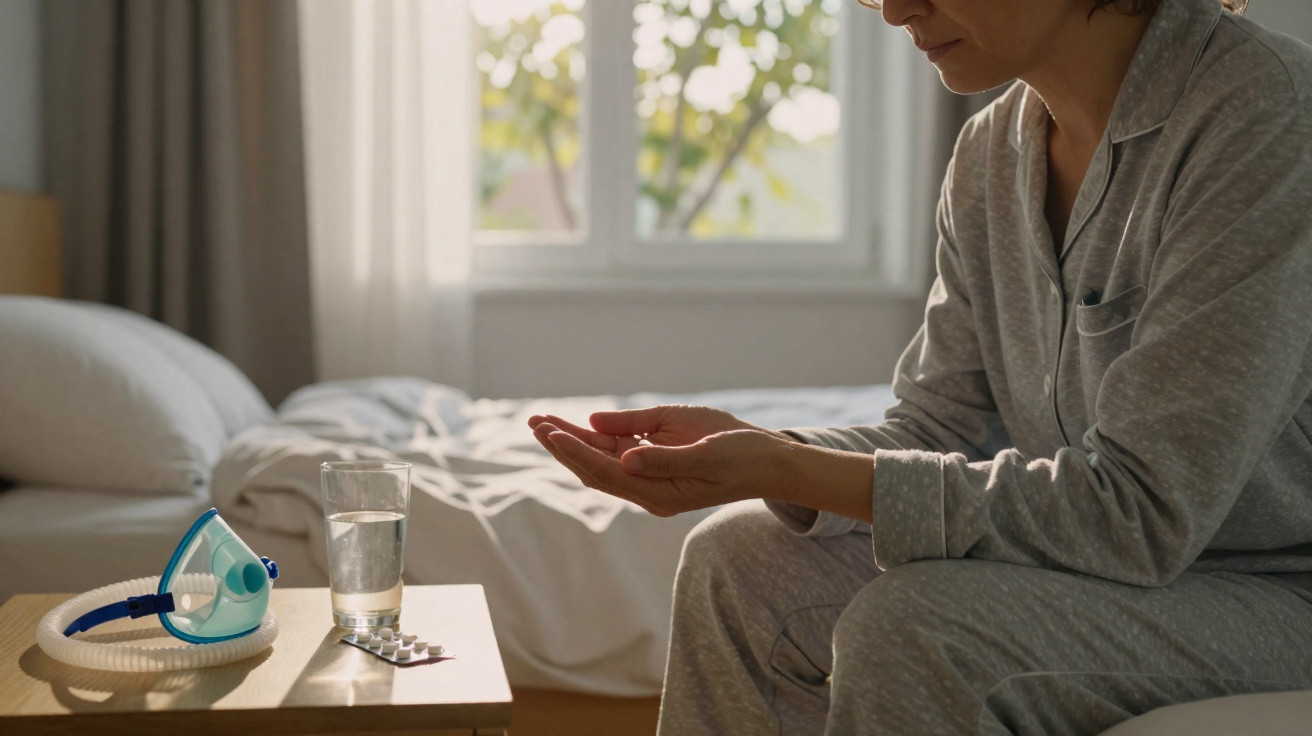
Until now, the assumption was clear: anyone with moderate to severe sleep apnoea would almost inevitably end up using a CPAP mask. This device keeps the airways open with positive pressure, saves lives, but is an everyday burden for many people. Now, a European study suggests that a well-known epilepsy tablet may substantially reduce the condition – potentially challenging an entire era of treatment.
A familiar medicine with a new purpose
The focus is Sulthiame, an active substance used in epilepsy treatment for years. The European Phase 2 trial, called FLOW, examined whether it could also counter breathing interruptions during sleep.
The study involved 298 adults with moderate to severe obstructive sleep apnoea. It ran for 15 weeks across five European countries. Some participants received Sulthiame at different doses, while others were given a placebo.
At the highest Sulthiame doses, the average number of nighttime breathing pauses fell by up to 47 per cent – a notable effect for a tablet-only treatment.
Blood oxygen levels during sleep improved at the same time. This is central to sleep apnoea: repeated drops in oxygen place strain on the heart, circulation and brain, increasing the long-term risk of high blood pressure, heart attack and stroke.
What sleep apnoea does to the body
Obstructive sleep apnoea occurs when the upper airways repeatedly narrow or close completely during sleep. The individual snores, struggles for breath, briefly wakes up or slips into lighter sleep – often with no conscious recollection afterwards.
- Repeated arousal responses disrupt the architecture of sleep.
- Blood oxygen levels fall again and again.
- The heart has to work against major pressure fluctuations.
- The body's stress system remains persistently activated.
During the day, many people experience the consequences very directly: pronounced tiredness, difficulty concentrating, morning headaches, irritability, and a greater risk of accidents while driving or at work.
Why so many people struggle with the CPAP mask
CPAP therapy, meaning Continuous Positive Airway Pressure, is currently considered the gold standard. A pump delivers air at mild positive pressure through a mask over the nose or mouth, keeping the airways open. In theory, it is close to ideal. In practice, the picture is different.
Almost one in two people stops using the device within the first year. The reasons are very human:
- The sensation of having something foreign on the face
- Pressure marks or skin irritation caused by the mask
- Pump noise that disturbs partners
- A sense of dependence: no sleep without the device
Many patients then use their CPAP mask only intermittently, with correspondingly limited benefit. An effective tablet that is simply swallowed with water in the evening can therefore seem like a promise of a more normal life.
How Sulthiame works during sleep
Pharmacologically, Sulthiame belongs to the group of carbonic anhydrase inhibitors. Put simply, it alters how the body detects and responds to carbon dioxide and oxygen. This concerns a technical but crucial issue: the stability of breathing regulation.
Loop gain – when breathing regulation overreacts
In many people with sleep apnoea, the feedback system controlling breathing and blood gases is overly sensitive. Specialists call this high “loop gain”. It creates an escalating pattern:
- CO₂ levels rise slightly.
- The body responds with excessive hyperventilation.
- CO₂ levels then drop sharply.
- The breathing centre reduces breathing activity – potentially until an apnoea occurs.
This is precisely where Sulthiame acts. It makes the system slower and more stable. The breathing response becomes less extreme, CO₂ levels fluctuate less, and the cycle of hyperventilation and breathing pauses is interrupted.
The study suggests that sleep apnoea can be influenced not only mechanically with masks, oral appliances or surgery, but also directly through breathing regulation.
Earlier research also indicated that Sulthiame may improve muscle tone in the upper airway. This could make it less likely that the throat simply collapses during sleep.
Limits: it addresses only part of the problem
As impressive as a 47 per cent reduction may sound, there are several caveats. Obstructive sleep apnoea results from several interacting mechanisms. Specialists generally identify four key areas:
| Mechanism | Role in sleep apnoea |
|---|---|
| Unstable breathing control | Overreaction to CO₂/O₂ fluctuations, encouraging apnoea cycles |
| Upper-airway anatomy | A narrow throat, large tongue, or fatty tissue around the neck |
| Neuromuscular control | Weak muscle tone, with throat muscles relaxing too much |
| The brain's arousal threshold | Some people wake very early, while others respond much too late to breathing problems |
Sulthiame primarily targets unstable breathing control. Anatomical and neuromuscular factors are affected only to a limited extent. This was evident in an earlier, shorter trial: breathing measures during sleep improved, but daytime sleepiness and perceived quality of life did not change at that point.
In addition, FLOW was a Phase 2 study. Trials at this stage are chiefly intended to establish which dose is appropriate and tolerable. Much larger and longer studies are needed before firm conclusions can be drawn about long-term effectiveness, safety and real-world daily benefits.
Side effects: usually mild, but not to be overlooked
Sulthiame was not entirely free of side effects in the trials conducted so far. Participants most commonly reported paraesthesia – altered sensations such as tingling or mild numbness in the hands, feet or face. In the available data, these symptoms appeared mainly temporary and relatively harmless.
Even so, the issue remains how readily patients will accept treatment over the long term. A pill that halves breathing interruptions but causes persistently tingling hands may quickly be left in the cupboard by some people in real life.
More than one tablet: an entire drug toolkit is emerging
Sulthiame is not the only contender in the search for drug-based sleep apnoea treatment. Several medicine combinations are aimed at different aspects of the condition.
AD109: targeting the throat muscles
The company Apnimed is developing the combination AD109, which brings together aroxybutynin and atomoxetine. The aim is to keep throat muscles more active at night so that they relax less. AD109 therefore clearly targets neuromuscular weakness in the upper airways.
Apnimed plans to submit an approval application to the US Food and Drug Administration (FDA) in early 2026. If successful, it could open a completely new chapter in sleep medicine: rather than “one mask for everyone”, there could be several tablet options for particular patient types.
IHL-42X: established substances in a new combination
Another candidate is IHL-42X from Incannex Healthcare. It combines two established active substances that have long been used in other areas. The treatment has already reached a Phase 2 trial. Here, too, the objective is to markedly ease sleep apnoea without a mask.
Tirzepatide: an indirect route through weight loss
Since late 2024, Tirzepatide, marketed as Zepbound, has even been the first officially approved medicine specifically for obstructive sleep apnoea – although only for patients with obesity. The active substance is primarily known from obesity treatment and often produces substantial weight loss.
Less fatty tissue around the neck and abdomen reduces pressure on the airways. Its effect on sleep apnoea is therefore indirect, arising through weight reduction. Tirzepatide currently has no role for people of normal weight or those who are only slightly overweight.
Sleep medicine is changing: from a one-size-fits-all solution to precision treatment
Taken together, these developments point to a fundamental shift in approach. Until now, the CPAP mask has been central as the standard solution. All other treatments – from mandibular advancement devices to operations on the throat and nose – have occupied more of a niche role.
In future, treatment could be far more personalised: identifying the dominant mechanisms, using targeted medicine combinations, and adding a mask, oral appliance or weight reduction where appropriate.
In practice, this might look like the following:
- Person A, with pronounced unstable breathing control and normal weight, benefits substantially from Sulthiame.
- Person B, with a large neck circumference, weak throat muscles and mild obesity, receives a combination of AD109 and a weight-loss medicine.
- Person C, with very severe anatomical problems, continues using CPAP but also takes a medicine that lowers the pressure setting needed, making the mask more comfortable.
Medicines and technology would therefore complement rather than compete with each other. For many people, this could mean wearing the mask less often, or using it at a lower pressure.
What patients can do with this information today
People currently living with sleep apnoea cannot simply be prescribed Sulthiame yet. The evidence comes from Phase 2 research, and it has not been approved for this indication. That could change if larger trials confirm the effects seen so far.
Even now, however, it is worthwhile to understand one's own sleep apnoea profile. Specialist sleep laboratories are increasingly able to assess which mechanisms dominate in an individual case. This will make access to tailored treatment combinations easier in the future.
At the same time, the current situation remains fairly pragmatic: anyone offered CPAP should give it a serious trial and work with their sleep specialist on fit, mask choice and settings. Every night of effective treatment lowers the risk of cardiovascular problems and demonstrably improves quality of life.
Terms that often raise questions
Many of the technical terms in this debate initially sound abstract. Two occur particularly often for people affected by the condition.
Apnoea-hypopnoea index (AHI)
The AHI measures how often breathing stops completely, known as apnoeas, or becomes substantially reduced, known as hypopnoeas, per hour of sleep. It indicates the severity of the condition:
- 5–15: mild sleep apnoea
- 15–30: moderate sleep apnoea
- over 30: severe sleep apnoea
The 47 per cent reduction in the FLOW study refers specifically to this measure: depending on the dose, it fell by almost half on average.
Daytime sleepiness
Alongside technical measures, it also matters how tired someone feels during the day. Scales such as the Epworth Sleepiness Scale help assess this. In the initial Sulthiame studies, this subjective sleepiness changed very little. That demonstrates how complex the relationship is between breathing measures, sleep architecture and daytime wellbeing.
Risks, opportunities and the outlook for the next few years
Medicines for sleep apnoea may sound convenient, but they bring their own risks. Interactions with existing treatments, along with effects on metabolism, blood pressure or mental health, must be properly studied in large patient groups. Safety issues are especially important because this would generally be a long-term treatment for a chronic condition.
On the other hand, tablets may help where mechanical approaches alone do not work optimally: for example, in people with highly sensitive breathing control or those who firmly reject a mask. A realistic scenario in a few years' time is that GPs and sleep centres prescribe tiered medicine combinations, routinely review sleep data from wearables or home devices, and adjust treatment dynamically.
For many people affected, this brings closer a daily life in which they are no longer connected to a machine every night, but instead sleep with an individually tailored mix of medication, lifestyle measures and, where necessary, modern technology. Sulthiame is not the final answer, but rather the starting signal for an entirely new generation of treatments.





Comments
No comments yet. Be the first to comment!
Leave a Comment