
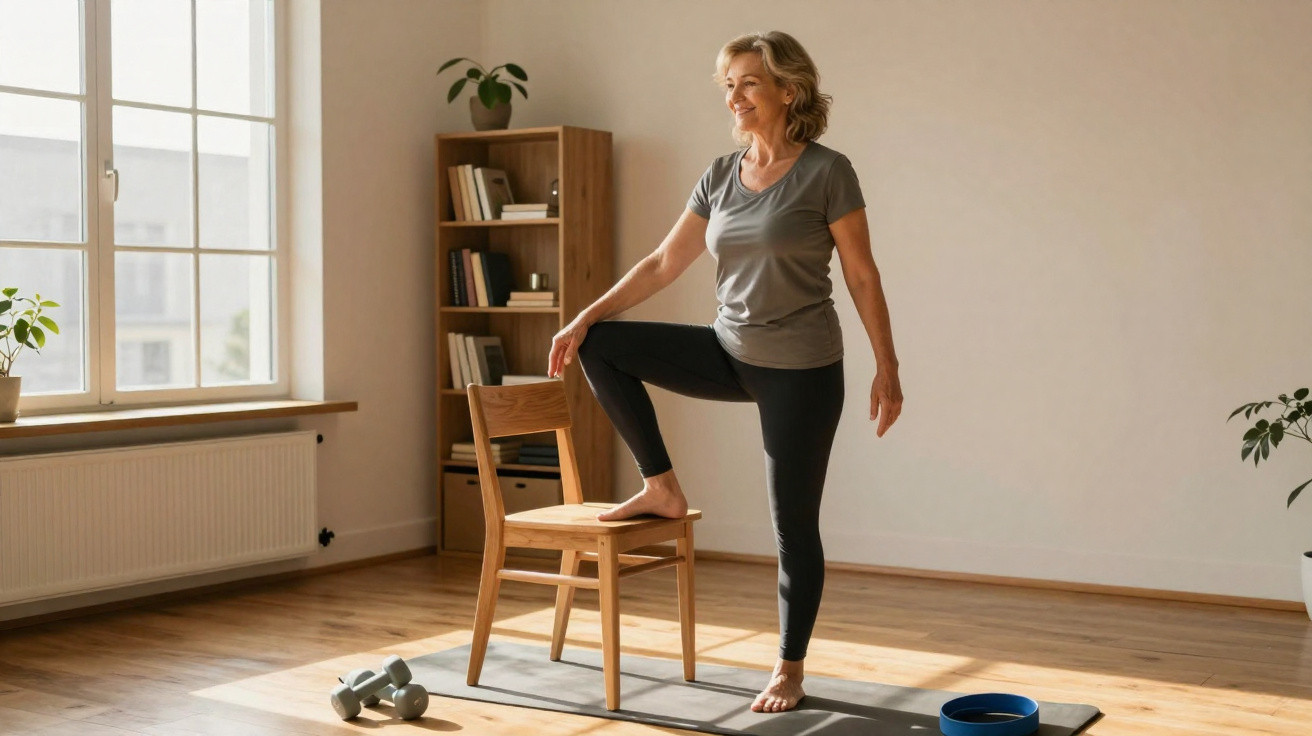
Exercises to improve balance after the age of 65 are among the most effective ways to protect independence, lower the likelihood of falls and maintain confidence in everyday activities. As people age, natural bodily changes can affect stability; however, straightforward movements performed at home can build the supporting muscles and stimulate the vestibular system, which is responsible for spatial orientation. Practised consistently, these exercises can improve coordination and make movement safer.
Why does balance decline with age?
Ageing naturally brings changes to the muscles, joints and vestibular system. Together, these factors can make it harder for the body to respond quickly when position changes, raising the risk of trips and falls.
A gradual loss of strength in the lower limbs can also affect stability during ordinary tasks, including walking, climbing stairs and getting up from a chair. This is why focused balance training becomes particularly valuable at this stage of life.
What are the best exercises to improve balance after the age of 65?
Certain movements are especially useful because they work on coordination, muscular strength and body awareness at the same time. They can be done at home without complicated equipment and can deliver excellent results when practised regularly.
To show how to include this routine simply and safely in daily life, physiotherapist Dr Kelwin Juan (@fisioterapiacomkelwinjuan) has produced a practical video guide demonstrating each movement step by step. Watch below:
How can these exercises help prevent falls?
Each movement activates important systems involved in bodily stability. Support-based exercises challenge the vestibular system, while strength movements develop the legs, hips and core muscles.
The main benefits associated with regular practice include:
- Improved motor coordination while moving about.
- Greater muscular strength in the areas that support the body.
- Faster reactions when unexpected loss of balance occurs.
- More confidence when walking and carrying out daily activities.
- A lower risk of falls and related injuries.
What is the ideal frequency for faster results?
For most people, the guidance is to perform the exercises three to five times a week. Short sessions of around 15 to 20 minutes are generally enough to encourage positive adaptations without causing excessive fatigue.
It is also essential to work within your own fitness level. Those starting out can use a chair or wall for support until they feel more secure. As stability improves, the level of difficulty can be increased gradually. Combining consistency, suitable progression and correct movement technique is what makes it possible to improve balance more quickly and remain independent for longer.






Comments
No comments yet. Be the first to comment!
Leave a Comment