
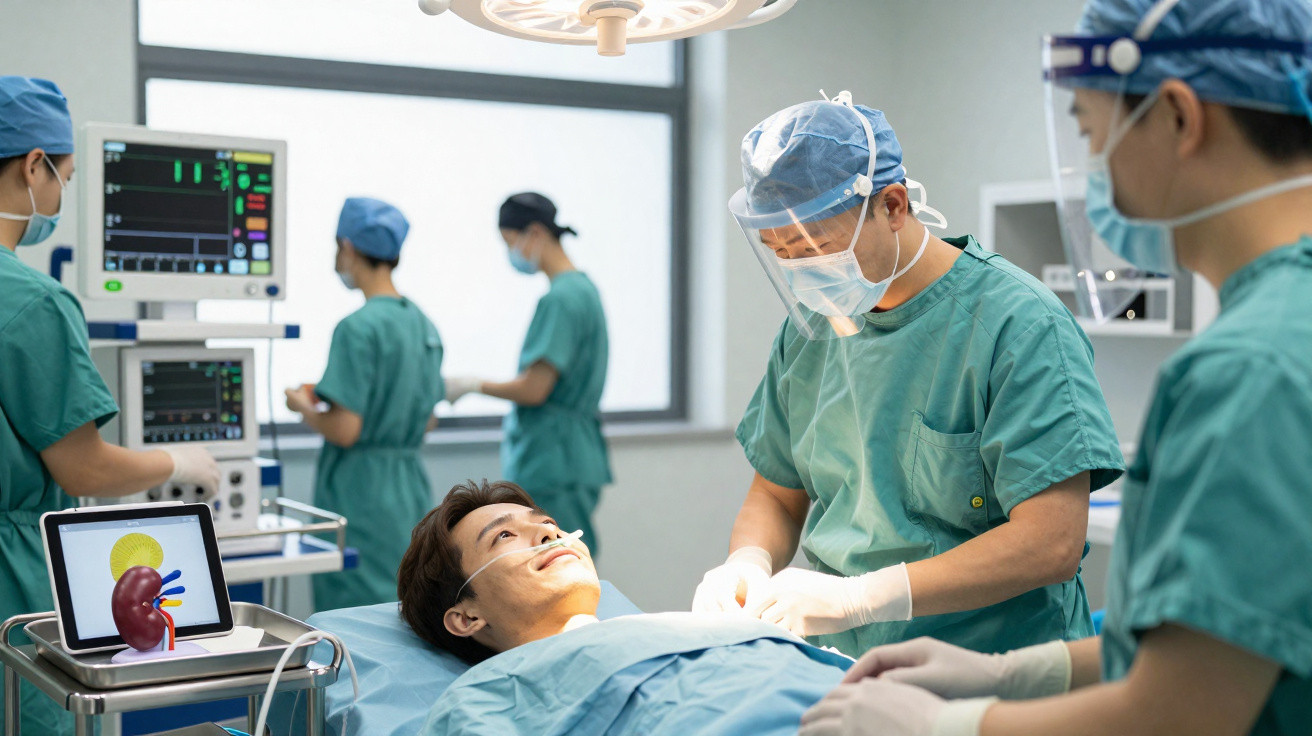
“I saw everything,” recalls Harry Stackhouse, 74, from Illinois, who remained conscious during his recent kidney transplant. While speaking with doctors, looking at the donated organ and watching the surgical team close the incision with staples, he experienced no pain.
Stackhouse left Northwestern Medicine only 36 hours after the operation. The hospital system hopes to make kidney transplants performed without the risks of general anaesthesia routine.
The procedure, completed in just over an hour on 15 July, was the second of its kind led by Satish Nadig, director of the Chicago-based hospital system’s Comprehensive Transplant Center. Nadig has since performed a third operation.
“We’re at an inflection point in transplantation today in being able to use the technologies that we have around us to really push us into this next era,” Nadig told AFP.
Although the prospect may seem unsettling, or even frightening, the health advantages of using a spinal anaesthetic during kidney transplantation are already well documented. The approach is similar to that used for caesarean sections.
General anaesthesia involves intubation, which may harm the vocal cords, slow the return of bowel function and lead to “brain fog” that can linger, especially among older people.
Medical studies have recorded a handful of awake kidney transplants in several countries over recent decades, yet the method has never gained widespread acceptance.
Nadig notes that this year is only the 70th anniversary of the first successful human kidney transplant from a living donor, and that doctors have been hesitant to depart from established practice.
“However, now the outcomes for kidney transplantation are fantastic and it’s time that we question the paradigms that we have historically stuck to.”
Life restoring
A father of six who formerly worked as a painter and decorator, Stackhouse says he became unwell in December 2019 with flu-like symptoms. His condition deteriorated until he could scarcely walk.
Several months afterwards, he went to A&E and discovered that he had contracted COVID-19 during the pandemic’s perilous early period. One kidney had failed, while the other was working at just two per cent.
He accepted that he would need dialysis three times a week. However, when the access ports began to fail and his veins started closing, his daughter, Trewaunda, encouraged him to pursue a transplant and offered to be tested as a donor.
Stackhouse was initially unwilling to “intrude” on the lives of his children, but he eventually consented.
Northwestern Medicine’s AWAKE Kidney Program
Following a meeting with Nadig, Stackhouse learnt about the AWAKE Kidney Program, which uses accelerated kidney transplantation surgery without general anaesthesia. He chose to undergo the operation.
“Believe it or not, I didn’t feel a thing – it was amazing,” Stackhouse told AFP.
He talked with the clinical team throughout the surgery. When a doctor offered to show him the donor kidney, he immediately agreed. “Man, I didn’t think a kidney is that big!” he exclaimed.
Because of his age, Stackhouse was discharged 36 hours later. This was slightly longer than Nadig’s first awake-transplant patient, who went home 24 hours after surgery in May, but far shorter than the US average stay of five to seven days for patients who receive sedation.
Who will be eligible?
Nadig attributed the outcome to developments including precisely targeted anaesthetic blocks in the abdomen and spine, avoiding opioid narcotics and encouraging patients to eat early. Even before the AWAKE programme was launched, these measures had helped Northwestern Medicine reduce the average time patients spent in hospital.
Stackhouse has recovered extremely well. He says he is walking, cutting the grass and getting his boat ready for a long-delayed fishing trip. His recuperation was even quicker than that of Trewaunda, 45, who had general anaesthesia.
“It’s just a gift that you can give someone, just to think where he was spiraling to, it wasn’t looking good,” the pre-school teacher told AFP. “You’re restoring somebody’s life.”
Christopher Sonnenday, director of the Transplant Center at University of Michigan Health, commended the Northwestern Medicine team for their “important innovation in our field.”
“Limiting exposure to general anesthesia has been shown to accelerate recovery across all surgical disciplines, and I am certain that benefit may be realized in kidney transplantation as well,” he told AFP.
Further experience will establish how widely these operations can be used, including whether they can be offered to people with underlying conditions such as obesity or heart disease.
© Agence France-Presse





Comments
No comments yet. Be the first to comment!
Leave a Comment