
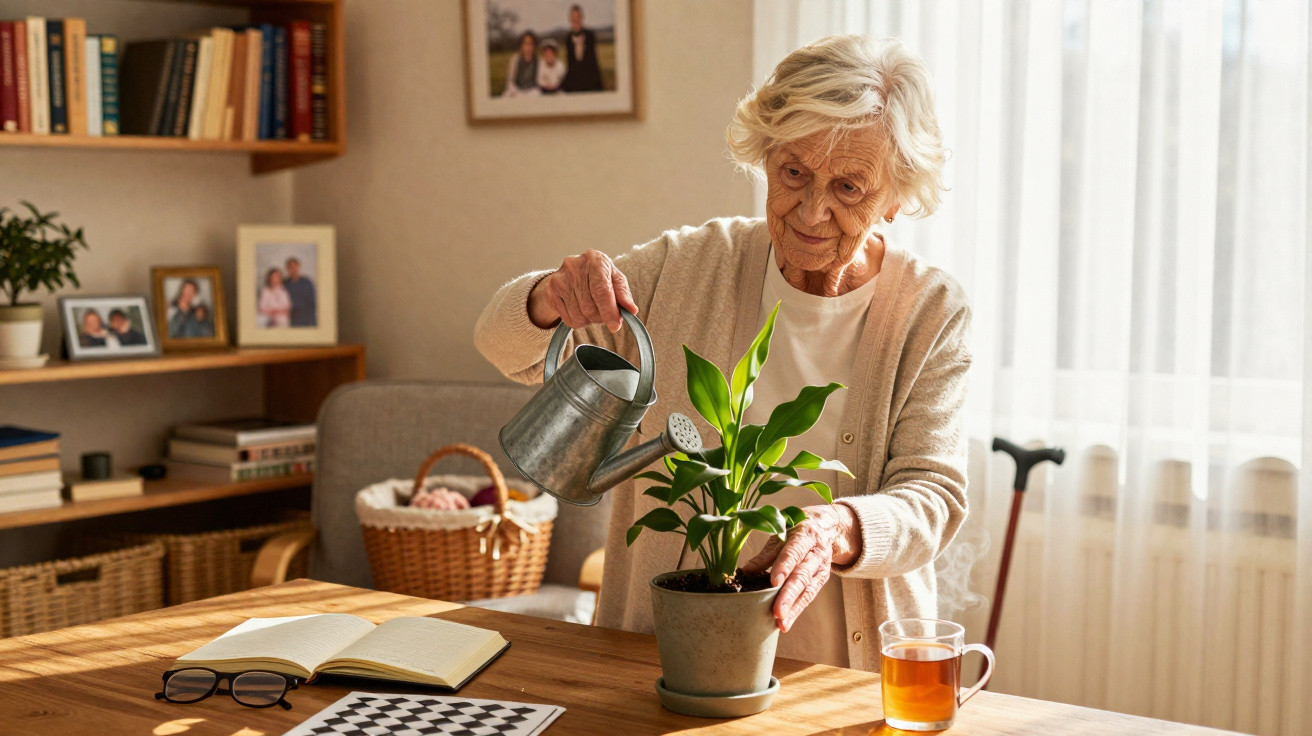
At 7 a.m., the kettle starts whistling in a compact kitchen with a faint scent of toast and lavender furniture polish. Edith, who celebrated her 100th birthday last spring, steadies herself against the worktop rather than a walking frame and drums her fingers against her mug. Delivery vans rumble along the road outside, while an old jazz standard she still knows word for word hums from the radio indoors.
Her cardigan is misbuttoned by one hole, and she laughs as soon as she spots it. “I’m not an Instagram grandmother,” she grins. Still, she stands tall, her gaze is alert, and there is no care-home leaflet anywhere in view. She gestures towards the window boxes she tends herself, the carefully piled newspapers and the handwritten calendar attached to the fridge.
“This,” she says, indicating the busy contents of her own life, “is why I’m still here.” She is not talking about the flat.
The quiet rituals that keep a 100-year-old active
At first, Edith’s day appears entirely unremarkable. She gets up, gets dressed and makes tea. Yet she never hurries, and she leaves very little wholly to accident. Her habits are not rigid rules so much as soft guardrails, stopping the day from veering off course.
Each morning, she draws the curtains herself, even if her knees object. Before breakfast, she walks the hallway three times, trailing her fingertips gently along the wall, “just to oil the joints.” Following lunch, she has her “standing news”: she listens to the midday radio bulletin while upright at the sink, folding dishcloths.
Individually, these habits may seem insignificant. Over decades, they amount to something more.
Edith is not an unusual example. Researchers studying people who live beyond 90 and 100 in Okinawa, Sardinia and areas of southern France repeatedly identify a similar pattern. The answer is not miracle supplements or flawless genes, but everyday movement woven into life as naturally as background music.
A study of “blue zone” centenarians showed that they were not relentlessly running on treadmills. They gardened, walked to see neighbours, knelt to pray and rose from the floor without giving it a second thought. Edith’s hallway circuits and dishcloth exercises follow the same model, only in a London flat rather than a village on a hillside.
When she hears about such research, Edith merely shrugs. “We walked everywhere,” she says about growing up in the 1930s. “You didn’t call it exercise. You called it ‘getting on with it.’” Her words differ from those used in scientific studies, but her behaviour is strikingly similar.
There is an underlying logic to Edith’s days, although she would never label it a plan. Every habit she has retained protects something important to her. Making tea while standing is not chiefly about burning calories; it tells her legs, you’re still needed here. Preparing her own porridge keeps her hands used to measuring, stirring, turning controls and handling pans.
By repeating these actions, she reminds both body and mind that daily life still has demands for them. They also cut down the decisions she faces when she is tired. Breakfast is nearly always identical. Her walk always follows the midday news. She rings her niece every Wednesday. With less mental effort spent on routine choices, she has more energy for what she calls “the unexpected bits of the day.”
That is the understated strength of a routine at 100. It is not about pursuing productivity; it is about keeping the door to independence on its hinges for a little longer.
Why Edith avoids a care home and how she manages instead
Mention care homes to Edith and her jaw sets slightly. There is no shouting or theatrical reaction, only a clear boundary. “I was a nurse,” she says. “I’ve seen enough linoleum corridors for a lifetime.”
Her choice is not a condemnation of every care home. It is a boundary that matters personally to her. She wants to choose when she drinks tea, when she opens the window and which blouse she puts on for a Tuesday. These are the small decisions that can seem unimportant when you are young and rushing to a meeting.
To remain outside a care home, Edith sees independence as something to be maintained rather than seized desperately at the final moment.
There are genuine compromises. Although she lives on her own, she is not unsupported. Her daughter holds a set of keys. When it rains, a neighbour’s son carries in the heavier shopping. Twice a week, a community nurse takes her blood pressure and spends ten minutes talking with her at the kitchen table.
She follows one personal rule: if a task could cause a fall, someone else does it. She never climbs on a stool. She does not carry full laundry baskets or bend down to unplug extension leads. “I’m stubborn, not stupid,” she says dryly. That balance of self-respect and practicality may be more valuable than any vitamin.
For many older people, loneliness casts a longer shadow than frailty itself. Edith tackles it as one would tackle weeds: often and before it takes hold. Every day, she speaks aloud to somebody who is not on a screen. It could be the postman, the woman in the corner shop or the neighbour whose dog leaves fur across her doorstep.
On Sundays, her flat fills with the aroma of gravy and the sound of extra plates being set down. Her family arrives for lunch, and stories travel around the table like additional servings. “When they stop coming,” she says, “then you can worry.” Until that happens, her door remains open in every sense.
The daily habits she relies on at 100
Edith begins the morning with one apparently simple act: she drinks a full glass of water before the kettle has even boiled. Her doctor urged her to do it years ago. Initially, she rolled her eyes; now it is as automatic as cleaning her teeth. Even on Christmas Day, it is non-negotiable.
She eats at broadly fixed times, not because she follows a diet regime, but because her body “likes the rhythm.” Most mornings bring porridge, a handful of frozen berries and a spoonful of honey. For lunch, she has soup that can be eaten with a spoon in one hand and bread in the other. Supper is modest: scrambled eggs, a little cheese and steamed vegetables. Biscuits sit in a tin, but she neither idolises nor fears them.
“Food should comfort you without knocking you out,” she laughs. It seems she arrived at that lesson through years of experimenting and learning.
When people ask for her secret, Edith sometimes lets out a sigh. “You all want a magic bullet,” she tells her grandchildren. Her actual answer is plain and truthful. During every waking hour, she moves a little. She takes a break before reaching exhaustion. She takes her medication at the same time each day, marking a box on a paper chart beside the fridge. Let’s be honest: nobody truly manages that every single day.
If she has an off day, she simply resumes the following morning. There is no punishment and no grand pronouncement. That gentle, compassionate discipline may be why her habits endure while more demanding schemes suggested by well-meaning relatives fail before Friday.
People often picture life at 100 as one long, indistinct afternoon. Edith’s life has more shape than that. She allocates her energy as carefully as someone managing a limited budget. The morning is reserved for anything needing focus or balance, such as changing bed linen with a grab rail close by or writing birthday cards while her hands are at their best.
After lunch, she turns to “light tasks”: organising photographs, deadheading plants or calling a friend. “If I try to do the big things when I’m tired,” she says, “I get cross and clumsy. Then I break something or myself.” It sounds almost like workplace planning until you see it written in biro on her worn calendar.
Her day consists of small bargains between pride and limitation. Slowly, she has discovered which of the two should prevail most often.
How Edith keeps her mind clear and her heart occupied
One of Edith’s firmest habits does not involve physical fitness at all. Once the lunchtime news has finished, she completes a crossword. It is a proper newspaper crossword, not an app. An old-fashioned dictionary stays on the table, and she consults it as though dipping into a sweet jar.
When she feels slow or foggy, she reads newspaper headlines aloud simply to hear her own voice in the room. Then, at about three o’clock, she writes a paragraph in a lined notebook: an observation, a memory that has returned or a thought about the neighbours’ new baby. It is both diary and mental exercise. “If I stop paying attention,” she says, “then I’m really old.”
Most of us recognise the experience of a day disappearing into doomscrolling and ambient noise. Edith does not have a smartphone, not through obstinacy but through habit. She watches television in the evening rather than leaving it on all day. Silence does not unsettle her, though she acknowledges that afternoons can feel lengthy.
She deals with this through a patchwork of contact with other people. Once a week, she goes to a small book club at the local library. Each Thursday, a neighbour brings over her toddler for 30 minutes, allowing Edith to “borrow his chaos.” There is nothing glamorous about it. It is ordinary life, complete with spilled juice and broken-off conversations. It also gives her more to consider at night than her own aches and pains.
“I’m not trying to be inspirational,” she insists. “I’m trying to be occupied.”
“A care home is not evil,” Edith says quietly. “It’s just not my story. As long as I can tell you what day it is, and laugh at the wrong joke, I want to wake up in my own bed and see my own curtains.”
Her position is not a manifesto. It rests on practical measures that make remaining at home realistic rather than unsafe. Grab rails are fitted in her bathroom. She wears a pendant fall detector rather than leaving it in a drawer. A small kitchen stool lets her sit while chopping carrots instead of insisting on standing until her legs tremble.
For anyone wondering what can be borrowed from Edith’s approach well before reaching 100, several themes are clear.
- Establish one modest morning ritual that says “I’m in charge of this day” – drawing the curtains, making a particular breakfast or writing a single notebook line.
- Link movement to everyday activities: pace while on the phone, stand through one song or stretch as the kettle boils.
- Work out now which risks you will hand over later – heavy lifting, unsafe ladders and late-night driving – so it feels like planning rather than defeat.
What Edith’s story means for everyone else
Seeing Edith move between her kettle and window could make it easy to romanticise her life. That would be wrong. She has arthritis. At 3 a.m., when wind rattles the bins, she can feel frightened. Some mornings, names that once came instantly escape her. She experiences loss just as keenly as anyone else.
Even so, she gets up with a quiet conviction that her decisions still count. She believes an afternoon spent one way or another can influence the balance between staying at home and signing a care-home contract. That is not mastery over fate; it is agency within her own four walls.
Not everyone can or should avoid care homes. Health, finances and distance from family all have their say. Edith’s routines nevertheless show something that applies widely: independence at 80, 90 or 100 is not created by heroic gestures. It develops through tiny choices repeated daily, beginning long before a person blows out candles on a three-figure birthday.
You may be decades from needing your first walking frame. You may instead be supporting a parent already contemplating the move that Edith rejects. Either way, her story offers a gentle prompt. Perhaps tonight you will walk to the shop rather than order a delivery, call a friend during the afternoon lull, or place a glass of water beside your bed and drink it before your first scroll.
None of these choices will make you a centenarian superhero. They might, however, alter the shape of your later life – and where you wake when your hair is white and the radio plays music from a world your grandchildren scarcely know.
| Key point | Details | Why it matters to readers |
|---|---|---|
| Build “hidden exercise” into chores | Make hallway walks, standing as the kettle boils and light tidying into brief bursts of movement instead of formal workout sessions. | It makes activity achievable if you dislike gyms or have limited mobility, while helping to retain the strength required to live at home. |
| Protect decision-making power | Continue choosing meal times, clothes, bedtime and minor daily preferences for as long as this is safe, even when help is needed for physical jobs. | Holding on to these choices supports dignity and mental health, reducing the sense of “sliding” into dependence. |
| Plan support before a crisis | Put keyholders, fall detectors, grab rails, regular check-ins and assistance with heavy work in place while life is still comparatively calm. | Planning early makes staying at home safer, reassures families and keeps the care-home decision genuinely optional for longer. |
FAQ
Can routines really delay the move into a care home? They cannot promise this outcome, but regular habits that protect strength, balance and mental alertness can mean less day-to-day support is needed, potentially delaying or reducing the need for institutional care.
What’s a realistic first step if I’m already in my 70s? Pick one daily anchor, such as a brief walk before lunch or straightforward stretches after morning coffee, then repeat it until it becomes automatic instead of feeling like a project.
How can family help without taking over? Help with risky jobs – ladders, heavy shopping and medication checks – while allowing the older person to retain control over ordinary choices including meals, clothes and social arrangements.
Is refusing a care home always a good idea? No. For some people, medical requirements, safety concerns or severe loneliness mean that a good care home can improve quality of life; what matters is reaching that decision through honest conversation rather than fear or pressure alone.
What if someone resists all help but clearly struggles? Begin by discussing what they value most – privacy, pets or remaining in the same neighbourhood – and present support as a means of safeguarding those things, rather than a judgement on their competence.




Comments
No comments yet. Be the first to comment!
Leave a Comment