
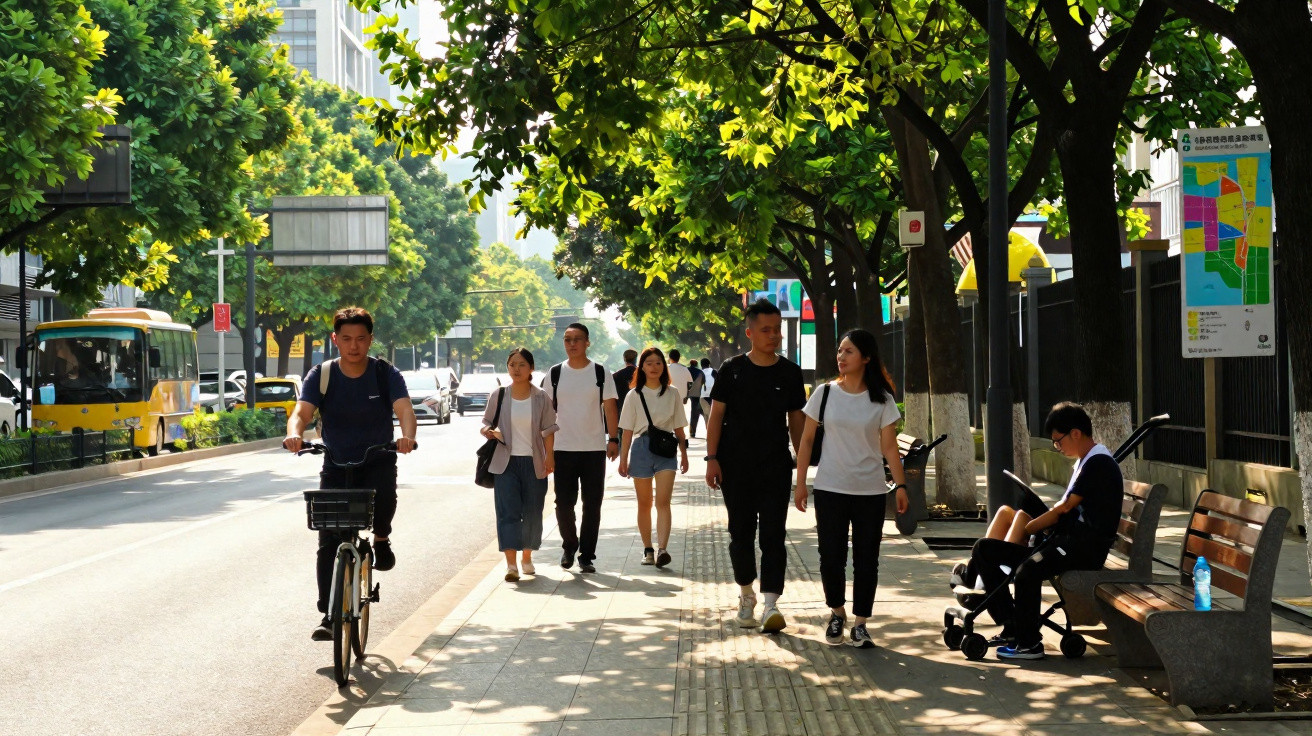
Cars inch forwards, air-conditioning units drip, and people press themselves into the shadows of buildings as though gripping a cliff face. But turn into a tree-lined side street and the atmosphere changes. The temperature drops by a few degrees. A passer-by pauses, takes off their cap and properly breathes.
Picture that relief extending across an entire city. Rather than being limited to one fortunate side street, it could be a linked network of leafy passages where children can walk to school without scorching themselves on metal railings. It could mean older people no longer have to choose between an oppressive bus stop and remaining indoors.
That is the effect of more than 300,000 new “urban shade corridors” being introduced discreetly in cities worldwide. They are not high-tech inventions. They are trees, and they are reshaping the way our bodies manage heat.
From blistering pavements to green corridors
On a sweltering afternoon in any large city, you can sense the boundary between hotter and cooler places on your skin. Move beyond a wall and sunlight pounds your shoulders; step beneath leafy cover and your pulse settles slightly. Urban planners once mapped these contrasts as “heat islands” and “cool spots”. Today, they are planning something different: extended, unbroken stretches of shade, like green arteries threading through grey streets.
These shade corridors consist of long lines of trees planted close enough for their crowns to meet and overlap. They are laid out beside bus routes, school areas and hospital districts. In certain cities, they trace former tram routes or neglected riverbeds. At first glance, the formula appears straightforward: plant trees along a street, wait for the branches to spread, then enjoy the shade. In practice, it represents a subtle revolution in the way cities approach health.
In Seville, Spain, for example, summer heat waves were driving up hospital admissions. The city responded with a focused “shade grid” scheme, planting more than 5,000 trees along routes leading to clinics and heavily used bus stops. Within only a few years, local researchers recorded surface-temperature reductions of up to 7°C on these routes at the height of the heat. Bus use rose slightly on the most shaded services. People quite literally selected the cooler route. Residents made this clear in interviews too: rather than mentioning “climate resilience” first, they said: “Now I can walk my mother to the doctor in the afternoon.”
Replicate that approach across hundreds of initiatives. In Ahmedabad, India, new tree corridors connect low-income neighbourhoods with public water points and markets. In Los Angeles, “cool streets” trials combine dense tree planting with reflective paving. Throughout Latin America, cities including Medellín have created whole “green corridors” that reduced heat-related emergency visits in surrounding districts. The total is substantial: various municipal and NGO databases now record more than 300,000 tree-lined routes, ranging from pilot schemes to established networks. Every one creates a cooler, safer part of urban life.
So how can a row of trees benefit your bloodstream and brain? Shade reduces direct solar radiation, the force that makes a street resemble a frying pan even when an app shows an apparently “manageable” air temperature. Beneath a mature canopy, this radiant burden can fall by 30 to 60 percent. Your body therefore has less work to do to keep cool. Heart rate remains more stable, while sweat loss is less severe. For older people, children and outdoor workers, that difference can separate minor discomfort from dangerous heat stress.
There is also a more gradual, unseen benefit. Tree corridors alter how long a city remains hot after dark. Asphalt and roofs commonly absorb heat, then release it slowly, making evenings feel like a persistent low fever. Uninterrupted tree cover interrupts this pattern. Leaves cool the air through transpiration, while shaded surfaces absorb less heat to begin with. As months and years pass, local health figures begin to shift: fewer cases of heat stroke, fewer worsening cardiovascular and respiratory illnesses, and fewer days when doctors quietly say, “We’re full again, the heat is killing us.”
How cities are creating urban shade corridors
The reality is less romantic, and far more calculated, than planting a sapling and returning five years later to find a flourishing avenue. Before a spade reaches the soil, modern shade corridors begin on computer screens. Teams layer maps showing heat, pedestrian movement, low-income communities, schools, hospitals and bus stops. They identify the “stress lines” that people have to travel, including on the most punishing days.
Next comes a practical puzzle. Where can roots develop without damaging pipes? Which species will withstand drought, pollution and restricted soil space? Many authorities are abandoning monoculture avenues made up of one tree type. Instead, they combine resilient native species with a small number of dependable introduced varieties. In Melbourne, planners select species that retain thick foliage throughout the hottest months. In Singapore, they prioritise trees that offer shade alongside dense leaves that clean the air. The aim is not simply to plant large numbers of trees, but to put suitable trees in the right order to create a continuous canopy.
A more human factor, rarely emphasised in official reports, is ownership of the land beneath the trees. A road may appear to be public space on paper, but small strips of land can in fact belong to businesses, utilities or private landlords. Those minor negotiations determine whether a corridor flows or is interrupted. In Medellín, some shop owners surrendered parking spaces so that the “Green Corridor” could continue outside their premises. In Phoenix, Arizona, neighbourhood groups adopted individual blocks and pledged to water young trees through their first harsh summers.
Such moments determine whether shade schemes succeed or fail. A corridor appears as a neat line on a map; on the pavement, it must contend with lorry routes, advertising signs, delivery bays, water-seeking roots and residents who may not welcome foliage near their windows. When cities get it right, it is seldom because they possess superior software. It is because somebody has gone from door to door, explaining, hearing concerns and exchanging small conveniences for lasting comfort. Let us be honest: nobody really reads 300-page urban-planning documents, but everyone understands the difference between walking beneath bare sunshine and walking in shade.
There is an unvarnished truth that many urban foresters admit quietly over coffee: the easy trees were planted decades ago. The remaining locations are difficult ones-unforgiving pavements, overheated squares and crowded junctions. To preserve continuity, planners are testing new solutions. Permeable paving enables roots to breathe. Larger shared planting pits can sustain several trees at once. Temporary shade structures bridge the gaps while young trees mature. In some Mexican cities, even bus stops have been redesigned as miniature oases, where climbing plants and native shrubs supplement corridor trees. The objective is straightforward, almost determined: the shade line must not be broken, even for 50 metres.
What urban shade corridors mean for everyday life
City-wide shade corridors may seem like decisions reserved for governors and mayors. To an extent, they are: their approval releases funding and road space. Yet there is a smaller, more personal level at which residents can influence the outcome. It begins with a practical exercise: paying attention to your own journeys. Consider your route to work, your children’s journey to school, or the stretch from the bus stop to your front door that always feels desert-like.
These journeys can be marked as lines on a map. On the ground, they are possible micro-corridors. Community groups in cities from Lyon to Lima have begun by walking these routes with a notebook and an inexpensive thermometer. They record where the heat feels unbearable, where a single tree stands and where climbing plants could grow along a wall. They then present the findings to councils not as vague climate activism, but as “our daily survival routes.” That wording changes the discussion. The subject is no longer decorative planting; it is safe travel during the next 40°C spell.
Naturally, wanting more trees is very different from waking up beneath one. Schemes can stall, budgets can be cut and maintenance can be overlooked. At an individual level, fatigue matters too. People have good intentions, but everyday life intervenes. On a Sunday afternoon, staying at home is easier than attending a neighbourhood meeting about root barriers and irrigation. The cities that progress most quickly recognise this human reality. They create tree-corridor programmes around manageable actions: adopt-a-tree initiatives, SMS watering reminders during heat waves and local “shade walks” in which residents assess comfort street by street.
Many organisers also admit that their greatest obstacle is not funding, but persuading people that a line of trees can genuinely alter health outcomes. In a world of data dashboards and satellite imagery, a young tree can seem almost too modest to matter.
“When we planted the first 200 trees, people shrugged,” recalls an urban health worker in Chennai. “Three summers later, during a heat wave, that same street had older residents sitting outside, chatting in the shade. They kept saying, ‘We thought this was just decoration. We didn’t know it would let us breathe.’”
Once people experience the difference, this change in perspective creates opportunities. They begin to protect corridors, objecting when trees are proposed for removal to make extra parking. They remind councils, politely but persistently, about pruning, watering and species diversity. To assist them, some cities now issue straightforward “shade corridor survival kits”, offering advice such as:
- Map your three hottest daily routes and mark places where shade could be added.
- Join, or set up, a local tree-stewardship group for your street or school route.
- Ask local officials specifically for “continuous shade” rather than scattered planting.
- Safeguard established mature trees first, as they provide the quickest and strongest shade.
- Share before-and-after photographs of shaded routes to build public pride and pressure.
There is a modest personal reassurance in this too. We cannot control heat waves. However, street by street, we can choose whether pavements feel like conveyor belts into an oven or slower, shaded routes where the body can cope. With each decision and each arch of leaves, the map of your city begins to change.
A quiet form of infrastructure with real consequences
Urban shade corridors will never attract the headline appeal of high-speed rail or gleaming new towers. They develop too gradually, create too little noise and have no grand ribbon-cutting moment. Their defining moments are quieter: an older man deciding he can walk to the shops again in the afternoon, or a delivery worker taking a marginally longer but cooler street and finishing the day less exhausted.
Most of us have crossed an exposed square in August and felt our energy collapse, as if somebody had switched off the power. The opposite experience-walking below trees as the rest of the city bakes-is less striking, and that is precisely its value. Effective shade makes stress disappear from view. It keeps the body closer to its comfort range. Public-health researchers monitoring hospital data in cities with maturing corridors are finding fewer ambulance call-outs on days of extreme heat, particularly in low-income districts where air conditioning is limited. They are also seeing quieter signs: improved sleep, fewer headaches and more people completing outdoor errands rather than delaying everything “until it cools down.”
This newer form of green planning has an uncompromising honesty. No one claims that trees alone will halt climate change, nor that every corridor will receive perfect maintenance. Branches will come down. Roots will conflict with pipes. Some streets will lose trees before replacements are planted. Even so, the overall direction is unmistakable: cities built only from concrete are a health risk; cities that combine shade and sun give our bodies a better chance in increasingly hot decades.
That may be why these 300,000-plus shade corridors matter far more than their unassuming appearance implies. They are not symbols but buffers. They will not save the planet, yet they could protect your neighbour’s heart, your postman’s kidneys or your own patience on a scorching Tuesday. They prompt a different question about where you live: not merely “Is my city growing?” but “Is my city caring for the people who walk it when the thermometer starts to flirt with danger?”
| Key point | Detail | Why it matters to the reader |
|---|---|---|
| Shade corridors reduce heat stress | Continuous tree canopies can lower perceived temperatures by several degrees and reduce radiant heat | Understand why taking a shaded route can genuinely make your body safer during heat waves |
| Over 300,000 routes already exist | From Seville to Medellín, cities are mapping and planting connected shade networks | Recognise that this is not simply theory, but a worldwide shift you can seek out in your own city |
| Residents can influence future corridors | Route mapping, tree stewardship and local advocacy affect where shade is created next | Discover practical ways to steer your daily routes towards cooler, healthier streets |
FAQ:
- What exactly is an urban shade corridor? An urban shade corridor is a continuous route-typically along streets or paths-where trees are planted sufficiently close together for their canopies to overlap, providing an almost uninterrupted strip of shade for people walking, cycling or waiting for transport.
- How much can trees really lower city temperatures? With dense canopy cover, people can feel 5–10°C cooler than they do on unshaded asphalt because radiant heat is reduced and surfaces are cooled, even if the official air temperature changes very little.
- Do shade corridors only help during extreme heat waves? No. They also lessen routine heat stress, reduce night-time heat retention and can lower risks associated with heart and lung conditions long before temperatures reach official “red alert” levels.
- What about allergies and maintenance problems? Choosing species carefully is important. Cities are learning to avoid highly allergenic varieties in built-up areas and are investing in pruning, leaf management and better root spaces so that corridors provide protection rather than problems.
- How can I support more shade where I live? You can take part in local greening groups, map your hottest everyday journeys, ask city officials for continuous tree lines rather than scattered planting, and help care for young trees near your home or workplace.






Comments
No comments yet. Be the first to comment!
Leave a Comment