
Pains that appear before breakfast, knees that complain midway up the stairs, wrists that object when you open a jar. Most doctors recommend swimming or Pilates. Both are excellent choices if you enjoy chlorine or exercise mats. But there is another, quieter approach supported by science, requiring neither a pool nor a reformer.
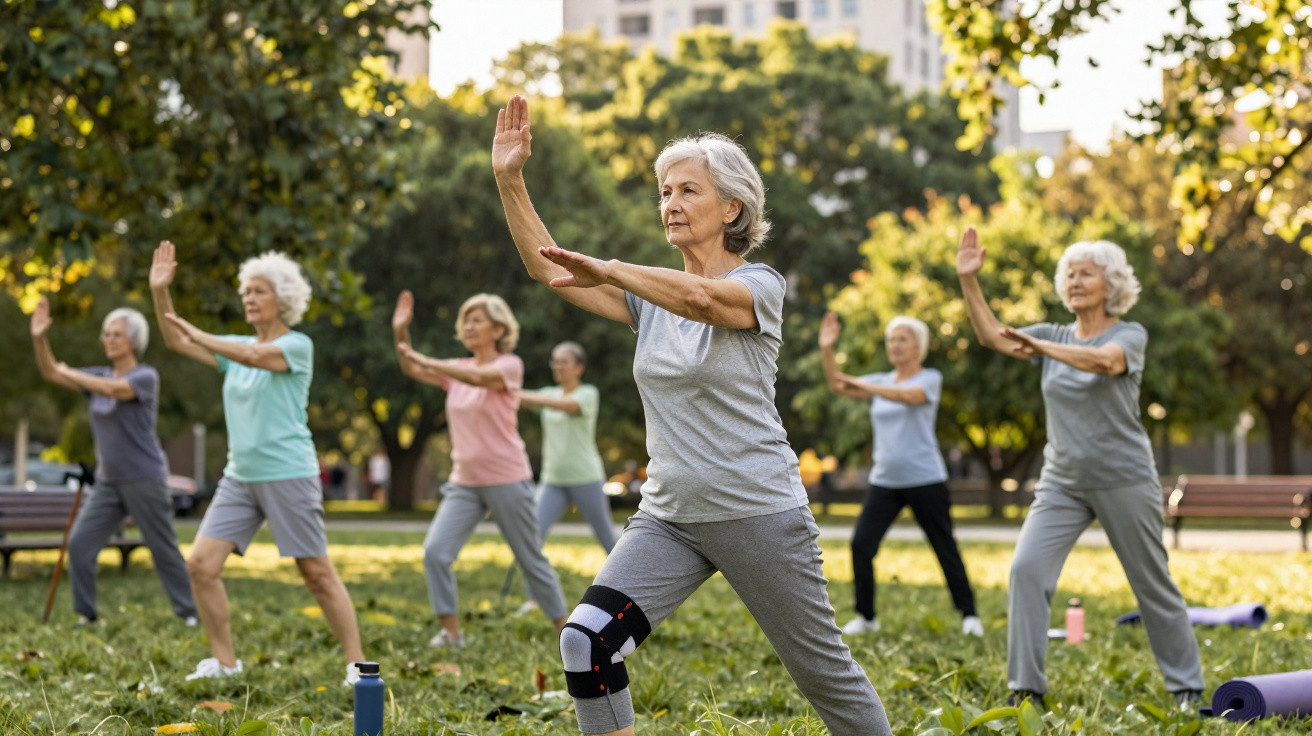
A small group of older people transferred their weight while their arms drifted like seaweed and their faces remained relaxed. There was no music and no shouted instructions, only shoes brushing the path and a handful of birds calling from the trees.
An 80-year-old wearing a navy windbreaker guided the group through the movements. One woman had a knee support on, yet she moved without wincing. A man with rigid fingers repeatedly opened and shut his hands, as though warming door handles. It appeared mild. It was carefully structured.
It seems like very little. It transforms everything.
The quiet champion: tai chi
Here is what many physiotherapists quietly mention before recommending anything else: tai chi can often outperform well-known activities for older adults living with joint pain. It places only light demands on the body, improves steadiness and keeps the heart working without jolting vulnerable cartilage. The Arthritis Foundation recommends it. Major reviews have found worthwhile reductions in pain and improved function in the knees, hips and back.
If that feels vague, consider Elaine, a 72-year-old I met who used to arrange her supermarket trips around what her knees could manage. Following eight weeks of two brief tai chi practices each week, she no longer organised her days around finding lifts. It was not a miracle-simply more stable walking, fewer flare-ups after errands and enough confidence to walk beyond the edge of the car park.
Its benefits make sense once you try it. Rather than teaching abrupt jumps, tai chi uses controlled weight transfers. Muscles engage in stages, supporting the ankle first, then the knee and hip, before the torso joins in. Picture very small squats at a comfortable angle. Instead of being compressed, joints move smoothly. Research even suggests tai chi can produce physical-therapy-equivalent results for pain and function in knee osteoarthritis, while also improving mood and balance.
Starting tai chi without aggravating your joints
Try 10-minute “micro-practices” three times weekly. Stand upright, relax your knees and picture the top of your head rising like a balloon. Transfer your weight into the right foot as though you were tipping sand, raise the left heel by the width of a breath, then lower it. Do the same on the other side. Aim to work at around 70% effort. Initially, it can seem almost too easy.
The usual mistakes are straightforward to avoid. Avoid lowering deeply; slight knee bends are better than deep lunges. Allow your arms to drift upwards instead of holding them directly at shoulder level. Make sure your knees stay aligned above your toes. If sharp pain occurs, reduce the size of the movement and slow your breathing. We have all experienced a new routine feeling unnatural, as if we are pretending-still, do three minutes. Let’s be honest: nobody really does that every day.
A dependable rhythm matters more than anything. Repeating two or three simple forms regularly is more effective than learning a complicated routine you cannot recall. Begin while standing behind a chair. Wear shoes if that feels safer. Breathe softly and consistently, as if you were steaming up a mirror.
Move gently, move often, let pain guide the pace.
- Begin with 10 minutes, three days each week
- Keep your knees relaxed; do not lock them or bend deeply
- Practise close to a chair or wall for support
- Choose 2–3 forms and repeat them
- Note “good soreness” and sharp pain in a small notebook
What low-impact tai chi teaches the body
Low impact is not a lesser option; it is a smart form of stress. Tai chi gives joints the nourishment of movement without grinding them down. It gently improves posture, makes ankles more stable and trains your core to engage before your feet lose their footing. Across twelve weeks, many older adults describe longer walks without pain, reduced morning stiffness and greater control when using stairs. Some also find that they sleep more soundly. That reflects a calmer nervous system, not only stronger muscles.
| Key point | Detail | Why it matters to the reader |
|---|---|---|
| Tai chi reduces load, not movement | Slow weight transfers and small knee angles safeguard cartilage | Move more while experiencing fewer flare-ups |
| Comparable to physical therapy for knee OA | Clinical trials report similar improvements in pain and function | An evidence-backed choice that can be practised at home |
| Balance improvements reduce fall risk | Proprioception, ankle strength and core timing get better | More confidence on stairs and uneven surfaces |
FAQ:
- What makes tai chi different from yoga or Pilates? It is performed standing up, with continuous movement, very small joint angles and no held positions. Its flowing nature keeps strain low while developing coordination and stability.
- Can I do tai chi with knee osteoarthritis? Yes, many people with knee OA find it beneficial. Keep bends shallow, align knees over toes and reduce your range of movement on difficult days.
- How often should I practice? Two to three short practices per week are effective for beginners. Add a five-minute “movement snack” on days when you feel stiff.
- Do I need a class or can I learn online? An in-person class can help with technique and motivation. Brief videos from reputable sources are a useful starting point where classes are limited. Focus on straightforward forms rather than choreography.
- Can it be done seated if I have balance issues? Yes. Numerous forms can be modified for a chair. You can still practise breathing, posture and arm patterns while giving your legs a rest.
This change in thinking is what opens the door to improvement: pain does not mean “stop forever”; it means “change the volume and the angle.” Tai chi is particularly good at managing volume. It allows you to rehearse moving gracefully even when your joints are not cooperating. With time, that ability carries over into daily life-when stepping down from a kerb, reaching for a pan or turning to acknowledge somebody calling your name.
Friends might still encourage you to swim lengths or join mat-based classes. That is fine; plenty of people enjoy them. Yet if pools and reformers have never appealed to you, consider this courtyard form of strength: slow, accurate and quietly challenging. Within a few weeks, the “long walk to the letterbox” may involve fewer negotiations with your knees. The distance stays the same. Your relationship with it changes.
Remember, the most effective plan is the one you keep doing. Select two forms. Practise as the kettle boils. Swap one scrolling session for ten unhurried minutes of weight shifting and breathing. Notice the world becoming slightly steadier as your feet do. The practice is uncomplicated. Its wider effects rarely are.
Comments
No comments yet. Be the first to comment!
Leave a Comment