
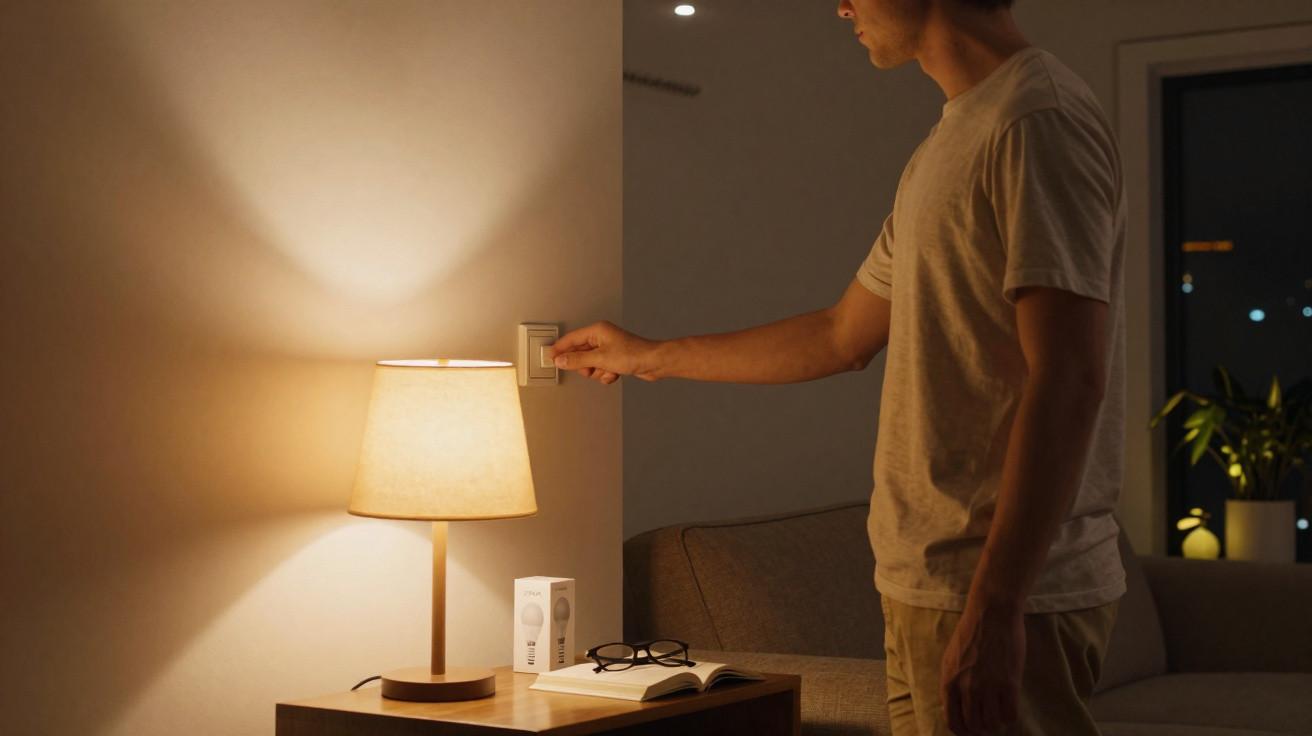
It began, as it so often does, with a headache I dismissed as “just one of those days”.
At 11.47pm, my flat was quiet apart from the fridge’s soft hum and the odd car passing outside. I was bent over my laptop, with my phone face-up next to it and a glaring white ceiling light shining down like an interrogation lamp. My eyes were as dry as sandpaper and my shoulders had tightened, but I carried on scrolling because that is what we do. When I eventually made it to bed, my mind was fizzing like a broken neon sign.
My eyes were still sore the following morning. It was not the dramatic pain of a migraine, but the flat, weary sting that follows crying on a train while acting as though nothing is wrong. I blamed work, the relentless news cycle and getting older. In truth, the cause was half a metre above my head, hiding in plain sight as something dull and everyday: a light bulb. The small change I made had a bigger effect on my nights than any expensive wellness app.
The night everything felt too bright
The issue with my light bulbs crept in so gradually that I barely registered it. Like plenty of people, I had proudly swapped the old yellowish bulbs in my flat for crisp, energy-efficient LEDs several years earlier. They were inexpensive, bright and made everything appear sharp in photographs. I could spot dust on the shelves, read every word on a page and see every crumb on the kitchen worktop. It felt “modern”, which is an odd description for lighting, but that was exactly how it seemed.
Then the pandemic arrived, and my flat became an office, studio, cinema and, at times, a battleground. From breakfast until bed, I lived beneath artificial light. When a screen was not lighting my face, that piercing white ceiling bulb was. My eyes began objecting in quiet, incremental ways: a blur here, a sting there. It was a muted protest that I repeatedly told to keep quiet.
We have all had the experience of leaving a laptop, entering another room and suddenly noticing that our body has been protesting for hours. That happened to me on a Tuesday evening. Standing in my dark hallway, I realised for the first time that simply stepping away from that harsh pool of light made my whole face loosen. It was like leaving a supermarket after a long, noisy shop and walking into the gentle dusk. I did not have the words for it at the time, but I felt it clearly: my home lighting was wrong for that hour of the day.
The simplest advice no one actually follows
Naturally, I had seen the warnings before. There were eye-health tips, the 20-20-20 rule - look 20 feet away for 20 seconds every 20 minutes - and all the sensible routines we are meant to adopt to protect both our eyesight and our sanity. Honestly, though, hardly anyone follows them daily. We intend to; we may manage it for one afternoon, then deadlines hit, a friend sends a message, a notification appears, and those good intentions dissolve like ice in a hot drink.
Lighting advice is much the same. “Limit screens at night.” “Avoid bright lights before bed.” “Use warm light in the evening to help your body wind down.” It is sensible, evidence-based and reasonable. Still, many of us lie in bed beneath the glow of a cold white bulb, reading group chats and half-watching TikToks, then wondering why we are simultaneously wired and exhausted. We treat that advice like “stretch more” or “eat less sugar”: somewhat important and conveniently easy to ignore.
What made me finally take notice was not a scientific paper, although there are plenty of those. It was one small, absurd moment in a supermarket lighting aisle. I stood there exhausted, squinting at a wall of boxes labelled “COOL WHITE”, “DAYLIGHT”, “WARM WHITE” and “SOFT GLOW”, using my phone torch to read the fine print as if I were solving a crime. Beneath the fluorescent strip lighting, my eyes hurt, and for once I did not simply shrug and move on. I thought: what if the answer is actually this boring?
The quiet power of 2700K
The light-bulb change that shifted everything was this: I replaced the bright, cool “daylight” bulbs in my main living areas with warm white bulbs. That was all. There was no smart-home set-up, no colour-changing magic and no app connecting to my Wi-Fi. I chose bulbs marked below roughly 2700K - the colour temperature, for anyone wanting the technical detail - and screwed them in.
On the first evening I switched them on, my flat honestly looked a little… old-fashioned. The glossy white glare I had become accustomed to had vanished. Instead, the room seemed gentler, more like a café near closing time than a showroom. Light rested more softly on the walls rather than ricocheting off every surface like a spotlight. My phone screen no longer seemed to compete with the ceiling glare.
Within about half an hour, my eyes registered the difference before my mind did. The pressure behind them softened. The outlines of objects appeared less severe, less “high definition”. I noticed that I had stopped making the unconscious half-squint that had become normal for me. My home no longer felt like a round-the-clock office; it felt like somewhere meant for the evening. I had not expected such a minor visual adjustment to produce such a noticeable physical response.
Not mood lighting, just human lighting
This was not an attempt to create an Instagram-ready amber haze. I did not put fairy lights or candles everywhere, although both have their uses. I kept the arrangement practical: a warm white ceiling bulb, a gentler lamp beside the sofa and another at my desk. It was the sort of layout my grandparents might have used, only with newer technology inside the glass.
The difference was not limited to fewer headaches, although those decreased dramatically. My evenings began feeling like proper evenings again. Once work ended, the room’s lighting helped tell my body, “We’re done now.” The contrast between my screen and the room around it no longer felt like a battle. My eyes were not perpetually flinching at the gap between neon-blue pixels and bluish overhead glare.
Our eyes were not built for midnight daylight
There is a reason such a straightforward switch can help. Our eyes and brains developed under one dominant light source: the sun. It is bright and bluish during the day, then gradually shifts towards warmer shades as evening arrives. By filling our homes with cool white or “daylight” bulbs at night, we effectively persuade our bodies that it is still mid-morning. The brain receives the message, “Still daytime! Stay alert!” regardless of what the clock says.
Bluish light can be excellent for concentration. In the appropriate environment, it supports alertness, focus and sharpness. Offices favour it, as do supermarkets, hospitals, gyms and airports. At 11pm, however, your nervous system does not. It wants the visual version of a soft blanket, but receives another espresso instead.
Warm white lighting sits nearer the comfortable end of the spectrum. It does not strike the retina with the same force. The contrast between shadowy corners and bright bulbs becomes less harsh. Your pupils no longer need to repeatedly constrict and relax as though they are in a nightclub. Your eyes stop protesting, and your brain can finally believe you when you say, “We’re done for today.”
The small things your body quietly notices
What surprised me was how strongly my body reacted even on evenings when I remained glued to my devices. I might be scrolling through an endless news thread when, suddenly, I would simply feel finished: sleepy, heavy and ready to stop. I had not experienced that for years without making myself snap the laptop shut.
There is a particular relief in no longer demanding that your body fight physics all the time. Warm lighting does not make screens harmless by magic, but it removes the sensation of being locked inside a glowing white box. Your living room stops resembling a hospital corridor and begins acting like an evening space. The effect is subtle, until it is not.
The £5 experiment anyone can run tonight
This is the point I wish somebody had made clear to me years ago: you do not need to refit your entire home to notice a change. Nor do you require a smart bulb capable of producing every colour of the rainbow. Buy one or two warm white bulbs and test them in the rooms where you spend your evenings.
Choose the spot where you usually doom-scroll, binge-watch or reply to “just one more email”. Replace the main bright, cool bulb with a warm white version. If you do not know what you currently have, inspect the box if you kept it, or check the small figures printed on the bulb: 2700K or 3000K is your new friend; 4000K, 5000K and above are probably what you should avoid at night. Live with the adjustment for a week before deciding whether you like it.
You may dislike it on the first night because your eyes are accustomed to the “clinical clean” appearance of cool lighting. Allow them time to adjust. It is like moving from deafening music to a quieter playlist: relaxation does not arrive instantly; instead, you gradually stop tensing yourself. See whether your eyes sting less at midnight. Notice whether your phone appears less blinding. Pay attention to whether you start yawning earlier, in a welcome way.
One lamp, one habit
If you live in a shared flat or family home and cannot replace every bulb, try this instead: choose one lamp. Fit it with a warm white bulb and make it part of your evening routine. After a set time - perhaps 9.30pm - let that be the only lamp you use in the living room or bedroom. No large overhead lights and no full blaze of lighting. Just your evening lamp.
There is something unexpectedly grounding about such a small ritual. Turning that lamp on becomes a cue, rather like putting on pyjamas. It tells your body, your eyes and perhaps the people you live with that the high-alert stage of the day has ended. Screens may remain, but the room itself is no longer working to keep you wired.
The moment you realise your eyes aren’t “just tired”
We normalise eye strain to an absurd extent. We joke about “screen eyes”, top up our coffee, rub our temples and carry on. By the point we recognise genuine discomfort - the sort that makes you close your eyes beneath the shower and stand in the dark water for a minute - it can seem nearly too late. As though something has been damaged.
For many of us, though, the issue is not damaged eyes at all. It is an environment set up badly: lighting that is too bright, too cool and used at the wrong time. The tiny muscles in our eyes are doing double shifts because the surroundings we have made do not resemble the world they were designed for. We blame age, stress, genetics or “just a lot on”, when part of the answer is suspended from the ceiling.
That was my moment of truth: understanding that my body had communicated this long before I had listened. The late-night headaches, gritty eyes in the morning and feeling that my brain was “buzzing” after closing the laptop were all feedback rather than failure. I had simply been too busy, too wired or too distracted to hear it.
The boring fix that feels like an upgrade
There is a cultural fondness for grand, dramatic answers: a digital detox, a cabin in the woods or a “no screens after 7pm” challenge. They sound heroic, which may explain why we so seldom sustain them. Changing a bulb seems laughably unglamorous by comparison. Nobody boasts at brunch, “I went 2700K last night and it changed my life.”
Yet modest, unexciting changes are often the ones that quietly last. Once a warmer bulb is installed, it demands no willpower. You use the switch, and the room simply becomes a little more pleasant to look at. Less buzz, more exhale. In time, that becomes a new normal without requiring a battle with yourself to keep it going.
Perhaps that is the overlooked lesson in the lighting aisle: not every improvement to your life needs to be costly, complex or Instagrammable to matter. Sometimes it means five minutes on a step stool, replacing one piece of glass with another, then spending a week noticing how your eyes feel. Sometimes, the route to less strain is literally a different colour of light.
If you are rubbing your eyes at midnight beneath a blazing white ceiling and wondering why you feel wired and worn out at once, begin with the smallest adjustment available. Lower the colour temperature, even in only one corner of your home. Let evenings look like evenings again. Your eyes will let you know, quietly but unmistakably, when you have found the right balance.






Comments
No comments yet. Be the first to comment!
Leave a Comment