
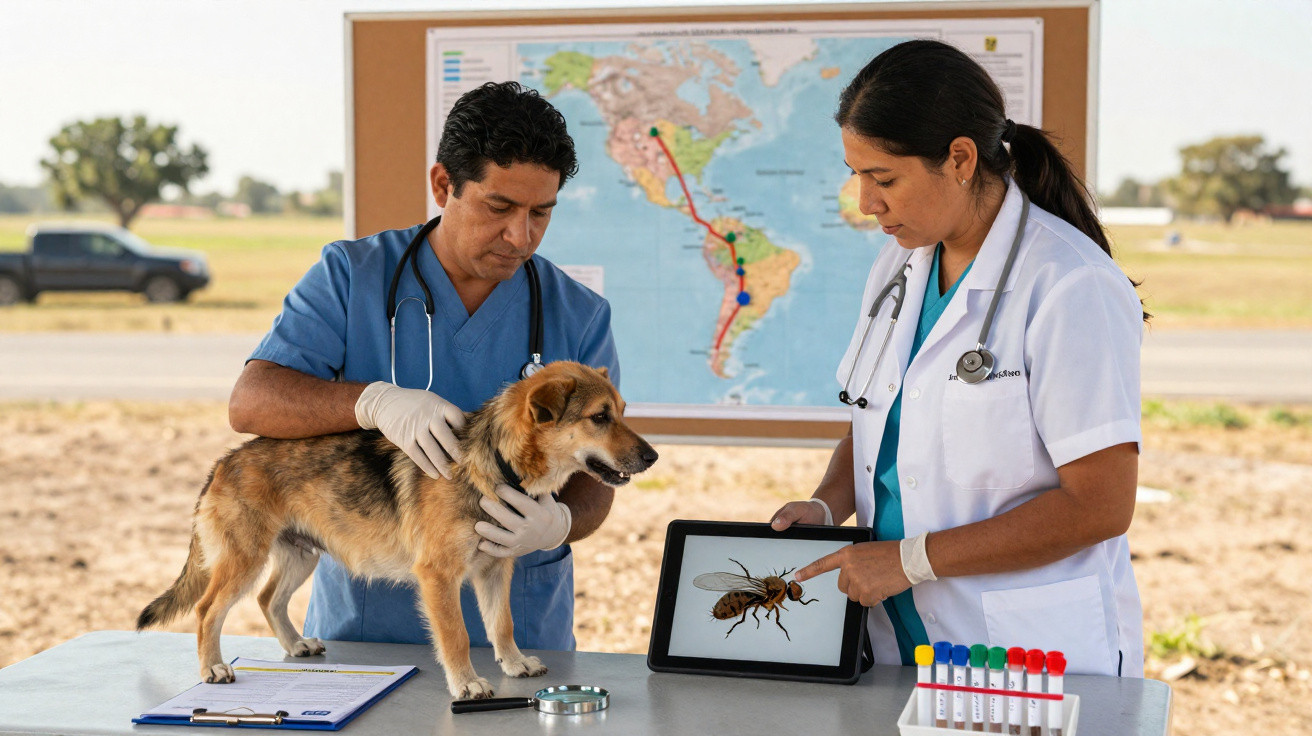
The flesh-eating New World screwworm (Cochliomyia hominivorax) outbreak has caused seven deaths and infected at least 1,190 additional people across Mexico and South America. As it moves northwards, the US Centers for Disease Control and Prevention (CDC) has issued an alert for health workers.
New World screwworm cases move towards the US border
Mexico currently has 601 active animal cases, including eight in Tamaulipas, the state bordering Texas. This proximity has prompted the CDC to publish a health advisory.
The warning asks doctors, vets and other US health-system professionals to watch for the screwworm, described as "a devastating pest". It was eliminated from the US in 1966, then eradicated again in 2017 after fly larvae infected deer in Florida during 2016.
The New World screwworm is a fly larva that inhabits and consumes the wounds and mucous membranes of warm-blooded animals.
Cattle, horses and pigs are most often affected, although the parasite may also deposit eggs in the flesh of dogs, cats and humans. Untreated infections can prove fatal and may kill even an adult cow within one week.
Before the 1960s, cattle farmers in Texas were dealing with roughly 1 million screwworm cases annually.
Why a Texas outbreak could be costly
The pest's advance towards Texas is particularly worrying because it is the largest cattle-producing state in the US. According to the US Department of Agriculture, an outbreak there could result in costs of about $1.8 billion.
An aspect of the New World screwworm's biology helped earlier attempts to suppress the fly population. Females generally mate only once during their 21-day lives, whereas males mate repeatedly.
In 1962, researchers started using gamma radiation to produce sterile male flies. Each sterile male could mate with numerous wild females, resulting in unfertilised eggs.
Billions of sterile males were dropped from aircraft over southern Florida, Texas, California, Arizona and New Mexico. By 1982, the fly had been declared locally extinct in the US, Mexico and parts of Central America, due to the 'sterile insect technique', chemical treatment for cattle and favourable weather conditions.
How the screwworm crossed the Panama barrier
A facility in Panama, the country linking North and South America and home to the hostile wilderness corridor known as the Darién Gap, has continually released further sterile screwworm flies as a protective barrier. Yet the worm somehow crossed that barrier in 2023, restarting its northward movement and arriving in Mexico by November 2024.
In September 2025, Mexican authorities confirmed an infection in an 8-month-old cow only 113 km from the US border.
According to the CDC, "unregulated cattle movement, increased movement through the Darien Gap, and new areas of farming contributed to rapid northward spread of NWS."
Researchers have also cautioned that climate change may be aiding the flies, as rising temperatures extend both their 'boom' season and geographical range.
No human or animal infestations associated with this outbreak have so far been identified in the US.
"However, given the potential for geographic spread, CDC is issuing this Health Advisory to increase awareness of the outbreak and to summarize CDC recommendations for clinicians and health departments in the United States on case identification and reporting, specimen collection, diagnosis, and treatment of NWS, as well as guidance for the public," the agency explains.
The US CDC's complete health advisory is available here.






Comments
No comments yet. Be the first to comment!
Leave a Comment