
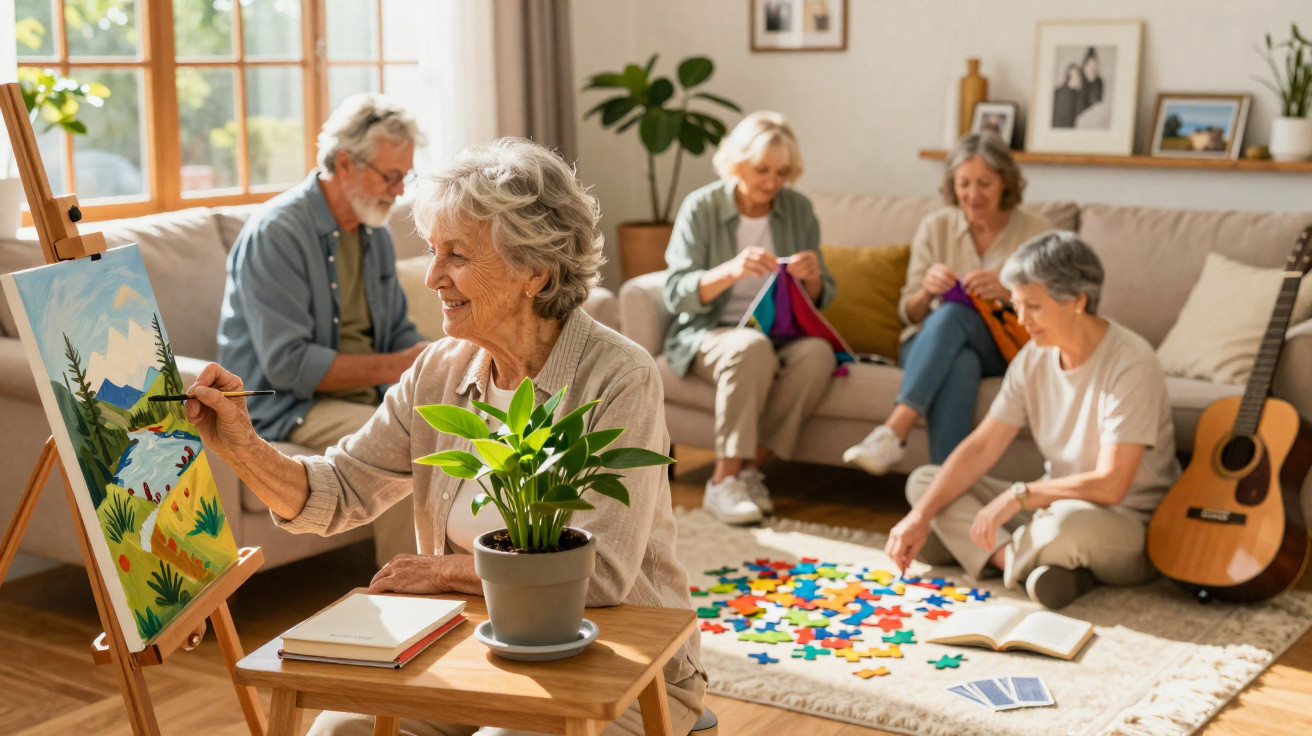
The hubbub of the café seemed to disappear as she began describing her choir. Her hands trembled slightly when she raised her cup, yet her eyes sparkled with a nearly mischievous energy. Widowed at 72, she explained that she “refused to spend evenings listening to the fridge hum,” and joined a community choir on a wet Tuesday. She has not looked back since.
All around us, screens lit up and people scrolled, but she was talking about another kind of life altogether: a week arranged around rehearsal evenings, in-jokes, coach journeys and WhatsApp groups buzzing late at night with blurry concert pictures.
Psychologists describe this as “social embeddedness.” In her words, it was simply “having somewhere to be on Thursday.”
She is far from alone in quietly reshaping what old age can look like.
Why hobbies have become a psychological lifeline
Step into any retirement community and the modern status symbol is clear: it is not wealth or an elegant flat, but a packed noticeboard. A knitting circle at 3 p.m., a walking group at 10 a.m., a language club, book club and gardening team. The people who seem most full of life are not necessarily those in the finest health, but those rushing along the corridor because they are already late for an activity.
Psychologists have cautioned for years that loneliness in later life can be as damaging as smoking or obesity. Yet the quiet protection is not merely “seeing friends”. It lies in shared jobs, daft traditions and regular dates that get you out of the house, even on days when staying in your slippers feels more appealing.
This is the point at which hobbies stop being simple pastimes and start acting as a safety net.
A major UK study tracking more than 7,000 older adults found that people who took part in hobbies or cultural pursuits faced a significantly lower risk of developing depressive symptoms. Crucially, the benefit was not about performing a Chopin waltz perfectly or producing immaculate jumpers. It came from being involved: regular contact, steadily improving and the feeling that “I’m working on something.”
Consider Pierre, 68, who set up a modest photography group in his town. Initially, it consisted only of him and a neighbour. A retired nurse then came along, followed by a former maths teacher, and later a reserved 74-year-old who had not touched her camera for ten years. Now six of them gather every Sunday morning to “hunt for light,” as they put it, before sharing their photographs over coffee. None of them is becoming an Instagram sensation. But none of them is spending Sunday alone, either.
The figures record less loneliness. The lived reality is six people kindly debating which photograph of a lamppost is the least dreadful.
From a psychological perspective, hobbies meet several needs at once. They provide routine, giving form to days that could otherwise merge into one endless afternoon. They also support identity: “I’m a painter,” “I’m learning Italian,” “I’m the one who always brings cake to the chess club.” Such identities ease the difficult shift from being a “worker” or “parent” to being a “retired person”, a description that can feel like a full stop.
They also foster what researchers term “weak ties” – friendly acknowledgements, brief conversations and familiar faces you may not invite for Christmas, but whose presence reassures your mind that you belong to a network. Among older adults, these weak ties have a strong association with wellbeing.
Loneliness does not always make itself heard. At times, it simply removes your reasons for stepping outside. Hobbies put fresh reasons back into the day.
10 hobbies that quietly protect you from loneliness
To be specific, psychologists and ageing specialists identify certain hobbies as especially effective against loneliness because they combine three things: repetition, interaction and a manageable degree of challenge. Choir singing, for example, works almost miraculously in this respect. You literally breathe in unison. As you keep to the rhythm and listen to those beside you, your brain synchronises with theirs. Research shows that taking part in a choir improves mood and social connection, including for people who claim they “can’t really sing.”
Group walks are another overlooked treasure. There is no requirement for Lycra or walking poles. A weekly stroll through a park with the same three or four people forms a quiet micro-community. Conversation often comes more naturally when you are walking side by side rather than facing one another across a table. Your body is active, your thoughts begin to settle and talking feels less strained.
The important thing is not the exercise itself. It is having an entry in your diary that is not a medical appointment.
Naturally, not everybody feels able to sing in front of others or join a club straight away. Many older adults voice the same concerns: “I don’t want to be a burden,” or “Groups are already formed, I’ll feel out of place.” That anxiety is genuine, and it can stop someone on the threshold.
This is where gentler hobbies can help – activities begun alone that can organically bring you into contact with others. Take urban gardening schemes. At first, you may do no more than water a plant in one corner of a shared garden. A month later, somebody asks about your tomatoes. After three months, there may be a WhatsApp group called “Crazy Gardeners” swapping advice about slugs at 6 a.m.
Local libraries can offer the same route in: a monthly book club, creative writing session or even board-game evening can begin with you listening quietly at the edge of the room. The first move need not be courageous. It only needs to be made.
Psychologist Julianne Holt-Lunstad, known for her work on loneliness, has a simple message: “Connection doesn’t have to be deep to be protective. It just has to be consistent.”
- Community hobbies: Choirs, walking groups, community gardening and book clubs. These suit people who want gentle, dependable contact with others.
- Skill-building hobbies: Language lessons, painting courses, computer clubs and photography. A good choice if you enjoy the sense of getting better at something.
- Helping hobbies: Volunteering in a charity shop, reading in schools or visiting isolated neighbours through local programmes. Particularly valuable if being useful makes you feel better.
- Body–mind hobbies: Tai chi, gentle yoga and dance classes for older people. Excellent when you need movement as well as company.
- Creative micro-projects: Knitting circles, craft meet-ups and cookery workshops. Well suited to shy people who enjoy making things with their hands.
How to keep a hobby going when life gets messy
Here is the straightforward truth: let us be honest, nobody keeps up a new hobby “every single day” for the rest of their life. Life intervenes – fatigue, health problems, a visiting grandchild or a poor night’s sleep. The answer is to arrange your hobby life so that losing a week feels like a break, rather than a failure.
Psychologists who focus on behaviour change recommend aiming for “minimum viable engagement.” Instead of telling yourself, “I’ll paint every day,” you might decide, “Once a week, I’ll get my paints out and do something, even if it’s just mixing colours for ten minutes.” Or: “I’ll attend two choir rehearsals a month, not all four, and that counts.”
Making perfection less important usually makes it more likely that you will turn up.
A frequent error, particularly after retirement, is attempting to cram every spare hour with intensely productive hobbies. Three clubs, two sports and an online course… then, by the second month, you are worn out and privately embarrassed about “not keeping up.” That embarrassment is a loneliness trap in another form. It can lead you to retreat, leave messages unanswered and miss gatherings.
A kinder strategy is to select one or two social anchor hobbies, alongside one private pleasure to enjoy alone. For instance, a weekly walking group and a monthly cookery class could be your anchors, while jigsaws at home provide quiet enjoyment. Then, when you have little social energy, there is still something meaningful to do without added pressure.
A compassionate reminder: you are not competing to become “best retiree of the year.” You are simply hoping to feel a little less alone as evening arrives.
Gerontologist Karl Pillemer likes to say: “Don’t ask ‘What do I enjoy?’ Ask ‘What keeps putting me in the path of other people?’”
- Start small: try one session, have one conversation or take one walk. Momentum begins with very modest steps.
- Expect initial awkwardness. The first three visits to a new group rarely feel comfortable. That does not mean you do not belong there.
- Use deadlines: Dated events such as concerts, exhibitions and tournaments give you a goal to prepare for and discuss.
- Mix age groups where possible: Intergenerational hobbies, including language exchanges and community theatre, are associated with greater life satisfaction.
- Prepare for difficult weeks: Keep a “Plan B” hobby that you can do from the sofa while remaining connected, such as an online class or a shared WhatsApp reading group.
A different way to think about old age
Ask people in their thirties to imagine old age and the same three descriptions tend to recur: slow, quiet and lonely. Spend time, however, with 75-year-olds debating a Scrabble board or practising a daft dance for the local festival, and that image falls apart within five minutes. Growing older with hobbies is not glamorous. It is simply… more active than we have been taught to anticipate.
Psychology does not claim that a pottery class or language group can remove grief or magically repair a shrinking social circle. What it does indicate is that people who continue learning, practising and turning up somewhere are less likely to slip into the invisible category of “the isolated elderly”. Hobbies become modest acts of defiance against that invisibility. They declare: I am still here, I still have something to do on Tuesday at 5 p.m., and someone will notice if I do not arrive.
We have all known that pause with a hand on the handle of an unfamiliar door, questioning whether we are too old, too shy or too late. Research – along with countless real lives – suggests something else: your next decade could be waiting beyond that door, singing a little out of tune, offering you a paintbrush or asking you to come for just one walk.
| Key point | Detail | Value for the reader |
|---|---|---|
| Choose social hobbies | Give priority to activities involving regular meetings and shared tasks, such as choirs, walking groups or book clubs. | Creates a dependable circle of familiar faces and lowers the risk of chronic loneliness. |
| Start small and imperfect | Choose “minimum viable engagement” over strict daily targets, and accept that sessions will sometimes be missed. | Helps you maintain hobbies over the long term without guilt. |
| Mix meaning and pleasure | Pair enjoyable activities with “helping hobbies” such as volunteering or mentoring. | Reinforces a sense of purpose, which is linked to improved mental and physical health in old age. |
FAQ:
What if I’m very shy and hate groups?
Begin with hobbies where the activity, rather than other people, is your focus: gardening, crafts or a small library club. You can take part quietly at first and allow conversations to develop on their own.Can online hobbies really help with loneliness?
Yes, particularly when there is consistent interaction: weekly Zoom language lessons, online book clubs or gaming groups with voice chat. Combining online and in-person contact often works best.Isn’t it too late to start a new hobby after 70?
Research into brain plasticity shows that learning remains possible well into later life. Many people find their favourite pursuits only after retirement, once time pressures ease.What if my health limits what I can do?
Seek out low-impact, seated or home-based options: chair yoga, telephone reading circles, craft groups or simply hosting weekly tea for neighbours. What matters is repeated contact, not intensity.How do I find these hobbies in my area?
Look at local libraries, town halls, older people’s centres, church or community noticeboards, plus Facebook or Meetup groups. Casually tell your GP, pharmacist or neighbours that you are “looking for something to join” – people often know about small informal groups that are never advertised online.



Comments
No comments yet. Be the first to comment!
Leave a Comment