
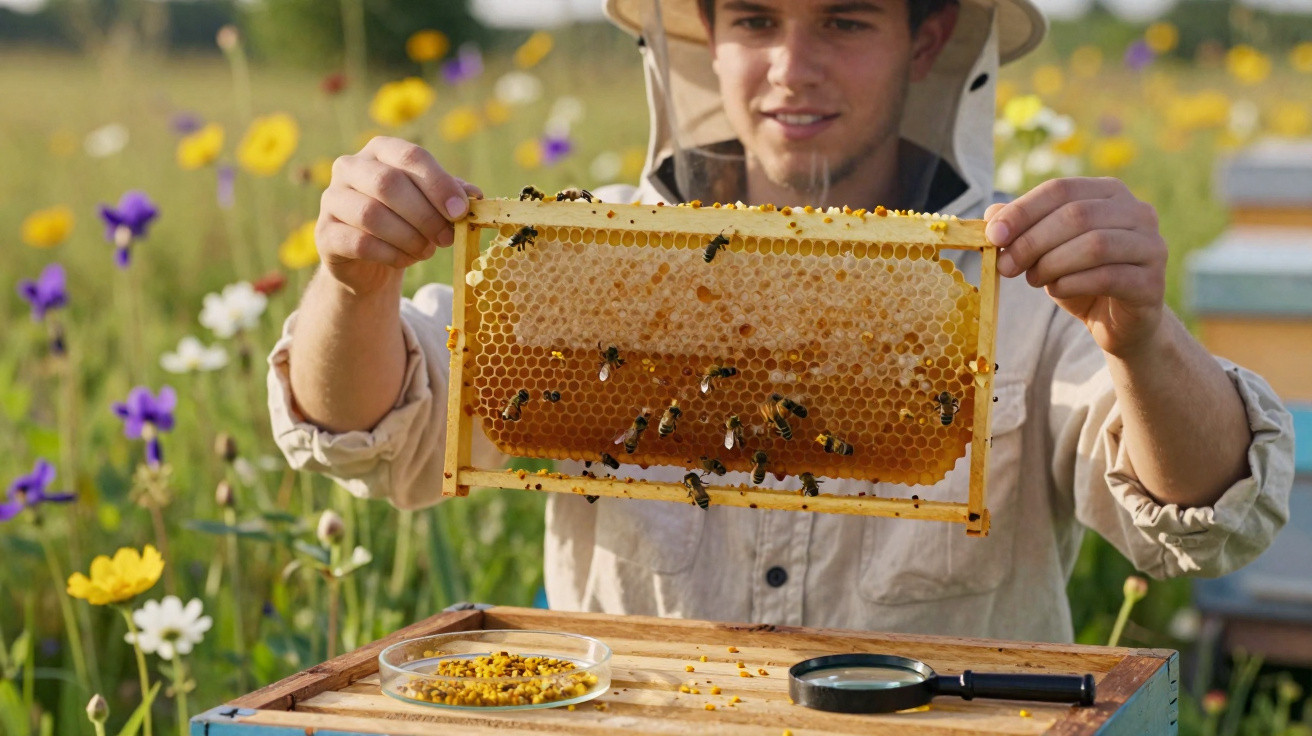
In many countries, beekeepers report weakening colonies, empty hives and mounting losses. Conventional medicines are reaching their limits, while some pathogens barely respond to commonly used antibiotics. A US research team now suggests that bees’ real protective pharmacy has long been in the hive: in flower pollen itself.
Invisible allies: what pollen really contains
Honey bees gather pollen mainly as a protein source for their brood. Inside the comb, it forms compact stores that often look unremarkable: yellow to brown clumps sealed in wax. For a long time, this pollen was regarded primarily as food. The new study presents a different picture.
Pollen is home to a remarkably diverse bacterial community. Researchers isolated 34 distinct strains of so-called actinobacteria from fresh flower pollen and from pollen already stored in the hive. Well over two thirds belonged to the genus Streptomyces - microorganisms from which human medicine has obtained important antibiotics for decades.
“Bee pollen conceals a kind of natural antibiotic store that protects both the animals and our crops.”
These bacteria are not found only in the hive. They are already present in flowers, adhere to the bodies of foraging bees and travel into the colony with the pollen they bring back. This creates a cycle: plants host beneficial microbes, bees transfer them, and within the hive they reinforce the colony’s microbial protective layer.
Flower diversity also feeds the microbiome
The richness of this bacterial community depends heavily on its surroundings. In landscapes with a wide range of flowering plants, pollen is not only more colourful but also more diverse microbiologically. Every plant species brings its own microflora.
In simplified agricultural landscapes dominated by large monocultures - such as vast maize or oilseed rape fields - this diversity declines. For bees, that means not merely a monotonous diet, but also a depleted microbial defensive arsenal. The study indicates that flower strips and species-rich field margins provide more than nectar and pollen: they also offer a broad range of helpful bacteria.
Natural antibiotics from the hive
What the Streptomyces bacteria can do is crucial. In the laboratory, researchers tested them against six known pathogens: three affecting bees and three infecting important crops.
- Bee diseases: the fungal infection “stonebrood”, American foulbrood, bacterial gut infections
- Plant diseases: fire blight in pome fruit, bacterial wilt, and root and stem rots in crops such as tomatoes and potatoes
Almost all tested Streptomyces strains inhibited the fungus Aspergillus niger, which causes the feared “stonebrood” disease. Infected larvae harden, turn dark and resemble tiny stones - a nightmare for beekeepers because the fungus may remain unnoticed until whole areas of brood are affected.
Other strains halted the growth of Paenibacillus larvae, the causative agent of American foulbrood. This disease is considered particularly dangerous because it spreads quickly and can destroy entire colonies. In some countries, affected hives still have to be burned.
On the plant side, pollen bacteria blocked several pathogens responsible for major losses in fruit and vegetable production. These included bacteria that cause fire blight in apple and pear trees, wilt in tomato plants and rot in potatoes.
The compounds produced by the bacteria
The microbes do not rely on a single active substance. They function like miniature chemical laboratories, producing a whole range of bioactive molecules, including:
- PoTeMs: complex macrolactams with strong antimicrobial activity
- Surugamides: cyclic peptides that block the growth of various bacteria
- Lobophorins: compounds with a broad antibacterial spectrum
- Siderophores: molecules that bind iron, depriving pathogens of an essential nutrient
Many of these compounds target bacteria or fungi specifically without measurably harming bees or plants. This is precisely what makes them attractive for farming and beekeeping: a biological weapon naturally integrated into the cycle of materials.
How plants, microbes and bees work together
To establish where the Streptomyces strains originate, the research team analysed their genetic material. The result was that they do not simply occur randomly on plant surfaces, but live as so-called endophytes inside plant tissues. There, they support their green “home”, for example by producing growth hormones or making nutrients available.
The researchers identified characteristic genes that allow these bacteria to:
- break down plant cell walls
- produce growth factors such as auxins and cytokinins
- mobilise iron using siderophores
When plants flower, the endophytes enter the pollen. Foraging bees brush them off with their legs, make their pollen baskets and thereby carry the microbes directly into the hive. There, they multiply in the stored supplies and continue producing antimicrobial substances. No additional external treatment is required.
“Plant, bacterium and bee form a kind of protective community in which every side benefits - and, ultimately, so do people through more stable harvests.”
A new opportunity for chemical-free beekeeping
Until now, beekeepers have generally relied on two antibiotic active substances when serious disease strikes. Although these products can save colonies, they also create problems: residues in wax and honey, disruption to bees’ gut microbiome, and increasing pathogen resistance. Some foulbrood bacteria already respond only weakly to standard medicines.
The pollen bacteria described here point to a different strategy: rather than killing harmful germs and taking the entire microflora with them, it may be possible to encourage beneficial bacteria selectively. The aim would be to strengthen colonies’ biological “protective wall”.
What such an application could look like
Researchers and commercial operators are considering several possible approaches:
- breeding and multiplying particularly effective Streptomyces strains from local plants
- mixing these bacteria into feed paste or pollen substitutes that beekeepers already use
- applying them in flower strips, allowing bees to collect them naturally while foraging
- combining them with bee breeding lines that are especially diligent at bringing in pollen
For this to work, key questions still need answering: how stable are these strains in the hive? Do they affect the flavour of honey? How do other microorganisms in the hive respond? Initial laboratory and pilot trials appear promising, but long-term effects can only be assessed through field trials.
Benefits for agriculture and food security
The implications extend far beyond individual beekeeping operations. Around one third of our food depends directly or indirectly on pollination by insects. When bees become ill, fruit, vegetable and oilseed harvests are affected as well. At the same time, bacterial and fungal diseases destroy millions of tonnes of apples, tomatoes and potatoes every year.
Pollen bacteria act on both levels: they help stabilise bee populations while also inhibiting important plant pathogens. In future, farmers could use them as biological plant protection products - for example, as seed treatments, blossom sprays or soil preparations in vegetable growing.
If such solutions become established, the use of synthetic fungicides and antibiotics could fall. That would reduce pressure on ecosystems, limit residues in food and lower the risk of new resistance.
What beekeepers and gardeners can do now
The bacteria described are not yet an approved product. Even so, the study offers practical lessons that any beekeeping operation and home gardener can apply.
- Greater flower diversity: mixtures of wild and cultivated plants flowering from spring to autumn increase the likelihood of a rich pollen microbiome.
- Native plant species: local flora carries established endophytes adapted to the climate and soils.
- Restrained use of chemicals: fungicides and broad-spectrum antibiotics can affect beneficial microbes as well as pathogens.
- Reliable pollen supplies: strong, well-nourished colonies can make better use of microbial protective mechanisms.
For the home garden, this means that mixing fruit trees, wild perennials and herbs does more than create a buffet for insects: it also supports this subtle interaction between plants, microbes and pollinators.
Key terms and background explained
American foulbrood: A bacterial disease of bee brood. Larvae liquefy and die, and whole colonies can collapse. Many countries require strict control measures, including the destruction of equipment.
Stonebrood: A fungal infection of larvae in which offspring become hard and dark. Infestation is often detected late because symptoms become clearly visible only at an advanced stage.
Endophytes: Microorganisms that live inside plants, usually without causing harm. Some promote growth or protect against pathogens - a quiet defence system in leaves, roots and flowers.
Siderophores: Substances bacteria use to bind iron, giving them an advantage over other microbes. Disease-causing germs come under pressure when they are deprived of this essential element.
The study makes one point particularly clear: anyone seeking to save bees must consider more than Varroa mites, honey yields and treatment plans. The inconspicuous life in pollen also matters - depending on the landscape, it contains stronger or weaker allies that can protect bees and crops at the same time.





Comments
No comments yet. Be the first to comment!
Leave a Comment