
At times, discoveries emerge that prompt us to reconsider how the earliest communities created shared meaning.
Göbekli Tepe human statue discovery
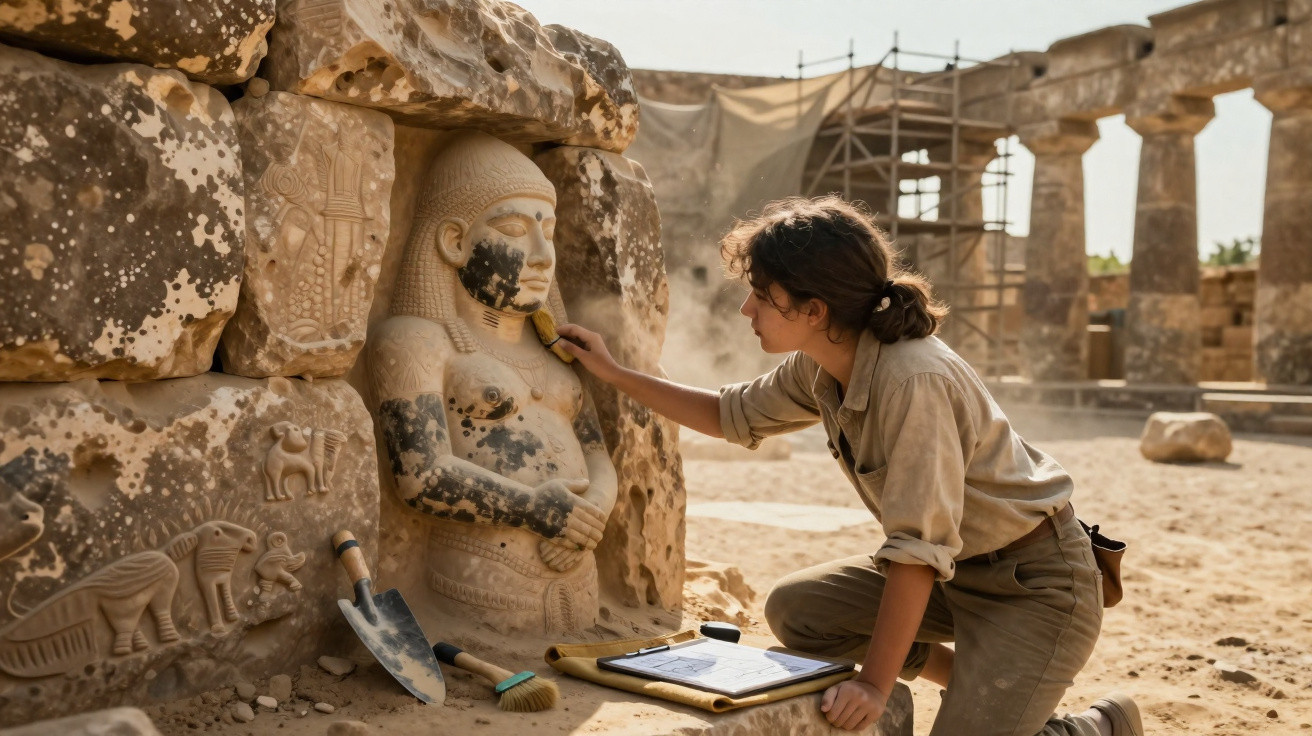
A recent discovery at Göbekli Tepe, in the hills of south-eastern Turkey, poses striking questions about faith, construction and remembrance. Researchers led by Professor Necmi Karul of Istanbul University have found a human statue enclosed within a stone wall at the site, which dates to approximately 9600–8800 BCE. Mehmet Nuri Ersoy, Turkey’s culture minister, announced the discovery on social media. The excavation forms part of the Taş Tepeler programme, bringing together 36 institutions and 220 researchers at ten Neolithic locations. Conservation work is under way, while a peer-reviewed study has yet to be published.
A discovery from a closely documented excavation
Göbekli Tepe stands around 15 kilometres from Şanlıurfa, on a limestone ridge overlooking the surrounding plain. Excavators found the figure lying horizontally in a recess within a wall, apparently positioned there deliberately. Both its context and close fit point towards a votive deposit rather than the casual use of building debris. Stratigraphic records, geomagnetic surveys and systematic photographs chart the excavation sequence.
The archaeologists protected the object as soon as it was uncovered, reducing the risks from weather exposure and handling. Detailed photographs have not been released while the artefact undergoes cleaning, stabilisation and assessment. The Ministry of Culture and Tourism oversees this work, regarding the discovery as important to both the nation and science.
A deliberately embedded human figure inside a Pre‑Pottery Neolithic wall is both rare and forceful for this region.
For the researchers, the setting is as significant as the statue itself. By incorporating a human form into the masonry, the builders made the wall a vessel for meaning rather than merely a ceremonial background.
A rare human figure among stone animals
Göbekli Tepe is renowned for its T-shaped pillars, decorated with foxes, snakes, wild boar and vultures. Fully formed human images are uncommon on the hilltop. This contrast is important, indicating that animal motifs carried most of the builders’ messages. A complete human sculpture built into the architecture departs from that pattern and merits particular attention.
Initial dating places the object in the site’s earliest Pre-Pottery Neolithic A occupation. This period came before pottery and the widespread keeping of domestic animals. Its communities hunted, gathered and stored resources, but also created monumental structures. In such a context, a human statue invites questions about identity, ancestors and how early groups expressed belief.
What its position and pose may represent
- A protective figure identifying a threshold within a ritual chamber.
- A dedication associated with a building’s construction or closure.
- An ancestral representation that sealed collective memory into the stonework.
- Part of a wider symbolic frieze that has since disappeared.
- A cosmic symbol, combining a human form with animal carvings to balance a mythic order.
There are related indications at Karahantepe, another Taş Tepeler location, where incomplete human carvings have been found. These examples provide useful comparisons, but the deliberate insertion of an entire statue into a wall remains highly unusual. Its exceptional nature is likely to fuel discussion about purpose and significance for many years.
Architecture with meaning
Göbekli Tepe does not appear to have been a conventional village. Excavations have revealed no hearths, burials or domestic floors. Instead, teams have recorded circular and oval enclosures formed from enormous pillars, some reaching six metres in height and weighing as much as 20 tonnes. Their makers quarried, carved and transported these stones through organised labour and effective engineering.
The newly revealed statue further supports the idea that ritual and architecture operated as one system. In this reading, the wall serves as text, the structure performs an act, and the statue anchors a message within the building itself.
Work on Structure C, completed in 2025 through the Heritage for the Future programme, returned several pillars to positions indicated by their original sockets. Experts strengthened outer walls using mortar mixed with goat hair, following formulas identified during earlier phases. Geophysical investigations are now identifying voids and concealed alignments to direct the next excavations.
Here the building is not just a shelter for ceremony; the building is the ceremony.
Reconsidering the beginnings of settled life
For many decades, textbooks presented farming as the force that produced permanent settlements and monuments. Göbekli Tepe helped reverse that interpretation. It demonstrates that mobile or partly mobile communities devoted substantial effort to communal gathering places before farming became secure. The human statue set into the wall accords with this view: myths enacted in stone may have united groups firmly enough for them to return season after season.
This reframing has broader theoretical importance. It places belief and social organisation alongside crops and storage in accounts of increasing complexity. Symbols, feasting and rules may organise labour, while public buildings can consolidate alliances. The discovery also belongs within a wider cultural policy. Following a Rome exhibition in 2023, Turkey is planning a Berlin exhibition in 2026 featuring 96 objects from Şanlıurfa’s museum, presenting these early ritual experiments on an international stage.
What comes next
Conservation specialists will examine toolmarks, pigments and residues. Microscopic study may identify traces of limewash or bitumen, and micro-CT scanning could expose internal fractures or methods of joining. Should soil survive around the statue, laboratories can investigate phytoliths and microscopic charcoal for evidence of activity beside the wall. Stable-isotope analysis of calcite deposits may also improve the site’s micro-chronology.
Field teams will revisit neighbouring stones to look for sockets, plaster layers and cutbacks corresponding with the statue’s location. A closely defined context could establish whether the insertion accompanied floor renewal, pillar replacement or the closure of a room. Each possibility would imply a distinct ritual sequence.
Reading a face 12,000 years old
Interpretation is not without hazards. Modern observers may impose familiar concepts of rulers or gods on prehistoric images. Researchers will compare its proportions, gestures and stylised features with other PPNA figures from the northern Levant. They may assess whether details such as hands, belts or genital markers correspond with recognised forms. Deliberate abrasion on the face could indicate ritual “killing” before deposition. Eye sockets intended for inlays, meanwhile, might suggest that the statue once appeared to return its audience’s gaze.
Practical context for readers
Pre-Pottery Neolithic A was a transitional era between late hunter-gatherers and the first settled communities. People established large shared spaces, stored food and worked stone on a substantial scale, while still depending heavily on wild resources. Sites including Göbekli Tepe preserve this in-between period, when gathering places connected groups across the seasons.
Conservation creates its own challenges. Once exposed, stone is more vulnerable to salt formation, micro-cracks and pigment deterioration. Teams in Şanlıurfa now prefer shelters, managed drainage and reversible mortars. Digital twins assist with planning movements and sharing information without touching the original artefacts. Greater public attention can support funding, but also requires careful visitor management to safeguard delicate surfaces.
Key takeaways at a glance
- A human statue was found embedded in a wall at Göbekli Tepe, inside a PPNA structure near Şanlıurfa.
- Its context indicates purposeful placement, probably connected with ritual activity and shared memory.
- Human forms are unusual at the site, which is chiefly known for animal reliefs on T-shaped pillars.
- The discovery reinforces the argument that shared rituals and symbols helped sustain early communities before agriculture became dominant.
- Conservation and analysis continue; full publication should clarify its style, craftsmanship and meaning.
Readers wishing to explore the subject further may focus on two themes. The first is the social arithmetic of constructing monuments: straightforward models indicate that a small number of powerful incentives, including feasts, story cycles and marriage agreements, could mobilise hundreds of people without kings or taxation. The second concerns the production chain: extracting stone, carving, moving and installing a statue generate specialised roles and abilities that then influence status and training. The wall statue stands precisely where these forces meet, with belief joining technique to leave a trace that remains readable today.






Comments
No comments yet. Be the first to comment!
Leave a Comment