
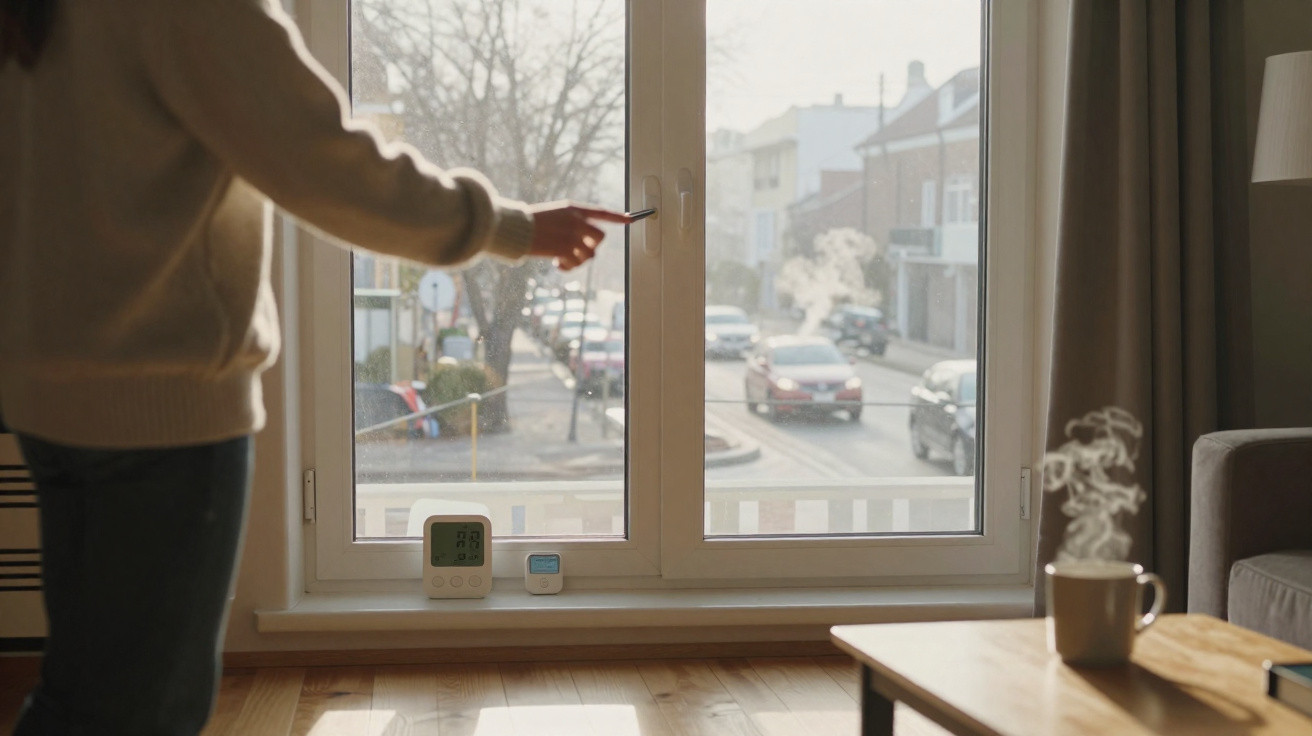
Those chilly first hours of the day can seem ideal for “freshening up” the house.
The air outside feels sharp and clean – perhaps even healthier than the air enclosed indoors.
Even now, many households open their windows wide soon after breakfast, believing it benefits both their breathing and their heating costs. Yet this routine increasingly conflicts with what air-quality specialists and building engineers measure every winter morning.
Morning rush hour, invisible smog
Between about 8 and 10 a.m., towns and suburbs become intensely busy. Commuters switch on their cars, buses begin to fill, parents make school runs and delivery vans move through residential streets. This activity produces a rapid surge of exhaust fumes, fine particles and a complicated blend of gases.
If you open the windows during this period, the air in your living room joins that outdoor mixture. What seems “fresh” may contain nitrogen oxides, fine particulate matter (PM2.5 and PM10), and remnants of unburnt fuel. These pollutants can enter homes readily, particularly flats near heavy traffic or properties in densely developed neighbourhoods.
Airing your home during the morning peak doesn’t dilute pollution – it can import the worst outdoor air of the day straight into your bedroom.
Health bodies associate repeated contact with fine particles with irritated airways, worsened asthma, cardiovascular strain and higher hospital admission rates on heavily polluted days. Children, older people and anyone with heart or lung conditions are more sensitive, although nobody’s lungs are entirely immune.
Winter makes this problem harder to escape. Cold air close to the ground can become trapped beneath warmer air above, creating what is called a temperature inversion. Rather than dispersing, pollutants build up at roughly window height. At street level, poor air circulation therefore occurs precisely when people open their homes to “change the air”.
Why indoor air often beats outdoor air in the morning
Indoor air has a poor image because of dust, cooking vapours and chemical releases from furnishings or cleaning products. However, across many urban areas during winter, outdoor air from 8 to 10 a.m. may be more polluted than the air already in your home.
When you ventilated late the evening before, ran the extractor fan during cooking and managed humidity levels, the pollution indoors may be lower than that on the road outside. Opening every window during rush hour can immediately remove that benefit.
Think of your flat as a filter: it slowly accumulates pollutants, but opening the windows at the wrong time replaces what you have with a more contaminated mix.
Monitoring equipment near busy junctions records distinct rises in nitrogen dioxide and ultrafine particles from 7.30 to 9.30 a.m. Levels gradually reduce afterwards as traffic calms, sunlight strengthens and air masses circulate. Matching your ventilation routine to this pattern means inhaling air at the top of the pollution curve.
Cold air, warm bills
There is also a less obvious reason not to air rooms early on winter mornings: physics and the demands on your heating. For most properties, temperatures outside shortly after sunrise are close to the day’s lowest point. Opening several windows together lets heat stored in the walls, floors and furniture escape, while heavy cold air enters.
Your heating must then work more intensely to bring the home back to a comfortable temperature. This greater demand happens when energy suppliers often experience their own “peak load”, as homes, workplaces and schools all use gas or electricity. Some networks meet this demand with less efficient backup plants, producing further air pollution – a cycle that leads directly back to the morning window routine.
How much heat you actually lose
The heat loss involves more than the air. Internal surfaces cool too, and when their temperature falls below that of the room, you may notice a mild chill for several hours. In poorly insulated properties, brief but repeated window opening during the coldest part of the day can result in considerable waste over an entire season.
| Scenario | Outdoor temp | Effect on heating |
|---|---|---|
| Windows open 10 min at 8:30 a.m. | 0–3°C | Steep temperature drop, boiler or heat pump runs at high output |
| Windows open 10 min at 12:30 p.m. | 5–9°C | Milder drop, shorter reheating period, lower peak load |
Building engineers also highlight a further consequence: major, repeated temperature changes put added strain on radiators, heat pumps and boilers. Heating systems switch on and off more often, potentially reducing their service life and increasing maintenance needs over time.
When should you air your home in winter?
Ventilation is still essential. Without it, humidity rises, windows steam up and mould can gradually develop behind wardrobes and in corners. Rather than avoiding fresh air entirely, the important factors are the timing and method of airing your home.
Smarter airing windows during the day
For most homes, the most practical approach is a short and controlled ventilation period during the quieter, warmer part of the day, typically from late morning to early afternoon. Traffic is generally lighter then, even weak winter sunshine has raised outdoor temperatures a little, and the air disperses more effectively.
- Use “shock ventilation”: open windows on opposite sides fully for 5–10 minutes, creating a powerful cross-draught.
- Opt for late morning or early afternoon, when temperatures outside and pollutant dispersion are generally more favourable.
- Prioritise moisture-producing rooms: the bathroom after showering, the kitchen after cooking and bedrooms after the night.
- Reduce the thermostat setting slightly before opening the windows, then return it to normal after closing them.
Some newer or refurbished homes use mechanical ventilation systems with heat recovery. These units remove stale air and bring outdoor air in through a heat exchanger that retains much of the heat. In these homes, keeping windows closed and allowing the system to operate can often offer a better balance of fresh air, comfort and energy consumption.
If your home has mechanical ventilation with heat recovery, frequent window airing in winter can actually disrupt its carefully balanced airflow.
The hidden role of humidity and condensation
Visible condensation and damp bedroom odours are among the reasons people open windows immediately in the morning. During the night, two adults can put more than a litre of water into the air simply through breathing. If it cannot escape, that moisture condenses on cold windows and walls.
A quick, intensive airing session is still helpful in this situation – but it need not happen during rush hour. You can delay it for half an hour or longer, allow the main traffic flow to pass, and then open the windows fully. Keeping the indoor temperature slightly higher during the evening can also help reduce condensation the following morning.
Dehumidifiers, suitably sized extractor fans and trickle vents above windows can also keep moisture under control. Reduced humidity lowers the risk of mould, limits dust mites and makes a room feel warm at slightly lower temperatures, reducing the burden on your heating in turn.
What commuters and home workers can actually do
Everyday life seldom follows an ideal timetable. Parents handling school runs, remote workers attending video meetings and shift workers each have different schedules to manage. Despite these limitations, modest changes can affect the quality of winter air you breathe.
Practical adjustments for typical households
- When leaving home early, ventilate the bedroom briefly on waking, then do so again at lunchtime or on your return, rather than between 8–9 a.m.
- If you work from home, do not leave windows slightly open throughout the morning. Instead, use one or two short, intensive airing sessions around midday.
- In polluted locations, consult local air-quality forecasts or look at the horizon; delay ventilation on days with obvious smog or official alerts.
- Pair winter ventilation with straightforward measures: keep internal doors closed while airing rooms to prevent the entire home cooling, and position furniture a few centimetres from cold external walls to reduce concealed mould.
Transport is another consideration. Every car taken out of the morning rush lowers emissions around houses and schools. Choosing to walk, cycle or share journeys reduces pollution around your windows and marginally improves background air quality for everybody’s ventilation routine, including your own.
Households planning renovation can also treat insulation, airtightness and controlled ventilation as a combined strategy rather than individual projects. A well-insulated property without planned air routes can trap both moisture and pollutants. Introducing a balanced ventilation system, even a basic one, makes short winter airing periods a backup measure rather than the only protection against stale air.






Comments
No comments yet. Be the first to comment!
Leave a Comment