
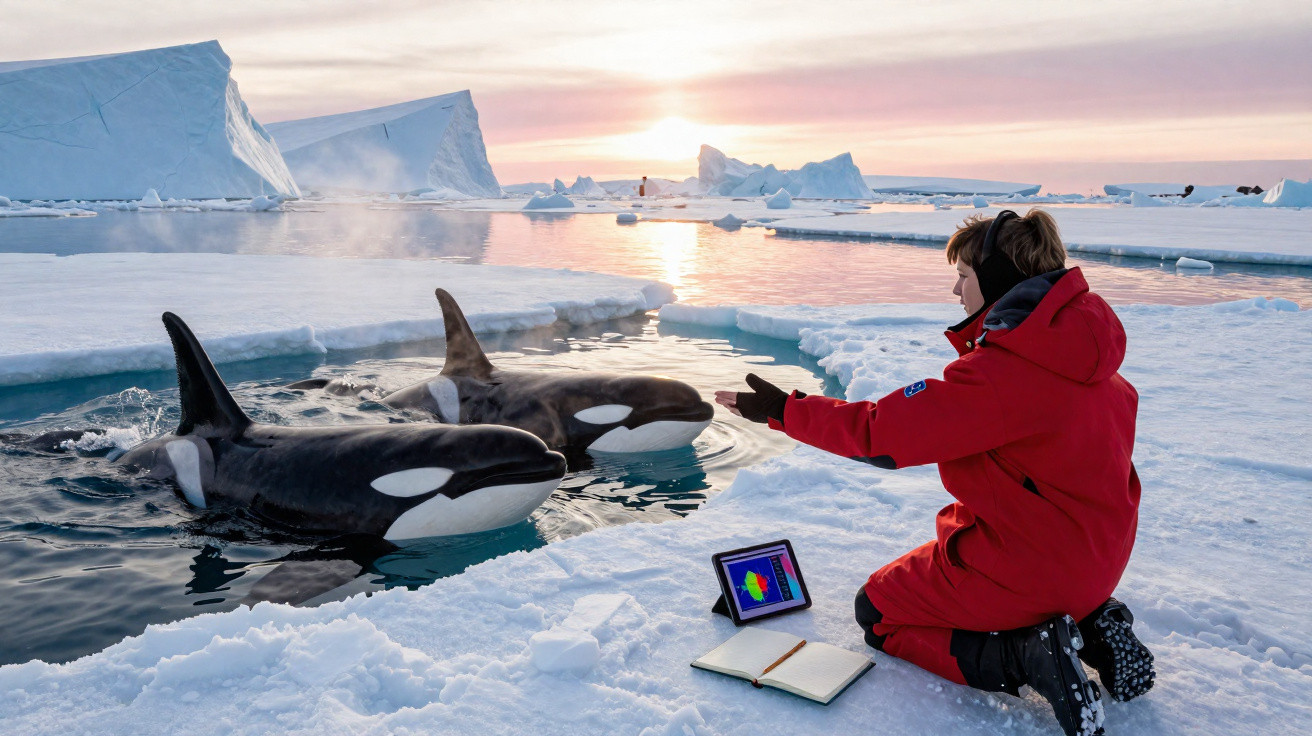
The ice cracks first, its report as sharp as a gunshot ringing across the fjord.
A black fin then cuts through the steel-grey water, moving directly towards a wall of ancient ice that appears less secure than it did only last summer. On the stony shoreline, a handful of researchers fall silent. All at once, nobody moves. The orca breaks the surface once more, nearer now, releasing a deep, hollow breath into the bitter air. It is stunning. It is also unsettling. Too near. Too warm. Too soon.
Phones come out, GPS positions are marked and voices become hushed. One person remarks that, in August, this used to be firm sea ice rather than open water visited by apex predators. Someone else checks the radio, though they already know the response that will come from town: the alert level is increasing. A gull shrieks above the subdued anxiety before disappearing into the white sky. A boundary is being crossed in real time, and nobody present knows what comes after.
Orcas at the edge of a collapsing world
Along Greenland’s west coast, close to communities that depend on sea ice as cities depend on roads, orcas are now travelling through waters where they were once almost never spotted. These predators are entering confined fjords and moving beside breaking ice shelves as they follow warmer currents and unfamiliar prey. For local people, the spectacle is both magnificent and deeply disturbing. Hunters raised to understand the ice instinctively now face conditions that keep changing.
Patrol researchers have begun recording orcas not only far offshore but immediately beside the vivid blue fronts of melting ice. They report hearing ice shelves release blocks as large as lorries while orcas circle nearby, seemingly probing the perimeter of a collapsing stage. This is no longer a remote account of climate change. It is an everyday, visible transformation of who uses these waters and under what conditions.
Greenland’s emergency declaration was not made without warning. For months, teams had monitored thinning ice, unexpected spikes in heat and increased marine traffic. The decisive factor was the recurring pattern: orcas repeatedly breaching within metres of ice shelves weakened by record melting. This is not solely about whales. It concerns the feedback loop they reveal. Warmer seas create routes for predators; predators alter ecosystems; ecosystems lose their former foundations. Ice already stressed from above and below becomes another unstable frontier in a region founded on frozen reliability.
What people can actually do from thousands of kilometres away
When you are looking at a phone between two Underground stops, Greenland’s emergency can seem far removed. Yet one highly practical, if unexciting, action can affect the direction of travel: paying attention long enough to make the connections. Follow data published by polar institutes, support independent reporting from the Arctic and remain interested after a headline has stopped trending. It may sound insignificant, but it is not. That attention underpins the funding, electoral choices and public pressure needed for major climate decisions.
A useful starting point is to follow one or two genuine measures instead of relying on a general feeling. Watch North Atlantic sea-surface temperature maps, summer sea-ice extent updates or a newsletter written by scientists studying Greenland’s glaciers. Rather than endlessly scrolling through every catastrophe, focus on a few figures and see how they shift from one season to the next. You begin to recognise the pattern that people in that fjord already inhabit.
Let us be honest: nobody really does this every day. Life is busy, and the Arctic can feel like another planet until food prices rise or fish disappear from coastlines you know. This is why regular habits matter more than grand gestures. Moving to a green energy supplier, voting for climate-focused local policies and reducing the most carbon-intensive journeys may not be glamorous, but together they achieve more than a single dramatic act every decade. At a global level, the orcas are not the villains here. Our exhaust pipes and power stations are.
“Watching orcas hunt at the edge of a collapsing ice shelf is like seeing a warning light flash on the dashboard of the planet,” says a marine ecologist based in Nuuk. “It’s spectacular, and it’s a sign that the system we grew up with is already gone.”
Most of us have experienced the moment when a crisis elsewhere abruptly becomes personal: a favourite holiday beach flooded, wildfire smoke drifting across a city or a child wondering why there is less snow than in old photographs. Greenland’s emergency belongs to that same quiet class of changes that reshape reality before we are ready to acknowledge them. The space between “somebody should do something” and “this is my problem too” is where much of the future is being decided right now.
- Follow one dependable Arctic science source and review it every month.
- If possible, avoid one high-impact flight over the next two years.
- Support at least one organisation involved in polar research or Indigenous rights.
A future written in ice and dorsal fins
There is an unsettling closeness in the image of orcas passing the last unbroken edge of an ice shelf. It is not a Hollywood catastrophe, with no enormous wave engulfing a city. Instead, it is a gradual creak, an unfamiliar fin on the horizon and a community radio broadcasting another report on changing ice routes. This is how periods end in the real world: quietly, in places that never chose to become the front line.
For Greenland, the emergency involves more than shielding people from sudden collapses and dangerous currents. It also means preserving a way of interpreting the landscape that has served communities for generations. Once ice becomes unreliable, the language, stories and expertise shaped around it begin to falter as well. Hunters must make more guesses. Fishers must travel farther offshore. Children grow up beside a coastline their older relatives scarcely recognise. Climate change ceases to be a theory and becomes a broken promise between people and place.
These sleek orcas, perfectly suited to their environment, are not invading monsters. They are doing what life has always done: pursuing warmth, food and opportunity. The difficult reality is that their new feeding grounds are a live transmission of the emissions produced over recent decades. That is painful to confront. But looking away does not reduce the melting. Telling the story does. Discussing Greenland around dinner tables, in classrooms and in message threads where climate change normally appears only as a meme is how far-off cracks in the ice begin to matter in cities thousands of kilometres away. Once they matter, they can still be changed.
| Key point | Detail | Why it matters to the reader |
|---|---|---|
| Orcas near melting ice shelves | Researchers report orcas breaching dangerously close to weakened ice in Greenland’s fjords. | Offers a striking image of how quickly the Arctic is changing today. |
| Emergency declaration | Greenland raised its alert after repeated sightings linked with rapid ice loss and warmer seas. | Demonstrates that this is more than a viral video - it is an official climate emergency. |
| Concrete actions | Follow Arctic data, support climate policy, and change personal energy and travel choices. | Turns a faraway crisis into practical steps you can take. |
FAQ:
- Why did Greenland declare an emergency over orcas? Scientists observed orcas operating unusually close to rapidly melting ice shelves, highlighting acute risks for local communities, ecosystems and infrastructure tied to unstable ice.
- Are the orcas themselves dangerous to people there? Direct attacks are extremely rare, but their presence signals thinning ice, shifting prey and hazardous conditions for hunters and boats that depend on predictable sea ice.
- What does this have to do with global climate change? Warming oceans and air temperatures are shrinking sea ice, opening new routes for orcas and other species, and accelerating the breakdown of Greenland’s ice shelves.
- Can this trend be reversed? Some local changes may be locked in, yet rapid cuts in greenhouse gas emissions can slow future warming and limit how extreme Arctic transformations become.
- What can someone far away realistically do? Support strong climate policies, reduce high-impact emissions in your own life, follow and share credible Arctic research, and back organisations working on polar and Indigenous resilience.





Comments
No comments yet. Be the first to comment!
Leave a Comment