
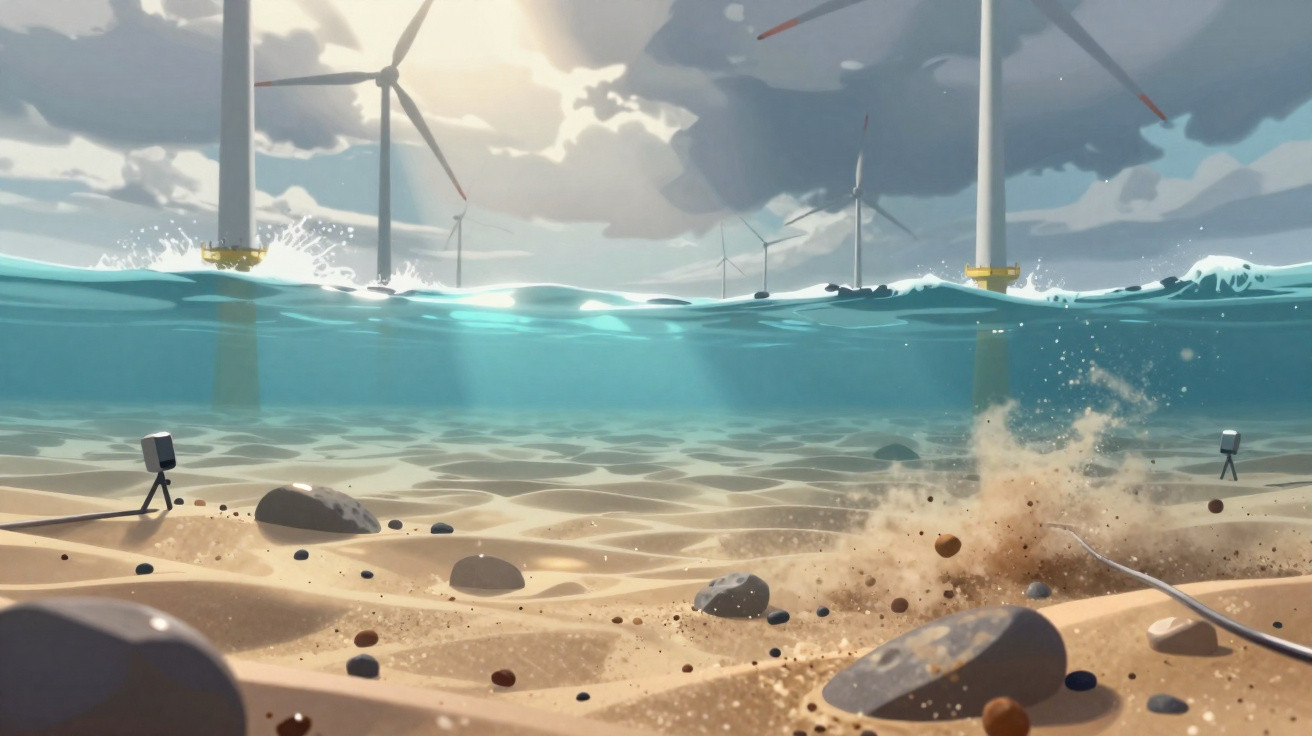
More water above the seafed might seem certain to increase stress on the seabed. While that may be the instinctive conclusion about sea level rise, the underlying physics point elsewhere.
New research has examined the issue beneath the surface. Its findings from waters off north-west Europe matter for every wind turbine, cable and living organism on the sea floor.
A hidden frontier
Climate studies largely focus on warming at the ocean surface or coastlines being lost. Far less attention is given to the make-up of the seabed and to the organisms that inhabit it or live on top of it.
Dr Julia Rulent, an oceanographer at the National Oceanography Centre (NOC), headed a team aiming to address that gap.
The researchers merged ocean and wave models with climate projections extending to 2093.
Their case study covered the North Western European Shelf, although the physical processes involved apply to shelf seas around the world. More precisely, the team investigated how rising sea levels and more intense storms could alter stress on the ocean floor.
Two competing forces
The study separates the influence of two factors. As sea levels rise, the water surface moves farther from the bed, reducing the ability of waves and tidal currents to affect the bottom.
This makes the seabed more tranquil, stable and predictable. Storms, however, have the reverse effect.
A warmer atmosphere is forecast to bring fewer, yet stronger, winter storms to north-west Europe. Every storm sends brief, forceful bursts of energy down to the seabed.
Before this research, nobody had measured how these two influences would interact across a whole shelf sea: when and where they would be felt, or with what intensity.
Sea level’s quiet effect
Using UK climate projections, the researchers modelled two rises in water level: about 11 inches (28 centimetres) by the middle of the century and 28 inches (71 centimetres) by 2100. They applied the same weather conditions to each scenario.
Greater water depth weakens almost every effect. Bottom tidal currents slow down, while wave energy finds it harder to reach the seabed.
Amphidromes - stationary locations where the tidal range is zero - can shift by as much as 2.4 miles (3.9 kilometres).
The mean fall in seabed stress across the shelf is modest but uniform, with the greatest reductions occurring in shallow waters and high-tide estuaries such as Morecambe Bay.
There is, however, an exception. When waves stop dissipating over Dogger Bank, more wave energy reaches the coast, potentially creating larger nearshore waves in the German Bight.
Seabed stress from storms
Storm patterns present a contrasting picture. Warmer seas are associated with more powerful low-pressure systems.
Current projections indicate that UK storm severity may increase by 30% by 2080, chiefly because storms could extend over larger areas.
Rulent’s simulations show that a major winter storm late in the century could impose up to 15 newtons per square metre of stress on the seabed.
That is more than double the force produced by the strongest spring tides today. In certain areas, storm-driven stress may rise by a full order of magnitude - ten times the level seen in calm conditions.
Bigger grains begin to move
The sediment a current can carry is determined by the force it applies. Under present-day calm summer conditions, only fine sand grains below 0.004 inches (0.1 millimetres) are lifted.
Severe storms can shift grains larger than 0.4 inches (11 millimetres), including small pebbles. Along coasts facing the Atlantic, peak storm conditions can already move stones exceeding 1 inch (25 millimetres) - roughly the diameter of a 10p coin.
At present, the seasonal transition from summer to winter changes the sediment types the sea can transport across more than 193,000 square miles (500,000 square kilometres) of shelf.
By the end of the century, that winter threshold is expected to extend beyond 247,000 square miles (640,000 square kilometres).
A widening seasonal gap
Together, these trends create an unusual rhythm. Summers are forecast to become calmer as wave conditions ease and rising water levels increase depth.
Winters, in contrast, are likely to become more severe as stronger storms arrive. Benthic habitats - including worms, clams, crabs and other organisms reliant on a stable seabed - developed under the current pattern.
“Increased storminess may create more and bigger disturbance regimes for benthic communities,” Rulent and her colleagues wrote.
Species that need calm periods to recolonise disrupted areas of seabed may therefore have less time to do so.
Offshore wind at risk
The shelf ranks among the world’s most heavily industrialised marine areas. Offshore wind capacity in the EU and UK was 36 gigawatts in 2023, and 110 gigawatts are planned by 2030.
Turbines, steel foundations, scour-protection rock and seabed cables are all placed on a sea floor whose behaviour is shifting. Rock armour designed for present currents may consequently prove inadequate for the storms expected in 2080.
A separate study involving several of the same researchers found that one turbine foundation can more than double the force exerted by currents on the seabed in its wake. Climate-driven forces could then add to that impact.
What comes next
For the first time, projected changes in seabed stress and sediment mobility have been mapped for an entire shelf sea. The difference between summer and winter conditions is expected to grow throughout the century.
Sea level rise will make the bed calmer in a gradual, predictable way. Storms, by comparison, will disrupt it more intensely and more frequently, producing an increasingly wide seasonal divide.
These changes have implications for offshore wind engineering, marine protected area planning and fisheries management. The same physical processes apply to shelf seas worldwide.




Comments
No comments yet. Be the first to comment!
Leave a Comment