
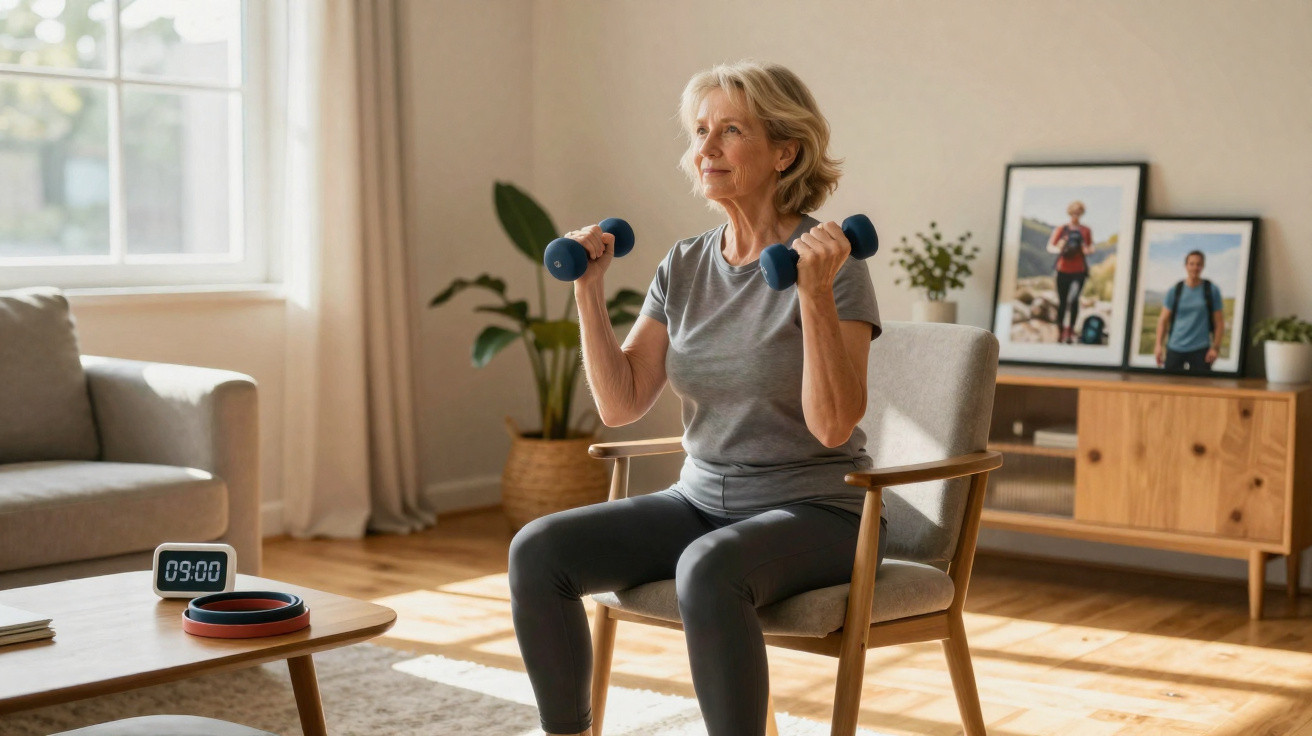
There is a moment that many of us never say aloud.
It may be when you cannot quite get a suitcase into the overhead locker, or when rising from the sofa suddenly requires a little help from your hands. There is no injury and no fuss – simply a private realisation: “Oh. I’m not as strong as I used to be.” It can show up on the stairs, as your legs begin to feel leaden, or when a stubborn jar lid defeats you and returns unopened to the cupboard.
Most of us label these moments as “getting older” and carry on. We might make a joke or dismiss it with a shrug, while a small fear remains underneath: is this the beginning of an inevitable decline? That is why research involving 62-year-olds, a stopwatch and a nine-minute exercise routine has attracted attention in scientific circles. It indicates that the familiar account of age-related muscle loss may need considerable revision.
The silent loss of muscle strength
Sarcopenia is the medical term, although most people experience it as the gradual loss of strength that can seem to arrive in our 50s and 60s. You do not wake up with half the muscle you had at 30. Instead, it resembles a silent thief taking a little each year, until one day you recognise what is missing. Your clothes may still fit and the scales may hardly change, yet lifting, pushing and carrying feel different. This is not about appearance; it is about function: standing from a chair, picking up a grandchild and retaining independence.
Doctors see its eventual consequences in hospital data: increased falls, slower recovery following surgery and people who lose trust in their bodies, then begin avoiding movement. Once that pattern begins, it can gather pace. You do less because you feel weak, then become weaker because you do less. Most of us have wondered, “If I fall now, will I be able to get back up?” before laughing it away and hoping the answer is yes.
For years, the unofficial message has been that this is simply what occurs. Muscles diminish, nerves signal less effectively, hormones alter, and that is supposedly the arrangement. Exercise might delay the process somewhat, but the underlying feeling is still one of quiet resignation. Yet what if that is not the complete picture? What if much of the loss reflects neglect rather than fate?
The research that rewrote the usual script
A research team – the kind of quietly dedicated scientists who appreciate clipboards and stopwatches – set out to test what a highly specific, brief strength programme could do for older adults. They did not recruit experienced gym-goers. The group comprised ordinary people in their 60s and early 70s, more likely to be seen at the supermarket than on the cover of a fitness magazine. Their average age was 62. Some had aches, some carried blood pressure tablets, but they all shared one feature: declining strength.
Rather than creating an ambitious hour-a-day programme that few people would maintain, the team chose the opposite approach. Nine minutes. A small selection of movements. Performed several times each week. It was the sort of routine that could fit around a boiling kettle and the low murmur of the news. After all, few people truly complete 45-minute home workouts every day; ordinary life rarely allows it.
The researchers assessed leg strength, grip and functional tasks, including repeatedly standing from a chair. They then gave participants the protocol, asked them to follow and log it, and invited them to return. The results were not miraculous, but they were quietly remarkable.
What the 9-minute protocol involves
Brief, intense and highly targeted
The protocol did not rely on elaborate equipment or complicated routines. It centred on basic strength movements that almost anyone could learn, adapted to each person’s capability. These included chair sit-to-stands, wall press-ups, slow and controlled calf raises, and several carefully selected leg exercises. Most were completed as intervals: 30–40 seconds of effort, a brief rest, then another round. That was enough time for muscles to work properly, without making the session overwhelming.
The whole routine lasted roughly nine minutes. This was not “nine minutes if you’re a triathlete with perfect form”, but nine minutes for ordinary people who stop, breathe, adjust their footing and shake out their hands. Some volunteers began with the most basic versions: holding the chair for balance, bending their knees only slightly and progressing gradually. What counted was not how impressive the exercises appeared, but the consistent, repeated message to the muscles: you are still required.
The difficult but essential element
One condition mattered especially: the movements needed to feel demanding. They were not meant to hurt, but by the last seconds of each set they had to be truly hard. It is the point at which your thighs object and your mind supplies several persuasive reasons to stop. That point is where muscle fibres can respond, even at 62 or 72.
Many participants needed to rediscover what “challenging” meant, because ageing often encourages us to reduce effort instinctively. The researchers took care, checking blood pressure, watching for pain and altering repetition numbers. This was not a macho demonstration of courage. It was controlled stress delivered in small, precise amounts. Over time, those small amounts began to accumulate.
What changed for the 62-year-olds
After several weeks, the figures had changed. Strength tests showed definite improvements: greater leg power, stronger grip and quicker performance when standing from a chair and walking a short distance. Some people who had found repeated chair stands difficult without using their hands could now manage them far more easily. These may not be achievements to boast about in the pub, but they matter enormously in daily life. They can mean the difference between fearing stairs and simply… climbing them.
There were also quieter changes that did not fit tidily into a spreadsheet. Several volunteers said they felt “more solid” on their feet when leaving a bus or walking over uneven pavements. Others noticed practical differences: carrying the shopping without pausing, or feeling less exhausted by the end of the day. One woman spoke of the unexpected satisfaction of opening a stiff window catch without asking her partner for help. The soft click of the window frame became a modest triumph.
Biologically, the explanation is encouraging. Muscles in our 60s and 70s can still react to the appropriate challenge by producing thicker, stronger fibres. The nervous system also becomes more effective at signalling those muscles. The changes may not be as dramatic as they would be at 25, but they are undeniably genuine. The old account claimed, “It’s all downhill.” The data quietly responds, “Not if you train.”
The emotional effect of becoming stronger
Far more than biceps
The researchers were struck not only by improved scores, but by changes in participants’ bearing. Recovering strength seems to affect posture, mood and the way a person moves through a room. One participant said she felt less “fragile”, as though the thin glass layer surrounding her daily life had become thicker. Everyday actions appeared less hazardous: reaching towards a high shelf, stepping into the bath or crossing a wet floor.
Muscle is often treated as something relevant only to appearance or sport. For older adults, it concerns freedom and identity. It is being able to agree when a friend proposes a walk, or to sit on the floor with a toddler knowing that getting back up will not become a minor ordeal. This is not vanity; it is dignity. When you can rely on your body physically, the world seems larger again.
The “I thought that ship had sailed” realisation
A number of people involved in the study acknowledged that they had assumed they could no longer improve at anything physical. Perhaps they could maintain what they had, or slow further loss, but genuine progress seemed reserved for younger people. Discovering that their legs could become stronger at 62, rather than merely decline more slowly, came as a quiet surprise.
That is the part that stays with you. The 9-minute protocol matters not only for the exercises themselves, but for what it symbolises: moving from passive decline to active control. It suggests that the next decade need not be something that simply happens to your body as you observe it, but something you can influence through small, efficient actions. Not everyone will take that option, but its existence matters.
How the 9-minute protocol can fit real life
Picture an entirely ordinary morning. The kettle is boiling, and grey, gentle daylight falls through the kitchen window. Rather than scrolling absent-mindedly or waiting for the water, someone pulls out a solid chair and completes 30 seconds of sit-to-stands. They rest for 30 seconds, then repeat. Next come gentle wall press-ups, supported calf raises and timed practice in safely getting up from the floor. Nine minutes later, the day continues.
There is no gym subscription, Lycra or motivational soundtrack. Some days will be missed because the grandchildren are visiting or the knees do not feel right. On other days, a person may feel stronger and work a little harder. The quietly radical and valuable principle is consistency rather than perfection. Three or four times each week, they are having a small conversation with their muscles instead of postponing everything until the grand monthly gym session that never quite materialises.
This is the detail many of us overlook. We tend to picture change as a dramatic gesture: a new membership, a fresh diet or an ambitious programme. Particularly as we age, our bodies may respond better to modest, truthful rituals that can be repeated. The nine-minute protocol belongs in the untidy reality of everyday life. It does not require you to become “a gym person”; it requires only that you regularly tolerate a few minutes of effort.
The difficult truths – and the encouraging one
There are some unavoidable realities. No matter how well designed, no protocol can remove every consequence of ageing. Joints still wear down, recovery still takes longer and certain health conditions create genuine safety limits. There will be mornings when even nine minutes seems like too much, and days when your body calls for rest – when it does, you should listen.
Starting from significant weakness can also feel emotionally exposing. It is not enjoyable to attempt sit-to-stands and find yourself short of breath after ten seconds. It can bruise your pride and make you want to shut the door and abandon the idea altogether. However, that discomfort is often the entrance point. The study participants who made progress did not begin strong; they began honestly.
Then there is the hopeful reality: muscle is more responsive than we have been led to think. Even later in life, it can react to effort when it receives the right signal frequently enough. That does not require turning the living room into a boot camp. It may mean only nine purposeful minutes, three times each week, reminding your legs, core and grip that they remain necessary and part of the plan. Age doesn’t cancel your right to get stronger; it just changes the terms of the deal.
A new account of growing older
None of us is returning to our 25-year-old body, and there is a certain grace in recognising that fact. Yet accepting reality does not mean yielding to it entirely. The story many of us were raised with – that ageing is an unavoidable slide into weakness – appears both lazy and somewhat cruel. Findings from that 9-minute protocol point towards another account: decline may be negotiable rather than assured.
Imagine yourself at 70, 75 or 80, not as a number but as someone stepping off a bus, carrying a bag, climbing a few stairs or laughing with a friend as wind reaches your face. Strength is the unseen framework beneath these moments. You barely notice it when it is present, but its absence becomes painfully obvious.
So when scientists report that 62-year-olds regained strength through nine minutes of focused exercise, it is more than an appealing detail from a study. It is an invitation – not to pursue youth, but to make the body you have now more robust and more kindly supported. You are not too old to get stronger. That straightforward, persistent truth may be the most radical thing we have heard about ageing for a very long time.





Comments
No comments yet. Be the first to comment!
Leave a Comment