
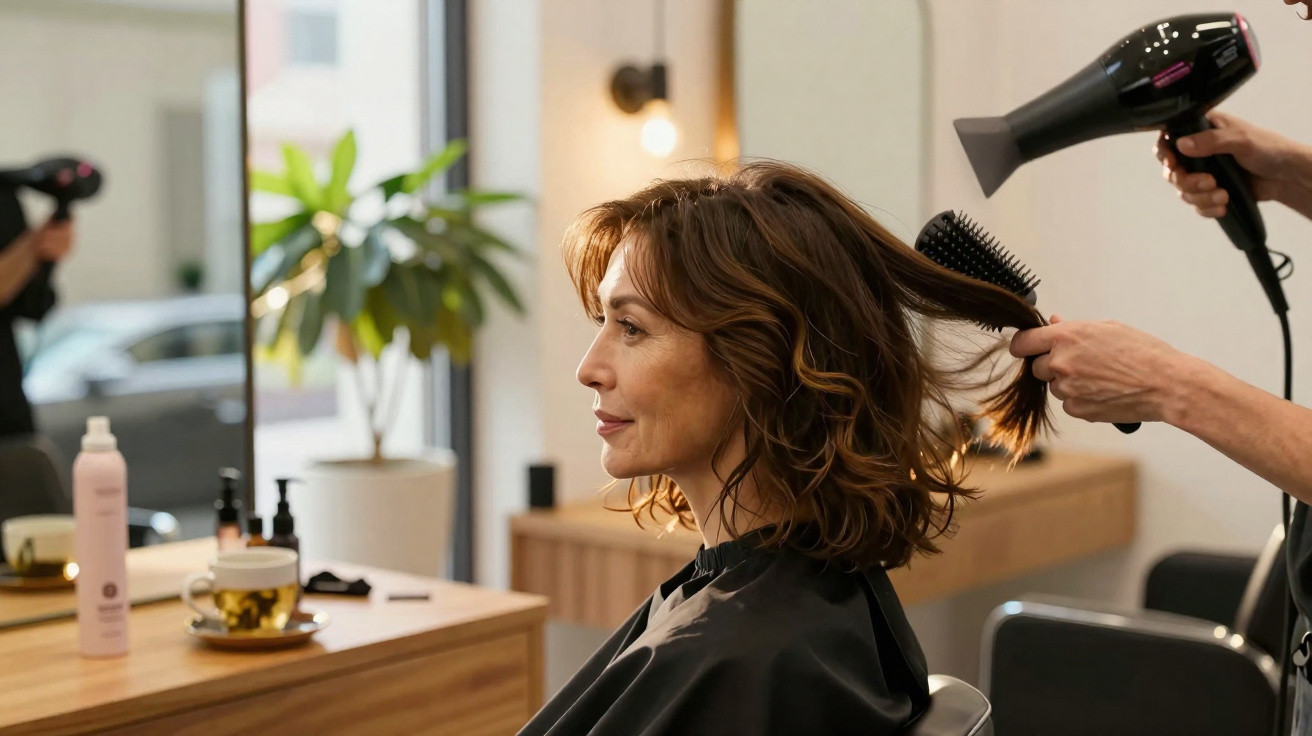
Hormones, stress and lack of sleep can all visibly change hair after 50. But rather than accepting limp lengths and widening partings, professional hairdressers rely on one particular cut and a few targeted techniques. The result is hair that looks fuller, more lively and younger – without a radical change of style.
What the menopause does to hair
For many women, the first signs are a widening parting, styling that lacks body and hair that feels finer. There is a clear biological reason for this. During the menopause, oestrogen and progesterone levels fall, while male hormones become relatively more influential.
As a result, the hair-growth cycle becomes shorter. Hair spends less time in its growth phase and often emerges from the scalp finer. Dermatologists report that the issue is often compounded by other factors:
- iron deficiency caused by diet or heavy bleeding in preceding years
- ongoing stress at work or at home
- poor-quality or insufficient sleep
- certain medicines or underlying health conditions
This can lead to what is known as androgenetic thinning: not the classic “clump of hair loss” in the hairbrush, but a gradual loss of density across the top of the head.
“Thinning hair during the menopause is not a personal failing but a hormonal response – although its visual impact can be significantly reduced.”
The one haircut that benefits almost all thinning hair
Celebrity hairdressers who regularly see women over 45 in the salon almost always turn to a modern version of a classic: the bob. Also commonly called a carré or bob hairstyle, it ranges from chin length to just above the shoulders.
Why very long hair can become a problem
Because of its own weight, very long hair pulls at the roots. This reduces fullness at the base, makes the ends appear wispy and can leave the face looking more tired. Fine-textured hair in particular lacks the “support” needed to carry lengths below the bust well.
At the other extreme, an ultra-short pixie cut can be tricky for women whose hair is beginning to thin on the crown. It is difficult to create proper lift where density is already limited.
A lively bob rather than a drastic short cut
The key is a compact, defined shape with more weight retained on the crown. Professional hairdressers recommend:
- Length: between the chin and shoulders, with light layers
- Nape: relatively exposed, but not shaved – this makes the back of the head appear rounder
- Crown: retain more hair mass to build volume
- Outline: soft lines that frame and lift the face
This creates a cut that gives the impression of denser hair without looking artificial. A slightly asymmetrical bob is especially flattering, kept a little longer at the front and more compact at the back. It adds movement and draws attention away from a sparse parting.
Why the scissors matter: point cutting instead of thinning
Many women will remember this from the 1990s: a hairdresser uses special scissors to thin out the ends, making hair feel lighter and airier. For hair that is already fine, however, this is usually the wrong option.
Heavy thinning removes what little substance remains. The roots collapse more quickly and the ends hang thin and forlorn.
The professional technique: small cuts for more movement
Celebrity stylists therefore use a different method: point cutting. The scissors make only small, precise cuts into the ends and lengths. This adds movement and texture without removing large amounts of hair.
“Point-cut ends reflect light differently, making hair look more lively and fuller – even though hardly any substance is lost.”
When sitting in the salon, it is perfectly reasonable to ask which technique the hairdresser is using. A clear request such as “please do not thin it out too much; use small cuts instead” can prevent misunderstandings.
Three simple routines for instant fullness
Alongside the cut, three everyday habits have a major influence on how hair looks. They may seem unremarkable, but together they create a noticeably fuller appearance.
1. Build volume in while blow-drying
Many people dry their hair upside down and let the hairdryer run more or less randomly. Fine hair needs more than that. Professionals advise:
- rough-dry the hair until it is only damp
- use your fingers like a small rake at the roots
- pull sections upwards and away from the roots before blow-drying them
- avoid blasting the hair in every direction; instead, lift it section by section
This gently “trains” every section of hair upwards at the root. If you wish, finish by briefly setting the roots with cool air. This helps the lift hold.
2. Waves rather than pin-straight lengths
A soft wavy look – not a tight mass of curls, but larger, gentle waves – makes thinning hair appear considerably fuller. The method is as follows:
- use a heat-protection spray
- add a slight wave to sections with curling tongs or straighteners, while keeping the ends fairly straight
- once the hair has cooled, brush out the waves rather than merely separating them with your fingers
Brushing afterwards blends the individual waves into a smooth, cohesive texture. It is precisely this “flowing movement” that creates the illusion of more hair.
3. Products that genuinely keep hair light
What is written on the bottle does not always deliver what it promises. For fine hair during the menopause, it is worth taking a critical look:
| Suitable | Better avoided |
|---|---|
| lightweight shampoos without heavy silicones | rich formulas with high silicone content |
| conditioner on the lengths only, not at the roots | masks applied all the way to the scalp |
| volume spray or mousse directly at the roots | oils and waxes around the roots |
Using too much rich conditioning care can overwhelm the hair. Less is more here: a small amount of one lightweight product is preferable to several different layers.
When it is worth booking an appointment with a dermatologist
Visual techniques have their limits. If the amount of hair shedding rises clearly above the usual rough estimate of 50 to 60 hairs a day, or if round bald patches suddenly appear, this should be medically assessed.
Warning signs may include:
- the parting becomes noticeably wider within a few months
- only a very thin bundle remains when hair is tied into a ponytail
- the scalp feels tight, itchy or looks red
A dermatologist can check whether, alongside the menopause, there may be a thyroid disorder, a severe nutrient deficiency, an autoimmune reaction or a genetic factor involved. The earlier targeted treatment begins, the better the chance of stabilising the hair roots.
What women can also do themselves
Lifestyle matters as well as cutting and styling. Hair responds slowly, but clearly, to the body’s internal balance. Approaches many affected women find helpful include:
- a protein-rich diet with adequate iron, zinc and B vitamins
- regular exercise to reduce stress hormones
- deliberate breaks and sleep rituals during a period full of changes
- gentle scalp massages with the fingertips to improve circulation
Anyone considering supplements should discuss them with their GP or gynaecologist beforehand. Not every product is suitable for every existing health condition or medicine.
Hair thinning during the menopause remains a sensitive subject for many women. Yet a well-planned bob, a smart cutting technique and three consistently applied styling habits can significantly change its visual effect – from “limp and tired” to “lively and well-groomed”. Often, the first look in the mirror after a new cut is enough to help you feel more like yourself again.






Comments
No comments yet. Be the first to comment!
Leave a Comment