
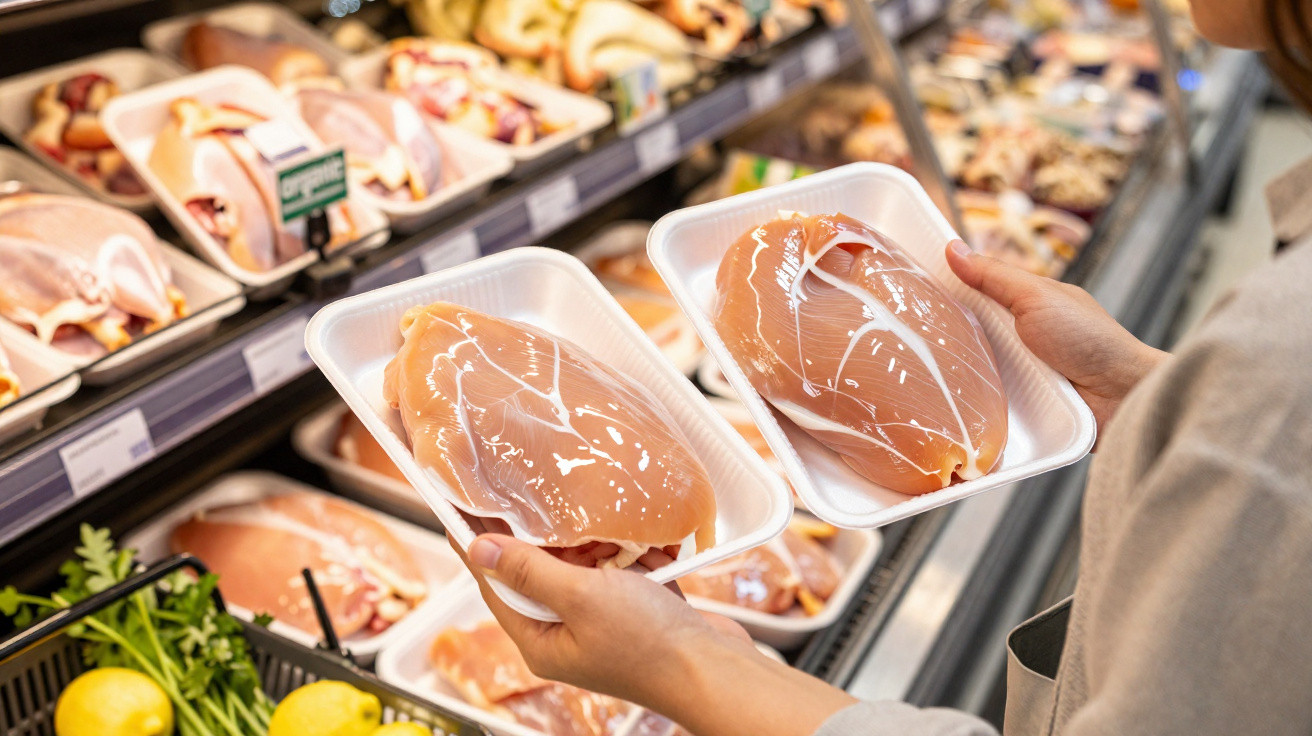
Shoppers are putting more chicken in their baskets than ever, but one small visual sign can quietly distinguish the best fillets from the others.
Beneath the plastic film on a supermarket tray, your evening meal can already reveal plenty. More telling than labels, national flags or persuasive slogans, the appearance of a chicken breast can indicate how the bird was reared, the speed at which it grew and its fat level. Once you recognise the signs, they are difficult to overlook.
Chicken leads the meat market, but quality varies
Across much of Europe and North America, chicken has become the preferred meat. It is comparatively affordable, simple to prepare and widely viewed as a lighter option than beef or pork. In France, for example, average consumption rose by around 15% over only five years, exceeding 31 kg per person in 2024.
Surveys in the country help explain poultry’s continuing appeal. Buyers commonly value its price, ease of cooking and the fact that it is generally accepted by everyone around the table. With chicken, duck, turkey, goose, guinea fowl and other species available, poultry appears to be an ideal all-purpose choice.
However, this success conceals an issue that many shoppers notice without knowing how to interpret: chicken breasts are not all alike. In certain European supermarkets, one in two chickens is now imported, frequently from countries with less demanding farming and welfare rules. The texture, taste and nutritional profile may differ sharply between fillets.
On the tray, the surface of the breast can reveal more than any marketing line on the label.
The visual clue that reveals lower-grade chicken
Food writers and poultry specialists highlight a straightforward check that takes only seconds. No equipment or specialist knowledge is needed: simply look closely.
Check the surface for thin white lines
Pull the plastic film taut over the fillet and inspect the meat carefully. A high-quality chicken breast should look smooth and evenly coloured, with fine muscle fibres aligned in one direction. Lower-grade meat often has a web of narrow pale streaks crossing its surface, resembling light chalk marks.
Those thin white streaks are usually tiny fat deposits and connective tissue spread through the muscle.
These marks are not seasoning, nor are they marbling of the kind seen in beef. Instead, they suggest that the chicken grew rapidly, gained weight fast and accumulated more fat within the muscle. This may produce a softer, occasionally mushy texture and a fattier nutritional composition.
Why rapidly grown chickens show marks in their meat
Industrial breeds described as “fast-growing” chickens can reach slaughter weight in just five to seven weeks. Slower-growing or “farm-style” birds, by comparison, usually require approximately 11 to 14 weeks before they are ready.
That gap of several weeks has wide-ranging effects:
- Fast-growing birds gain weight rapidly but are less active, particularly when reared indoors.
- They develop more fat and less tightly packed muscle tissue.
- Fat and connective tissue enter the breast muscle, producing visible white striations.
- Slower-growing birds, often reared outdoors, remain leaner and develop more muscle.
Research indicates that fat levels may reach roughly 4% in chicken breasts from intensively reared, fast-growing birds, versus around 1% in birds given outdoor access and more time to grow. On paper, the difference may appear modest, but it is frequently obvious on the chopping board.
Labels remain helpful, but inspect the chicken breast yourself
Organic and higher-welfare certification schemes can still provide useful guidance. They commonly set requirements for stocking densities, outdoor access and slower-growing breeds. A plainly listed country of origin may also assist shoppers who wish to avoid chicken imported from places with weaker standards.
Even so, a label is not a substitute for looking at the fillet. Packaging can be hard to interpret, while certain marketing claims sound comforting despite having no precise definition. A rapid inspection of the chicken breast therefore provides a second layer of protection.
A uniform, streak-free chicken breast that matches a trusted origin and label forms a strong trio of quality signals.
How to recognise a “good” chicken breast
When choosing from the chilled cabinet, place a few trays side by side for comparison. Look for fillets with:
- Even, lightly pink flesh and no dark or greyish areas
- A smooth exterior without irregular white lines or marbling-like streaks
- No excess moisture on the surface or large pools of liquid in the tray
- A firm feel when pressed gently through the packaging
Visible thick strands of fat, or thin white stripes running across the grain, will usually indicate a fattier, lower-grade cut from a quickly grown bird.
The effect on cooking and health
This visual sign is about more than appearance. It can influence the way the meat performs in the oven or frying pan. Leaner breasts with a good structure generally keep their shape, brown consistently and remain juicy when not overcooked. Chicken containing substantial internal fat and connective tissue may shrink unevenly, release additional liquid and become unusually soft in the centre while drying out on the outside.
| Feature | Higher-quality breast | Lower-quality breast |
|---|---|---|
| Surface appearance | Uniform, smooth, few visible streaks | Fine white lines, patchy texture |
| Typical fat content | Around 1% | Up to around 4% |
| Mouthfeel | Firm, slightly fibrous, juicy | Softer, sometimes spongy or stringy |
| Likely farming model | Slower-growing, often outdoor or higher-welfare | Fast-growing, intensive systems |
For anyone monitoring their fat consumption or choosing chicken as a lean source of protein, these percentages can accumulate over repeated meals. The visual check is therefore a practical nutrition aid as well as a quality screen.
Everyday meals where the check is particularly useful
The difference is often most noticeable in familiar recipes that require chicken breast to be cut up. For homemade nuggets, stir-fries or Caesar salad, fillets with numerous white streaks can break up more readily and release extra water into the pan. This can prevent browning, leaving the chicken pale and a little rubbery.
By contrast, a breast with a smooth, even appearance will normally produce neater strips or cubes that sear fast and retain a satisfying texture. Its flavour is often a little fuller and less bland, especially if the bird was allowed longer to mature.
A simple buying routine for busy shoppers
You do not need expert knowledge of poultry to improve your weekly shop. This quick approach is enough:
- Look at the origin and any trustworthy welfare or quality certification.
- Lift the tray and examine the meat for white striations.
- Compare two or three packs before making your selection.
- If uncertain, choose the more evenly looking fillet, even where it costs slightly more.
Over the course of a month, this routine can gradually improve the chicken you take home, delivering better texture and a result closer to the lean image that many people associate with chicken.
Why labels can be misleading on their own
Food regulation combines compulsory labelling, voluntary schemes and private standards. Some programmes are rigorous and inspected regularly, whereas others depend largely on producers’ self-declarations. Descriptions such as “farm-style”, “traditional” and “country-style” do not necessarily mean that chickens grew slowly or had outdoor access.
This is why the visual clue is so useful. Slogans do not influence it; it reflects the way the muscle actually developed in the bird. Although it is not flawless - some high-quality breasts can show small natural variations - it offers an unusual direct insight into farming methods from the meat itself.
Extra context: the meaning of “connective tissue” and “lipids”
Two words often feature in conversations about meat quality: lipids and connective tissue. Lipids simply mean fats. In limited quantities, they add flavour and help meat stay moist. When present in excess, particularly as streaks spread through the muscle, they alter both nutritional content and texture.
Connective tissue is the natural framework that keeps muscle fibres together. In active animals, it is properly organised and contributes to meat that is firm and springy. In birds that grow extremely quickly and move little, it may develop unevenly, helping to create visible lines and a somewhat stringy texture after cooking.
The next time you are in the chilled aisle, picture two trays at the same price with similar labels. One contains a breast with a smooth, consistent surface; the other has many tiny pale streaks. Once you understand what those lines can indicate about growth rate, fat content and likely rearing methods, the choice becomes clearer - and your next nuggets or salad strips may taste a little more like you intended.






Comments
No comments yet. Be the first to comment!
Leave a Comment