
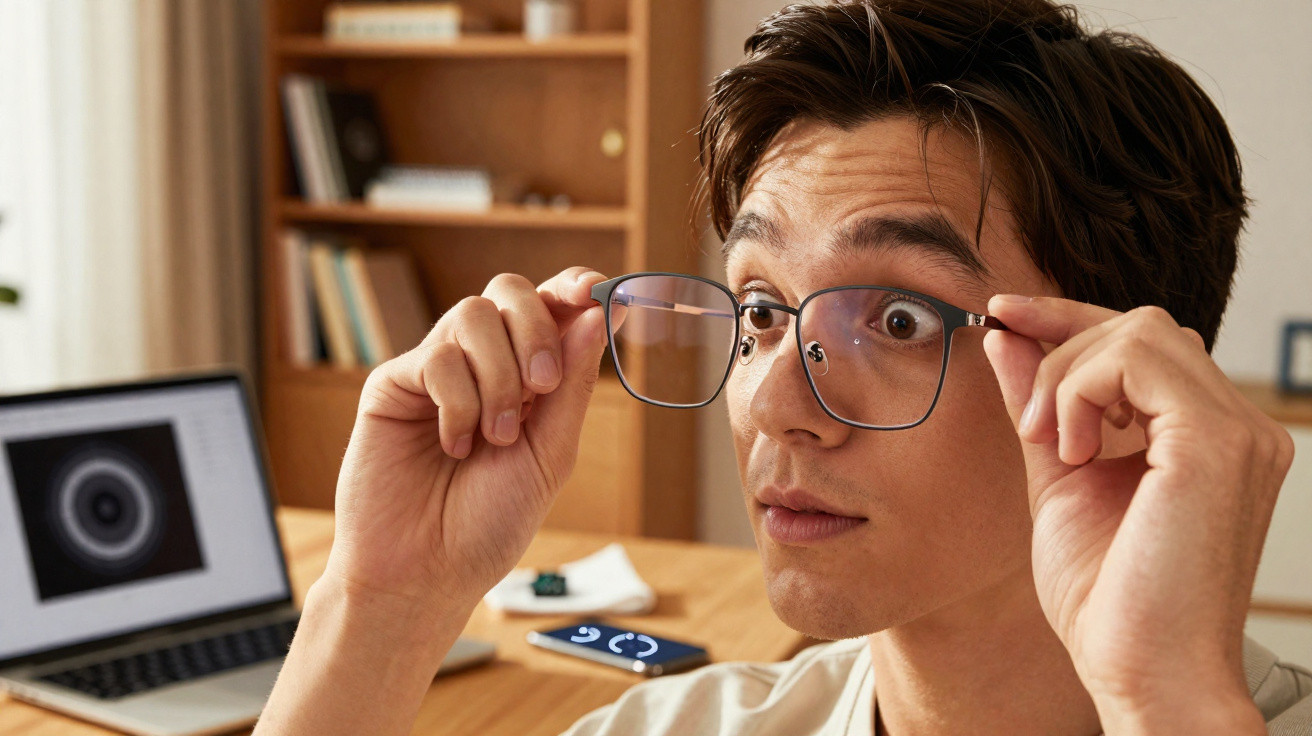
No nodding or tilting your head.
That prospect is moving nearer to everyday reality. A Finnish start-up is taking variable-focus eyewear from the laboratory into frames that, simply put, resemble ordinary glasses. Its proposition is straightforward: abandon the search for the progressive-lens “sweet spot” and allow the lenses to refocus automatically as your attention shifts from a screen to the street.
What autofocus glasses promise
For most people with presbyopia, wearing glasses involves an unusual routine. You angle your head, seek out the clear section of the lens and put up with blur beyond that narrow channel. Autofocus glasses are intended to remove this everyday inconvenience. Their lenses respond to your gaze, changing optical power in a fraction of a second so that text, faces and road signs remain sharp without requiring you to look through a restricted zone.
At first, the difference may seem modest: less adjustment. Across a full day, however, it could become significant. There may be less discomfort while working on a laptop, fewer trade-offs when looking at products on supermarket shelves and no uncomfortable lifting of the chin to read a menu. For people who have never adapted to progressive lenses, the technology offers another route to comfortable sight.
Goodbye to the “visual gymnastics” of progressives: autofocus aims to deliver sharpness wherever your gaze lands.
How the technology works
Eye-tracking that reads your intention
Eye sensors positioned within the frame monitor pupil movement. They operate with low power consumption and sample frequently enough to detect the quick movements and pauses involved in normal viewing. A miniature processor uses gaze behaviour and scene context to estimate distance, then instructs the lenses on the level of adjustment required. Look down at a recipe and the focus changes; look up at the television across the room and it changes again.
Liquid-crystal lenses that shift focus
These lenses rely on liquid crystals, materials whose optical characteristics alter when voltage moves their molecules. Changing that voltage changes the focal power. The challenge is achieving this quietly and smoothly without using excessive power. The Finnish team says the lenses reach focus in around 0.2 seconds, a speed that should seem immediate to most users. Small rechargeable batteries are concealed in the temples and are intended to provide a full day’s use between charges.
Fast refocus in roughly 0.2 seconds and a full day of runtime-the two claims that make the concept feel wearable.
From prototype to shop shelves
Espoo-based IXI Eyewear has brought together the supply chain and expertise needed to progress beyond demonstrations. It has acquired Finnsusp, a local lens specialist, and partnered with OptiSwiss for manufacturing. A recent $36.5 million funding round gives the project scope for testing and certification. Before a wider launch, the company identifies medical compliance and optical standards as its immediate priorities.
Cost is still the major unknown. The launch price is expected to be at the premium end, initially targeting older customers who want the clarity they had before presbyopia without swapping between several pairs of glasses. Reports suggest the frames retain a recognisable, conventional profile rather than the large “smart glasses” appearance that attracts unwanted attention.
- Goal: replace progressive lenses and bifocals with adaptive eyewear that works as a single pair.
- Design: traditional frame styling despite the built-in sensors and batteries.
- Market: a global category worth $175–$200 billion that is eager for new ideas.
Who stands to benefit
People with presbyopia would be the most obvious beneficiaries. This includes office workers moving between spreadsheets and colleagues’ faces during video calls, tradespeople who read measurements before assessing an entire room, and keen readers switching from phone to paperback. Drivers could also see a clear benefit: the dashboard, mirrors and distant signs might all come into focus without dipping the head to find the right lens area.
A potential argument also exists for younger users. Those spending ten hours daily across different screens often experience fatigue. Autofocus could reduce the continual burden of refocusing, even for someone with only a mild prescription.
Comparing with today’s lenses
| Aspect | Progressive/bifocal | Autofocus lenses |
|---|---|---|
| Focus change | Fixed zones; the wearer moves their head to find clarity | Lens power changes to follow the gaze |
| Adaptation period | Days or weeks for many wearers | A brief learning period if tracking is accurate |
| Peripheral distortion | Common with progressive lenses | May be reduced when the optics are well tuned |
| Power source | None | Rechargeable batteries in the temples |
| Maintenance | Cleaning lenses only | Charging, firmware updates and calibration checks |
| Price band | Broad range | Likely to be premium at launch |
Barriers still to clear
Regulation and safety
Smart eyewear combines optics with electronics. As a result, it must undergo drop testing, temperature cycling and long-term durability assessments for its hinges and seals. Medical directives and optical-accuracy standards are relevant, particularly for prescription glasses. Battery safety cannot be compromised, covering everything from charging behaviour to reliability in cold conditions.
Privacy and data
Eye movements can reveal a great deal. They may indicate reading speed, attention and even stress. The company will require robust, transparent policies: processing on the device as standard, no storage of raw gaze data and straightforward options allowing users to delete diagnostic information. If fittings record any tracking measurements, clinic staff will also need training in handling that data.
Maintenance and longevity
With basic care, conventional glasses can last for years. Electronics alter that expectation. Customers will want answers on battery replacement, the duration of software support and repair timescales. Opticians will need calibration equipment to match the autofocus range to each person’s prescription and interpupillary distance. A dependable service network may determine whether users trust the product.
Early buyers should expect premium pricing, steady software updates, and a service model that looks closer to consumer tech than eyewear.
What could come next
Once autofocus works reliably, further features become compelling. Dynamic tinting could be combined with focus adjustment for outdoor wear. Night-time settings could modify contrast and glare control alongside focus. Mixed-reality overlays remain a more distant possibility, although the same eye-tracking hardware could help position graphics without extra headgear. Insurance cover and flexible-spending eligibility will matter as well, especially where progressive lenses are already a substantial cost.
Wondering what the experience could be like each day? Imagine a morning beginning with a phone alarm, followed by a quick check of emails, a bicycle commute, an open-plan office, a late-afternoon supermarket visit and a film at home. Every transition-from handlebars to traffic, laptop to colleague, label to aisle sign and sofa to screen-requires your eyes to refocus. If the lenses respond cleanly and remain comfortable on your nose, you would largely forget they were there. That is the standard they need to meet.
Important questions remain to be followed: how the system performs during rapid saccades, whether it can adapt to individual viewing habits and how it handles difficult situations such as night rain or shiny reflections. A brief in-store simulation could be useful, involving eye-tracking calibration and a guided set of tasks moving from a book to a wall chart and then a street-scene video. If that demonstration feels seamless, uptake could be rapid among people who have never become comfortable with progressive lenses.






Comments
No comments yet. Be the first to comment!
Leave a Comment