
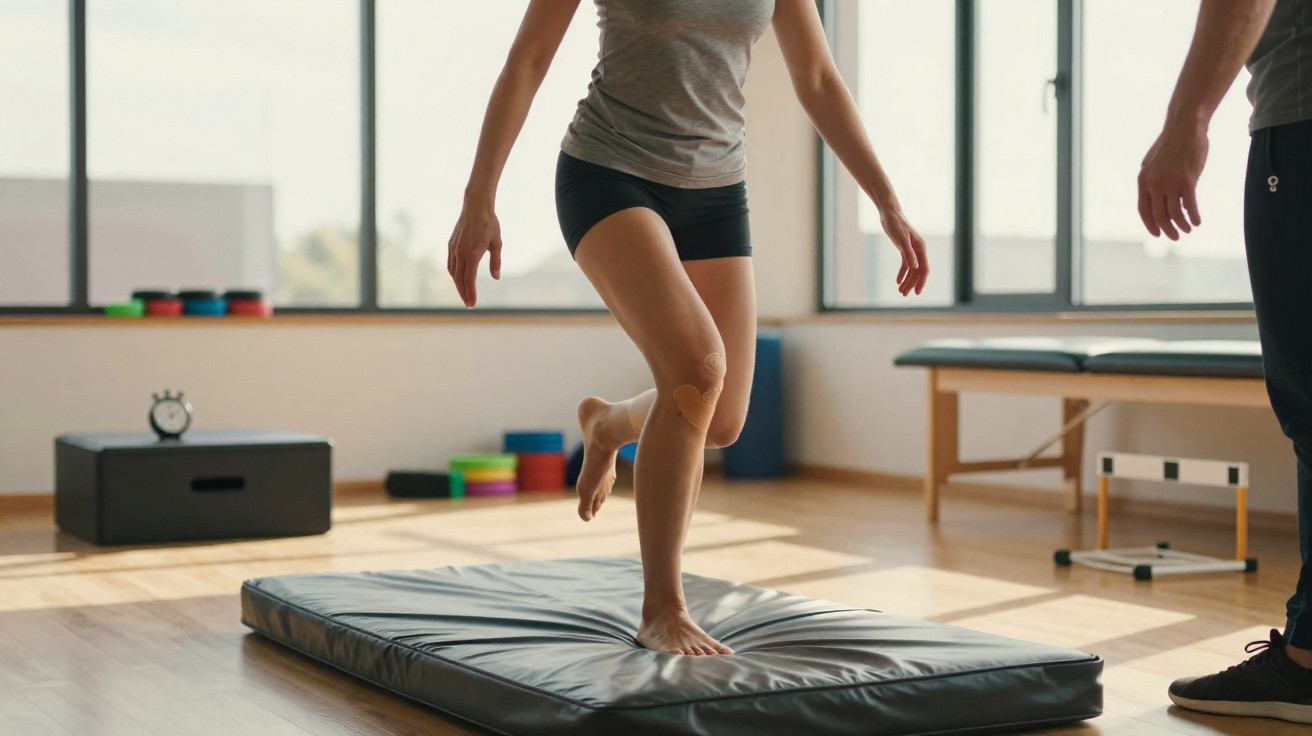
The physiotherapy room carried a faint scent of rubber mats and coffee. Anna, 46, pulled up her leggings and perched on the treatment table, expecting the familiar advice: “Try swimming, try Pilates, avoid impact.” For months, her knees had burned whenever she went upstairs, and she had faithfully worked through clamshells, bridges and slow wall squats. Nothing had made much difference.
This appointment was different: her therapist seemed unusually enthusiastic. “We’re going to try something different,” he said as he wheeled out… a small trampoline. Anna laughed, then grimaced. Jumping? On that? Her GP had explicitly told her, “No jumping, ever again.”
Yet ten minutes later, hot and smiling, she climbed off the mini-trampoline and found that her knees somehow felt freer and lighter.
The controversy began when she mentioned it to her other physio.
When avoiding impact is not the answer for sore knees
The same advice appears in surgery waiting rooms and online forums: “Knee pain? Swim. Do Pilates. Don’t jump.” It sounds sensible, careful and safe. But a growing number of therapists are taking an approach that can look almost irresponsible at first glance.
They are getting people with painful knees back on their feet and, in some cases, introducing trampolines or gentle hopping exercises well before those patients believe they are “ready”. That change alone causes disputes at professional conferences and in private Facebook groups for physios.
After all, when stairs make your knee hurt, the last instruction you expect is: “We need to teach it to bounce again.”
Consider Mark, a 52-year-old office worker who cycles at weekends. One spring, a brief run left his right knee in agony. The advice came quickly: “Stop running, stay on the bike, do Pilates for your core.” He followed it for a full year.
On paper, he became stronger and more flexible. Planks and bridges became easy. But whenever he jogged briefly to catch a bus, the familiar sharp pain returned beneath his kneecap. His knee seemed fragile, almost as though everyday life had become an allergen.
A new physio assessed him differently: very small hops on the spot, brisk step-ups and light pogo jumps on a cushioned surface. Eight weeks later, he trusted his knee more than he had after twelve months of supposedly “safe” exercise.
This is the point at which the profession divides. One group favours low-impact work such as swimming and traditional Pilates, concentrating on mobility, alignment and cautious strength work. The other believes a knee is not a porcelain ornament: it is a spring.
To function as a spring, they argue, it needs load, speed and some bounce. This does not mean careless leaps from tall boxes; it means intelligently graded impact that retrains tissues to absorb shock.
The disagreement is not over whether gentle exercise is useful. It centres on one straightforward but uncomfortable possibility: your knee pain might not fully resolve until your knee learns to handle impact again.
Low-level plyometrics: the “forbidden” activity for sore knees
The exercise currently dividing professionals is low-level plyometrics: small, controlled jumps and landing drills, performed either on the floor or on a mini-trampoline. The key difference is that they are introduced early, not kept as a final “bonus” stage of rehabilitation.
A standard session may begin with gentle two-legged bouncing, with the feet barely leaving the surface. This can progress to soft, fast mini-hops, side-to-side weight shifts, and easy step-and-bounce movements. These sessions are brief and purposeful, nothing like the Instagram “beast mode” workouts people may imagine.
It can appear almost childish. It can also frighten anyone who has spent years being told that impact is the enemy of knee health. Still, people who continue often describe a similar result: less pain on stairs, greater assurance over uneven ground and a feeling that the joint has become “alive” again.
People attempting this alone can make mistakes very quickly. Some jump too forcefully, too early, believing they must “push through”. Others bounce for only a week, become alarmed by the first twinge and stop altogether.
The useful middle ground is remarkably gentle. Picture it as helping your knee learn a new language, with one quiet syllable at a time. Keep sessions short, take regular breaks, and concentrate on a soft landing-as if you were trying not to wake a sleeping baby in the next room.
In reality, almost nobody manages this every day. Work and life intervene. Knees can be grumpy after a long day, sessions are forgotten, and people stop and start again. Improvement is seldom linear, which is where much of the frustration comes from.
Professionals are as emotionally divided as the people they treat. Some regard these bouncing sessions as a breakthrough; others still recoil from asking a painful joint to take any degree of shock. The friction emerges in quietly intense conversations in conference corridors.
“Impact isn’t the villain,” argues Laura James, a sports physiotherapist in London. “Chaotic impact is. When you reintroduce controlled bouncing in a safe way, the body often responds with less pain, not more. The problem is, our old education drilled ‘avoid impact’ into us for years.”
Those committed to ultra-low-impact rehabilitation respond that all jumping can become a slippery slope, particularly for older or heavier patients. They would prefer to prescribe more cycling, more reformer Pilates and more stretching.
- Gentle bouncing and mini-hops may retrain the way your knee absorbs shock.
- Swimming and Pilates are helpful, but they seldom teach the knee to cope with everyday impact.
- Differences between physios often come from different eras of training, rather than science alone.
- Plyometric progress should be gradual, soft and closely monitored.
- Many patients say they feel more “stable” once impact is reintroduced instead of avoided.
Should you bounce on a sore knee?
No single plan is right for every knee. Some joints are too inflamed, some operations are too recent, and some medical histories are too complex for jumping to be introduced immediately. Any therapist claiming there is one perfect protocol for everyone is overselling it.
At its heart, this argument reveals a more fundamental fear: fear of movement that appears risky. Patients worry about reinjury, while many physios worry about being the person who “pushed too hard”. That shared anxiety steers everyone towards pool- or mat-based options that feel safer.
But everyday life contains countless tiny jumps: stepping off a kerb, hurrying for a green light, or briefly stumbling and catching yourself. Eventually, your knees will encounter impact again.
| Key point | Detail | Value for the reader |
|---|---|---|
| Impact is not invariably harmful | Carefully introduced, light plyometrics can ease pain and build knee strength when progressed gradually. | Offers an alternative where swimming and Pilates alone have not improved your pain. |
| Physios do genuinely disagree | Different educational backgrounds can produce opposing advice on jumping and knee rehabilitation. | Explains why one professional prohibits impact while another may prescribe it. |
| You can request “bounce” in rehabilitation | Ask for a graded-impact programme involving mini-hops, soft landings and clear progression rules. | Helps you play an active part rather than simply completing exercises that feel overly safe. |
FAQ:
- Question 1 Is jumping always bad for arthritic knees?
- Answer 1 Not necessarily. For some people with stable, mildly arthritic knees, carefully measured low-level jumping may improve shock absorption and confidence. Medical clearance, soft landings and a starting point comfortably below your pain threshold are essential.
- Question 2 What if swimming and Pilates already help my pain?
- Answer 2 Keep doing them if they help. If you also want to walk faster, hike, run for a train or play with children, a small amount of impact work may be the next stage once your pain has settled.
- Question 3 Can I try mini-trampoline exercises at home without a physio?
- Answer 3 You can, although you should begin with extremely gentle bouncing, where your feet barely lift from the surface, for 30–60 seconds at a time. Stop if pain sharply increases during the session or on the following day. If unsure, arrange at least one face-to-face assessment.
- Question 4 How long before I feel any benefit from plyometrics?
- Answer 4 If they maintain two or three brief sessions a week, many people notice greater “lightness” or confidence within 3–6 weeks. Structural changes take longer, although the nervous system can adapt surprisingly quickly.
- Question 5 Why does my physio still tell me to avoid all impact?
- Answer 5 They may be acting cautiously because of your medical history, or they may use a more traditional low-impact approach. Ask them directly: “When and how could we safely reintroduce small amounts of impact?” That question alone may lead to a more nuanced discussion.




Comments
No comments yet. Be the first to comment!
Leave a Comment