
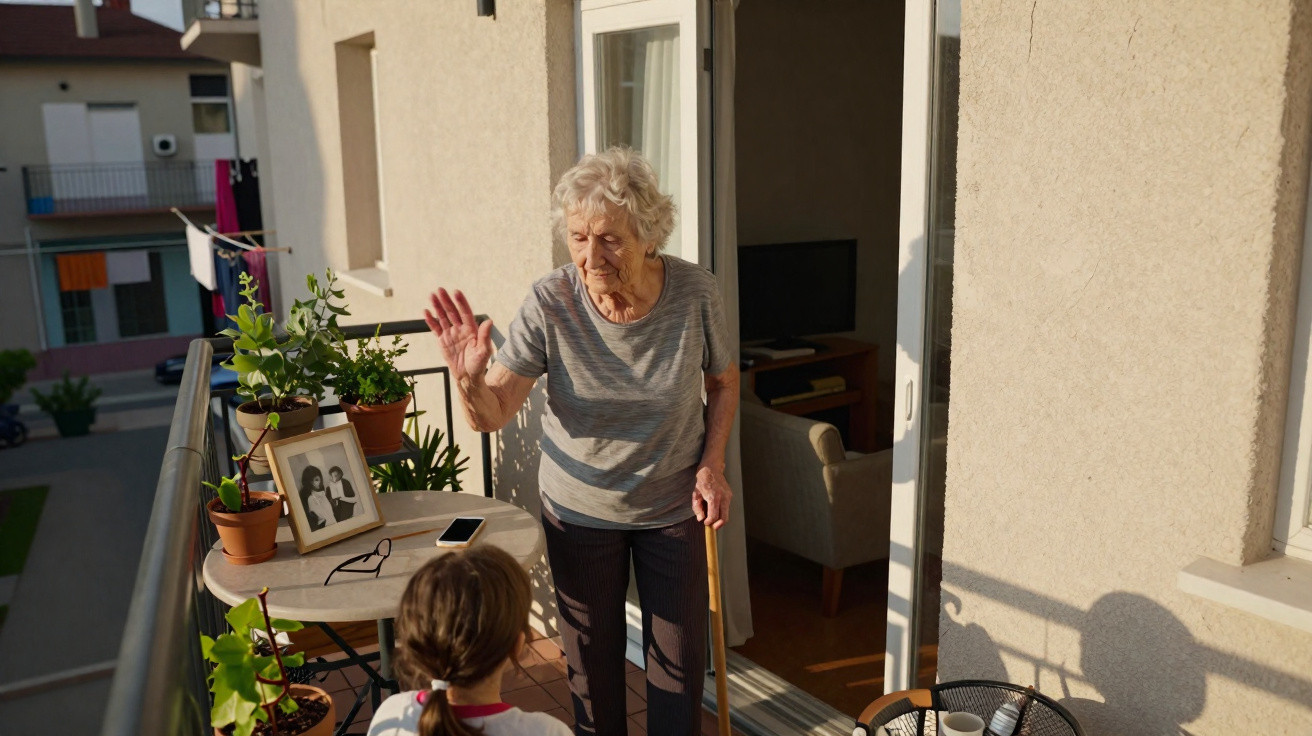
Across Europe, including the German-speaking countries, a quiet crisis is growing: increasing numbers of older people spend their days alone, without regular conversations or visitors, and often without feeling that they are still needed. Research from several countries indicates that this loneliness is not a marginal feature of later life, but the outcome of far-reaching social change.
A generation facing unexpected isolation in later life
For a long time, those born after the war were seen as a fortunate generation: economic growth, greater freedom and more opportunities than ever before. Yet the other side is now becoming clear – many people who were young then are growing old in greater isolation than any generation before them.
Psychologists describe an “epidemic of loneliness” in later life, with serious consequences for both physical and mental health.
Older people with very few social contacts are demonstrably less healthy. Their risk of cardiovascular disease, depression and dementia rises considerably. Some researchers compare the health effects of prolonged loneliness with those of smoking or severe obesity.
1. Living alone rather than in a multi-generational family
In the past, several generations often lived under one roof, or at least next door to one another. Today, many older people live alone in their own homes, while their children and grandchildren are often hundreds of kilometres away. This means no chance encounters around the kitchen table, no brief chat on arriving home and no “I’ll just pop round”.
- Fewer conversations each day
- Less practical help with everyday life
- Less emotional closeness and fewer shared routines
Unless they actively build new relationships, people in this position can easily slip into a form of “social invisibility”. Those around them frequently do not realise how little contact an older person genuinely has.
2. Later-life separations break up entire friendship circles
Divorce rates in later life have risen sharply in many countries. What is seldom considered is that separation does not only end a partnership; it often also dismantles a long-established circle of friends. Couples who have spent decades together reassess their loyalties, and relationships quietly come to an end.
This is particularly significant in later life, when forming new friendships is no longer as easy as it was at 20 or 30. Studies show that widows and divorced people of retirement age experience loneliness far more often than people in stable relationships.
Why women are particularly affected
On average, women live longer, yet they are also more likely to live alone in later life. Many care for their partner for years, then find themselves facing a completely changed daily life after their partner dies. If they do not feel able to ask for support or seek new connections, they withdraw little by little – often without anyone around them noticing.
3. Retirement leaves a social gap
For many people, work is about much more than earning money. It provides routines, jokes, small rituals and shared lunch breaks. Once the final working day has passed, that entire social setting can disappear overnight.
For many people living alone, colleagues were their most important contact – and suddenly the diary is empty.
People who do not prepare for retirement can quickly find themselves asking: who will call me now? Who will have coffee with me in the morning? When there are no answers, a sense of emptiness can emerge and rapidly turn into loneliness.
4. Career mobility loosens old roots
The post-war generation was highly mobile: moving for university, jobs and career progression. That brought social advancement, but it also came at the cost of belonging. Many left their home towns and never found their way back permanently.
By retirement, it may become apparent that hardly any old friendships from youth remain, the neighbourhood is made up of constantly changing faces, and local clubs or regular social gatherings never truly became established. What looked like freedom in younger years can feel like being uprooted in later life.
5. Digital divide: those who remain offline quickly lose touch
Families now organise themselves through messaging apps, video calls and social networks. Anyone who does not use a smartphone or computer misses not only photographs of their grandchildren, but also spontaneous arrangements, appointment planning and everyday stories.
- Family group chats continue without grandparents
- Invitations are sent digitally – and people who are offline may hear about them too late
- Online options for classes, meetings or sport go unused
Many older people say: “I don’t need that.” Yet this often masks uncertainty, embarrassment or fear of doing something wrong. Without patient help from relatives or access to classes, they remain excluded from an increasingly digital society.
6. Clubs, churches and meeting places are losing their strength
Those born after the war grew up with church attendance, club evenings, bowling groups and choirs. These settings provided structure and regular social contact. Much of this has weakened: fewer people attend services, fewer members take an active part in clubs, and pubs and community centres have closed.
Where villages and urban neighbourhoods once had established meeting places, there are now often only supermarkets and anonymous chain stores.
If bus services are reduced or meeting places for older people close as well, the physical journey to other people literally becomes longer. Those with limited mobility or no longer able to drive are more likely to stay at home.
7. Be strong, never complain – a risky life motto
Many people who are now older grew up hearing phrases such as “Pull yourself together” or “You do not burden others with your problems.” Showing weakness was regarded as embarrassing. That attitude can persist well into old age.
People shaped in this way rarely say: “I am lonely.” Instead, many play down their situation: “It’s fine, I can manage”, “Don’t worry about me.” As a result, children, neighbours and friends may not notice how badly someone is really doing.
Psychologists report that this silence can intensify loneliness. Those who never ask for help generally do not receive it either. Over time, invitations become less frequent because people around them assume that everything is fine.
8. Youth culture and perceptions of age: older people can quickly feel written off
Advertising, media and popular culture are dominated by young faces, fast-moving trends and new technology. Older people often appear only as a problem group: in need of care, unwell or a “burden on the system”.
These portrayals take hold. Many older people clearly sense that their experience is less valued, that decisions are made by younger people and that their perspective is barely represented. Feeling that they no longer truly belong intensifies loneliness, even where social contacts objectively still exist.
When expectations and reality drift apart
Psychological studies emphasise that loneliness does not automatically affect people with few contacts; it affects those who experience far less closeness than they would like. Many of today’s older people imagined later life as a time spent with family, friends and grandchildren, but now face a daily reality far removed from that picture.
What really helps: small steps with a major impact
The good news is that loneliness can be reduced, even in advanced age. Effective approaches are often surprisingly straightforward:
- Taking part in regular group activities, such as sport, choirs or games evenings
- Volunteering, for example at food banks, clothes banks or visiting services
- Housing schemes with communal spaces, such as multi-generational homes
- Technology courses designed for older people on using smartphones and video calls
For someone hoping to emerge from prolonged isolation, one regular commitment each week can often be enough to begin with – such as an older people’s exercise class or a neighbourhood café. Further connections can grow from that first contact.
How relatives and neighbours can take action
Younger people often underestimate the importance of a short visit or a dependable phone call. Even simple routines can help:
- A set telephone call each week
- Shopping trips or walks together
- Regular invitations to family celebrations, even when the journey is longer
Neighbours can make a substantial difference when they do more than “say hello in the stairwell” and instead deliberately ring the bell, ask how someone is or invite them to an event. For people living alone without children, this can become a vital lifeline.
Why loneliness is more than a private problem
Loneliness in later life affects not only individual people, but entire societies. When large numbers of older people become isolated, healthcare costs rise, care needs increase and the knowledge held by this generation is lost. Community structures in which younger and older people learn from one another continue to erode.
At the same time, an ageing society creates opportunities: towns, councils and clubs that develop activities for older people can foster resilient, vibrant neighbourhoods – from repair cafés to reading mentor schemes, and from sport for older people to mentoring for young entrepreneurs.
Loneliness in later life results from many separate developments: personal history, family, technology, place of residence and values. The more precisely these causes are understood, the sooner ways can be found to overcome the quiet crisis of loneliness – for today’s older people and for everyone who will follow them in the decades ahead.





Comments
No comments yet. Be the first to comment!
Leave a Comment