
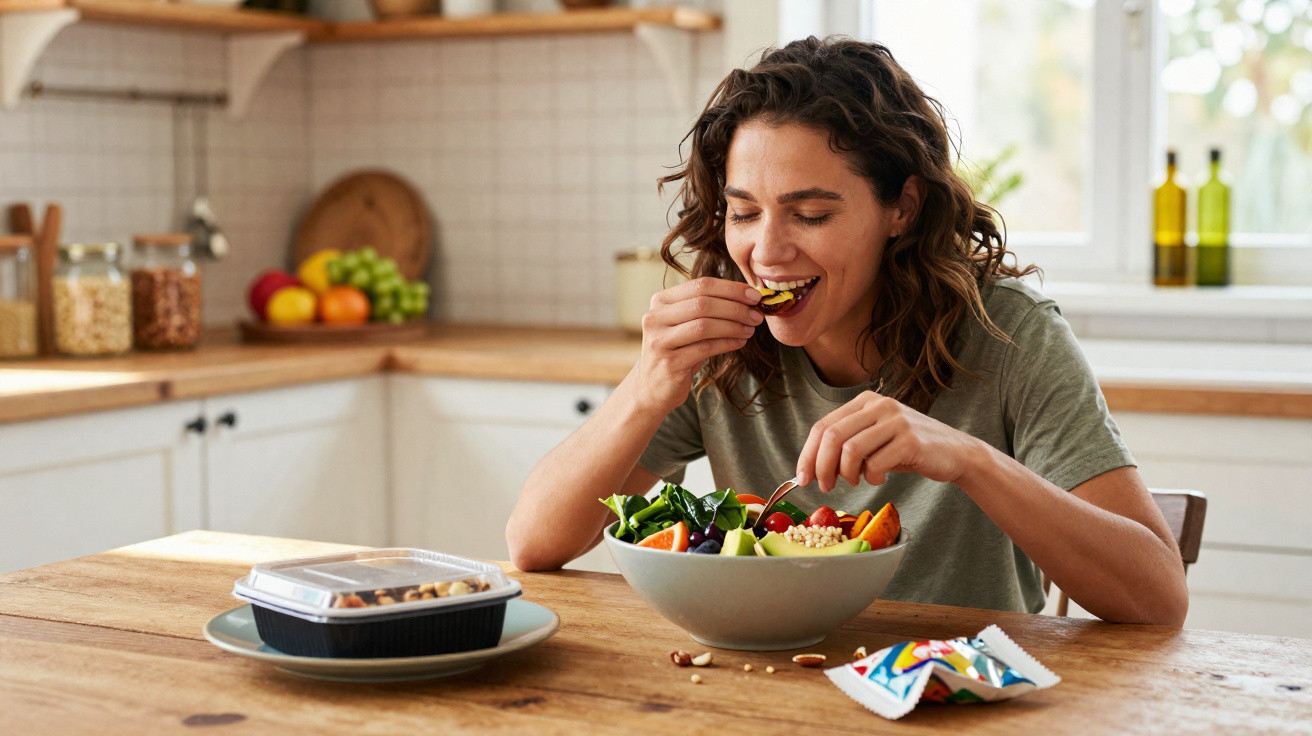
Anyone who has ever counted calories will know the feeling: persistent hunger, a bad mood and little to show for it. A British-American study now turns this traditional dieting principle on its head. What appears to matter less is how much we eat, and more what is actually on the plate – and how heavily it has been industrially processed.
More food, fewer calories: what the study actually found
The data examined came from a tightly controlled trial involving 20 adults at a research clinic. All participants lived at the study centre for one month, with every meal precisely recorded. On certain days, they were given only heavily processed products; on others, they ate only unprocessed foods that were as close to their natural state as possible.
The striking finding was that, during the unprocessed-food phase, participants ate 57 per cent more food by weight on average. Even so, they consumed roughly 330 fewer calories per day on average than during the phase involving heavily processed products.
More on the plate, less energy: unprocessed foods provide volume and nutrients without pushing calorie intake too high.
During the “natural” phase, participants automatically chose fruit, vegetables, pulses and simple filling sides such as potatoes more often. Pasta with cream sauce, ready meals, sweet snacks and processed meats barely featured.
Why they still felt fuller
Unprocessed foods generally provide more water, more fibre and more volume for each calorie. A large bowl of vegetable stew will often contain less energy than a small serving of ready-made lasagne, while still being filling.
The researchers noted that:
- Portions of vegetables and fruit amounting to several hundred grams per meal were normal.
- Feelings of fullness occurred sooner, even though plates looked generously filled.
- Cravings for sweet or fatty foods happened less often.
This outcome challenges the common assumption that losing weight primarily requires eating smaller portions. The data suggest that people who substantially improve the quality of their food can be more relaxed about quantity.
How heavily processed products disrupt our internal compass
The scientists refer to a form of the body’s “nutritional intelligence”. This means the ability of the body to select foods according to how well they supply vitamins, minerals and other micronutrients.
Where the food environment consists mainly of foods in their natural state, this internal compass appears to work remarkably well. People then instinctively reach more often for nutrient-rich but less energy-dense options – vegetables rather than fatty meat or rich sauces, for example.
Heavily processed products interfere with this system. They are often:
- highly energy-dense, with many calories in a small volume;
- high in sugar, fat and salt;
- artificially fortified with vitamins.
The body “sees” the added vitamins, but underestimates the hidden flood of calories – a perfect recipe for overeating.
The issue is that our bodies rely on signals that make sense in nature. A food delivering many micronutrients would, in evolutionary terms, almost always also have contained a sensible number of calories. Industrial products override that logic. Suddenly, there are snacks that appear vitamin-enriched while also being extremely energy-dense.
Mixed signals in the brain
In everyday life, this means that people who often choose heavily processed foods can easily consume more energy than their body needs over the long term, without consciously noticing it. Fullness signals arrive later, while appetite is guided by flavour, texture and rapid reward effects rather than balanced nourishment.
It remains unclear whether this nutritional intelligence is equally pronounced in everyone. Social circumstances, upbringing, food availability and advertising pressure all have a major influence on eating habits. Even so, several studies support the central idea: in a more natural food environment, many people find their way towards a more favourable calorie balance on their own.
Less diet stress: focus on quality rather than restriction
Traditional diets rely on strict rules: points systems, calorie charts, apps and scales. They can work in the short term, but many people struggle in the long run because of frustration and social pressure. The data now analysed point to a possible alternative: changing the type of food eaten can reduce energy intake without constantly feeling restricted.
Participants were allowed to eat until they felt full – with no instructions on portion size. The difference resulted almost entirely from food choice.
This leads to some useful approaches for everyday life:
- Make the plate look full – but fill it with plenty of vegetables, pulses and potatoes.
- Plan main meals around simple staple ingredients rather than ready-made products.
- Replace snacks where possible with fruit, small portions of nuts or natural yoghurt.
- For drinks, choose water, unsweetened tea and coffee without sweeteners.
With this approach, there is no need to weigh every strand of pasta. Food choices automatically steer the energy balance downwards.
What counts as a heavily processed product?
Research has established a broad classification. Without overloading it with technical terms, it can be presented simply as follows:
| Category | Examples | Everyday assessment |
|---|---|---|
| Unprocessed / natural | fresh vegetables, fruit, unprocessed nuts, eggs, unprocessed meat | The basis of everyday eating, as often as possible |
| Simply processed | wholegrain bread, natural yoghurt, cheese, frozen vegetables without additives, porridge oats | Well suited, usually unproblematic |
| Heavily processed | ready meals, crisps, soft drinks, confectionery, instant noodles, many processed meats | Only occasionally; ideally reduce gradually |
Nobody needs to eat perfectly overnight. Even small shifts – one fewer ready-made pizza per week and one more home-cooked stew instead, for instance – can make a difference over time.
Everyday barriers: why switching is difficult
In theory, it sounds straightforward: more natural foods, less factory-made food. In practice, many people face obstacles. Fresh fruit and vegetables are not affordable everywhere, and some areas have few well-stocked supermarkets. Shift work, childcare and stress leave little time for cooking.
The researchers therefore stress that body weight is not determined by individual discipline alone. The surrounding environment matters too: people confronted with confectionery vending machines, bakery snacks and fast food on every corner are more easily thrown off course. Sensible public health policy could address this by making natural foods easier to access and more appealing.
How to put the approach into practice
A few practical strategies can help in daily life without meticulous diet plans:
- Rework the shopping list: Put vegetables, fruit, pulses and grains first, then everything else. Buy ready-made products deliberately, rather than stocking up on them.
- Cook simply: Choose meals with few ingredients, such as a vegetable stir-fry with rice, roasted vegetables with chicken or lentil soup. Fewer ingredients often means less processing.
- Use filling foods: Potatoes, porridge oats, wholegrain products and beans keep you full for longer and add volume.
- Plan cupboard staples wisely: Frozen vegetables, tinned tomatoes without added sugar and dried lentils are quick to use.
People who incorporate these basic ideas often notice a change after a few weeks: steadier fullness, fewer cravings and gradually decreasing weight – without constant calculation.
Why “eating more” helps psychologically
The psychological aspect should not be underestimated. Many people associate weight loss with scarcity: empty plates, small bread rolls and deprivation when eating out. A strategy that says, “You can eat until you are full, but with different foods,” makes the transition easier.
A large, colourful plate of vegetables, some protein and a filling side dish does not feel like punishment; it feels like normal food. This approach reduces the risk of reaching for a bag of crisps out of frustration in the evening. At the same time, the palate learns to enjoy foods that are less sweet and less fatty again.
Ultimately, the research indicates that the body is better at regulating itself than many diet plans suggest. However, it needs the right “environment” to do so – and that starts in the shopping trolley and the kitchen, not on the scales.






Comments
No comments yet. Be the first to comment!
Leave a Comment