
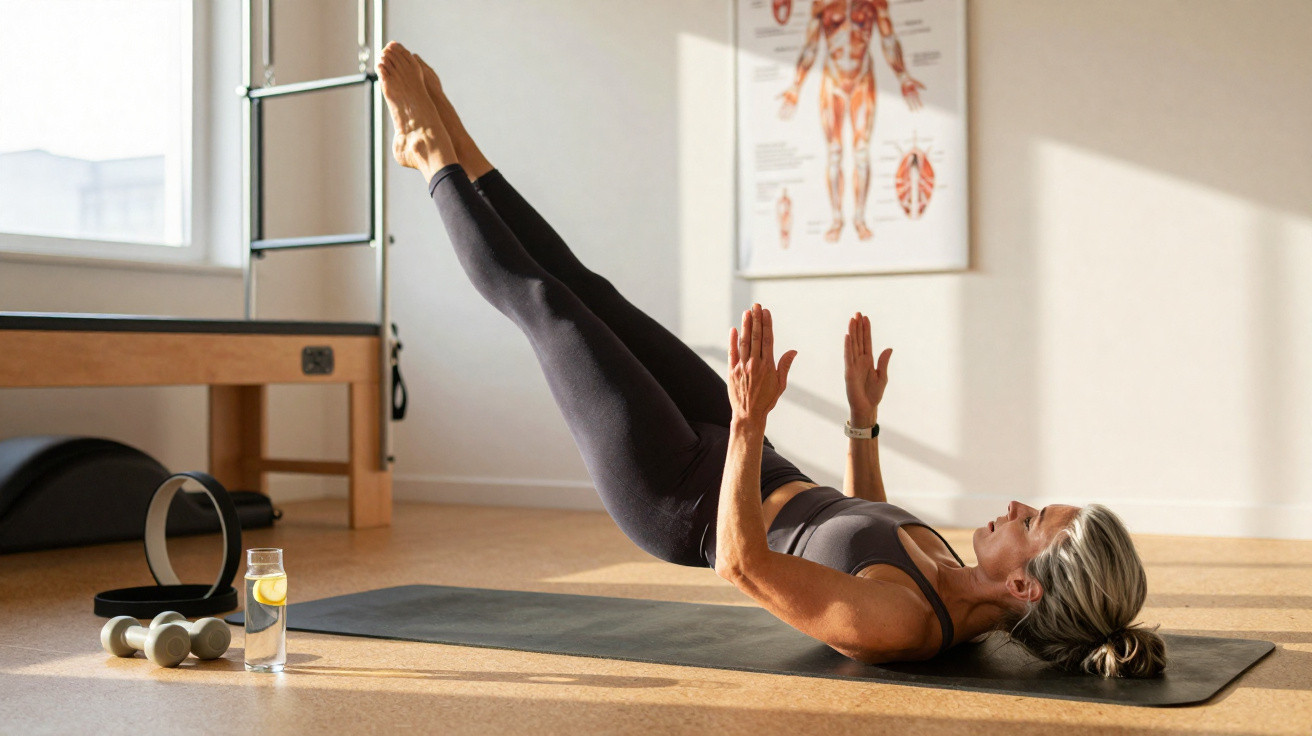
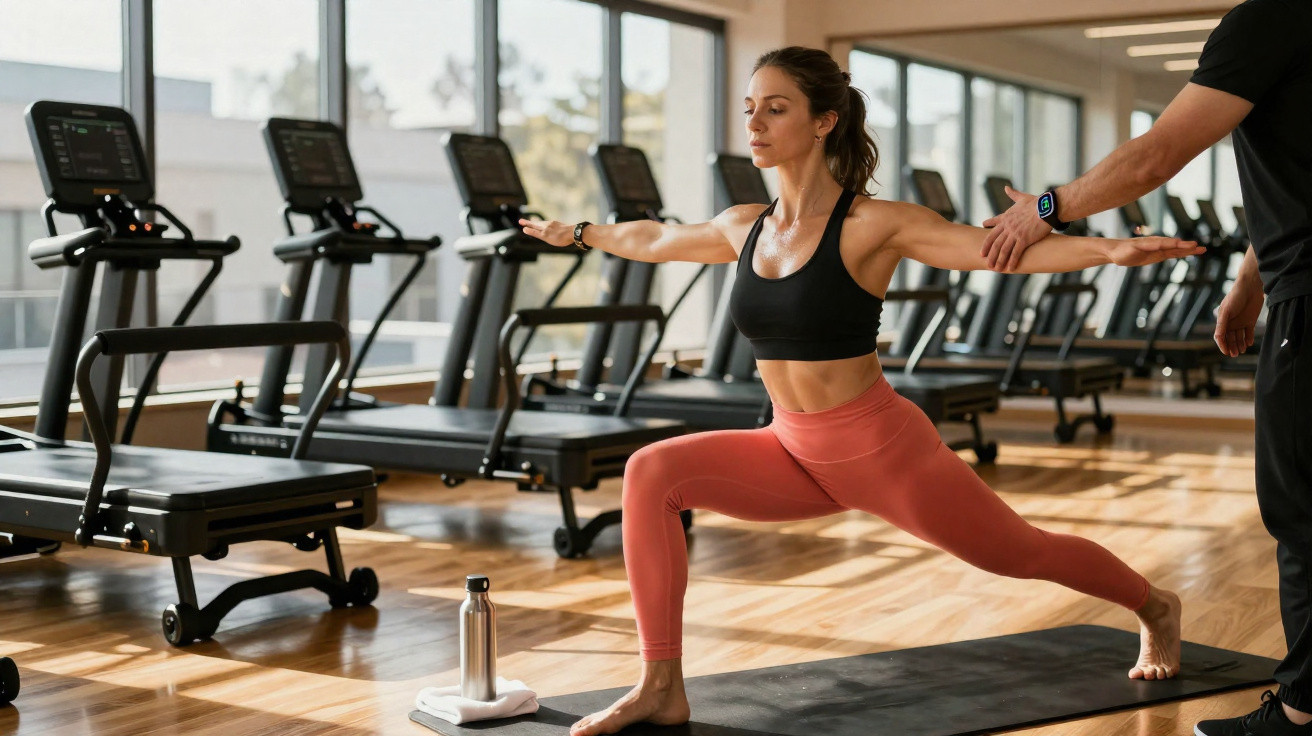
At the front, a woman in black leggings adjusts the microphone on her top. Beside me sits Brigitte, 56, gripping her water bottle tightly in both hands. “I haven’t been to a gym in years,” she whispers, then gives an uncertain laugh. When the instructor says, “We’ll begin lying down,” a collective breath of relief seems to pass through the room. Nobody has to prove anything to anyone. Just breathe. Just engage. Just notice what is happening inside. The movements look small, almost insignificant. Yet after ten minutes, Brigitte’s stomach is trembling. Suddenly, she realises there is far more strength there than she had imagined. The real surprise only arrives the following morning.
Why Pilates at 56 is not too late – but remarkably well suited
Something curious happens to our bodies in our mid-fifties: they can start to feel unfamiliar. Your back complains after sitting down, your knees have an opinion about every staircase, and your stomach seems as though it has secretly increased the force of gravity. Many people simply shrug to themselves and think: “That’s just how it is now.” This is precisely where Pilates comes in. Not through drills or an obsession with performance, but through calm, precise work targeting the deep muscles. These are the muscles we rarely activate consciously in day-to-day life, even though they quietly support everything: the spine, joints and posture. It is a little like pressing a reset button for your body, only without any dramatic fanfare.
Brigitte is far from unusual. In many studios, there are now more people over 50 on the mats than people under 30. Some arrive after years of back pain, others following shoulder or knee surgery, while some simply no longer recognise themselves in the mirror. One instructor told me about a 58-year-old former handball player. He had broad shoulders and plenty of strength, but was as stiff as a board. “I can’t even tie my shoes without getting out of breath,” he said at his first session. After three months of Pilates twice a week, he was able to touch the floor with his fingertips while standing for the first time in decades. It was not spectacular to an outsider, but his expression showed sheer amazement, along with a quiet kind of reconciliation with his own body.
There is a fairly straightforward reason for this. From around the age of 30, we lose muscle mass unless we actively counter it. The deeper muscle layers, which everyday life barely challenges, are particularly affected. We tend to train the muscles we can see: biceps, abs and glutes. Meanwhile, the muscles that stabilise the spine like a corset remain overlooked. Pilates reverses that approach. Movements are slow and controlled, breathing is deliberate, and attention stays on the centre of the body: the “Powerhouse”. That is where the deep musculature is located. Activating it purposefully can improve more than posture. It eases strain on the joints, makes movement smoother and lowers the risk of falls. It may sound technical, but in everyday life it feels more like: “I trust my body again.”
How to start Pilates at 56 without overdoing it
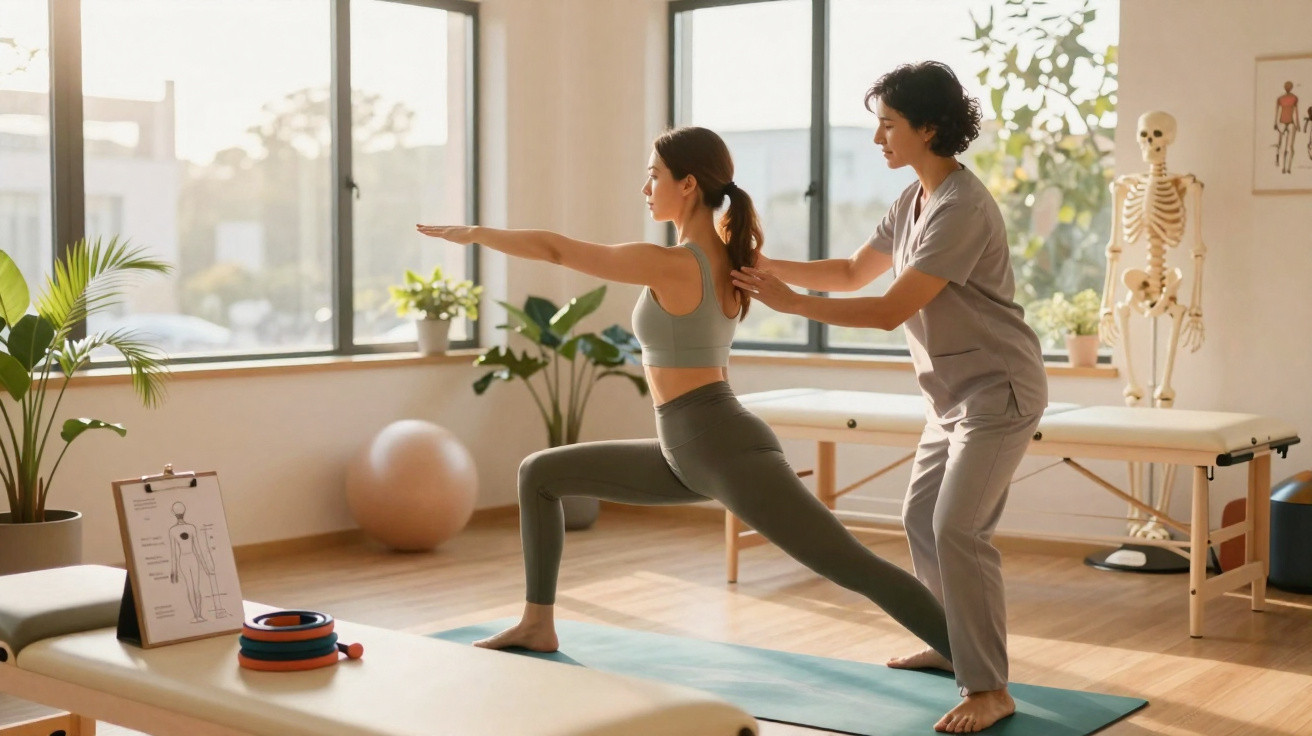
The most sensible way to begin is unremarkable. Choose a small class of no more than ten people, led by an instructor who observes, corrects and explains why you are doing each movement. Two sessions a week are more than enough at first. Your first piece of “homework” is tiny: lie on your back with your knees bent and feet planted, place your hands on your lower abdomen, breathe calmly into your stomach, then gently draw your navel towards your spine. Hold it, keep breathing, then release. It may sound like nothing, but you will soon feel a slight burn deep inside. That is your deep musculature making itself known. Practise this exercise regularly and you will quietly, steadily create a foundation that you can genuinely feel.
Many people starting at 56 share the same concern: “Am I not too inflexible for this?” The most uncomfortable mistake comes when they try to keep up with younger participants. They lift their legs higher, stretch their arms further, hold their breath and battle stubbornly against their own pace. Let us be honest: nobody actually follows an ideal training plan perfectly every day. Perfection is not the aim. The point is to scale movements down so your body can follow. If everyone else straightens their legs, you can keep yours bent. If an exercise overwhelms you, say so out loud. Instructors who love Pilates welcome that honesty because it enables them to help you properly. Your body will thank you for it rather than quietly taking offence.
An instructor who has worked with people aged between 50 and 70 for 20 years summed it up in one sentence:
“At 30, people do Pilates for a flat stomach; at 56, they come because they want to get out of bed in the morning again without swearing.”
- Start slowly – Keep the intensity low during the first few weeks, prioritising technique and breathing over the number of repetitions.
- Listen to your body – A gentle pulling sensation is fine, but sharp pain is a clear signal to stop, especially in the lower back or knees.
- Consistency over intensity – Two gentle sessions each week are better than one “hard” workout every fortnight.
- Use individual adaptations – Props such as cushions, blocks or bands can make movements far more accessible.
- Keep expectations realistic – You will often notice the bigger improvements only after 6–8 weeks, rather than after two classes.
When deep musculature starts changing everyday life
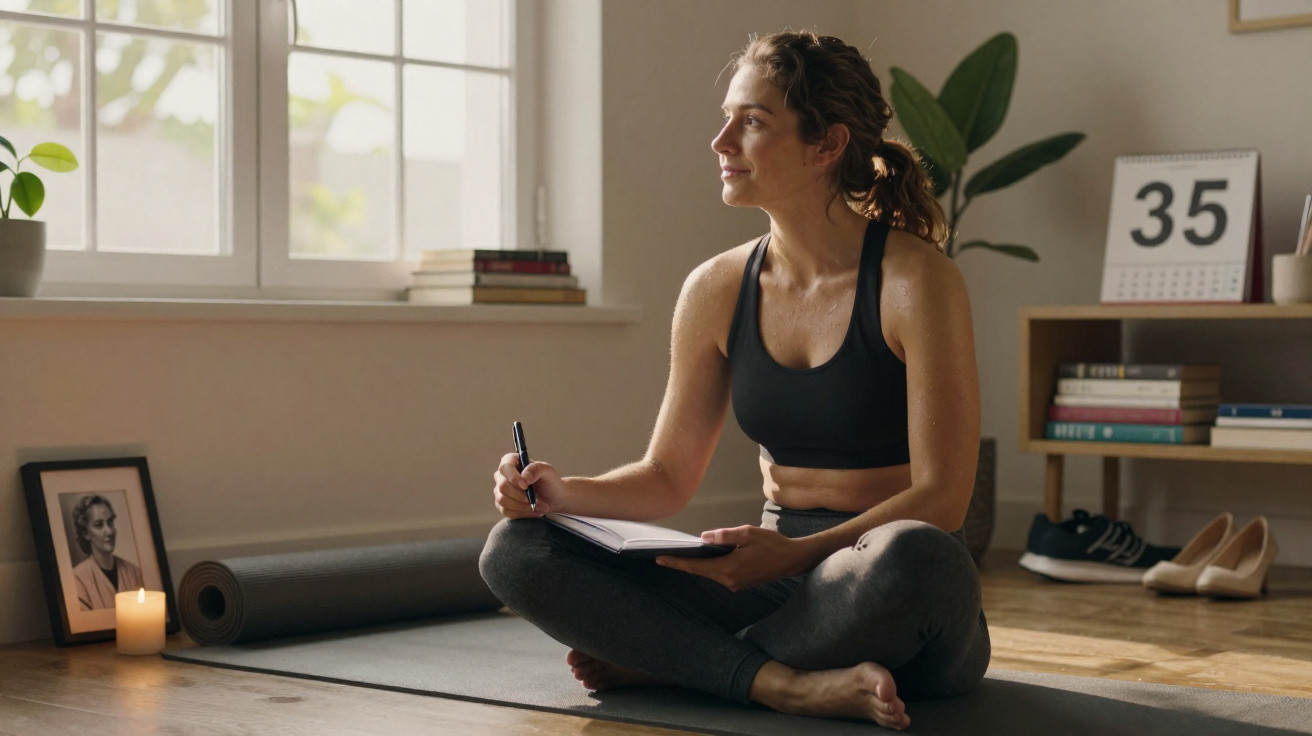
The most interesting moment usually happens away from the studio, somewhere in between everyday tasks: while shopping, putting on shoes or getting into the car. Brigitte told me that, after several weeks of Pilates, she lifted a heavy shopping bag from her car boot and instantly noticed that she was working “from the centre”. Her stomach was engaged, her shoulders relaxed and there was no sharp pain in her lower back. It was an ordinary moment that nobody applauded, but internally it felt as though a small curtain had lifted. Deep musculature does not exist to produce impressive Instagram photos. It is there to quietly protect you from yourself: from awkward movements, from that “ouch” moment when you bend down badly, and from the feeling of becoming weak at every minor task.
People who start in their mid-fifties often notice changes in their posture first. Their neck appears longer, their shoulders settle slightly further back and their walk becomes calmer. This is not magic. As the muscles around the spine grow stronger, the body has less need to compensate. Muscles that previously carried everything alone can finally share the load. Some people describe it like this: “I feel two centimetres taller, even though the scales show the same weight.” Their sense of their body often changes too. Where there were once only “problem areas”, there is suddenly curiosity: What else can my body do? How stable am I really when I stand on one leg with my eyes closed? These are not vain questions; they are a form of renewed relationship with yourself.
A strong “Powerhouse” also brings several quiet side effects. Breathing becomes deeper, some people sleep better and others report fewer digestive problems. Anyone who has struggled for years with demanding workouts may find Pilates a welcome alternative: less noise, less pressure and more subtle coordination. Not every exercise will become your new favourite. Some you may inwardly curse. Even so, with every session, this knowledge gradually settles in: I am not “too old” to become stronger. I have simply spent a long time trying to shape my body with the wrong tools. Now I am building from the inside out. Step by step. Breath by breath.
| Key point | Detail | Benefit for the reader |
|---|---|---|
| Starting later is possible | Pilates can be tailored to mobility, pre-existing conditions and fitness level | Reduces the fear of beginning in your mid-fifties or later |
| Focus on deep musculature | Targeted activation of the “Powerhouse” stabilises the spine and joints | Explains why less pain and improved posture are realistic |
| Gentle but consistent progress | 2 sessions per week, gradual increases and conscious breathing | Offers a clear, manageable approach instead of vague fitness resolutions |
FAQ:
- When will you feel the first benefits of Pilates? Many people notice more upright posture and less tension after around 4–6 weeks if they practise regularly. Deeper changes in body awareness usually take two to three months.
- Is Pilates suitable if you have a slipped disc or osteoarthritis? With medical advice and a well-qualified instructor, Pilates can be very helpful because it builds stability gently. The important thing is to avoid painful movements and adapt every exercise.
- Is mat training enough, or do you need equipment? Mat Pilates is entirely sufficient for getting started and building deep musculature. Equipment such as the Reformer or Cadillac can add further stimulus later, but it is not essential.
- How often should you do Pilates at 56? Two sessions each week are a good starting point. If you feel comfortable, you can increase this to three. Regularity matters more than maximum effort.
- Can Pilates replace traditional back training or physiotherapy? Pilates is a useful addition, not a complete replacement. For acute symptoms, treatment from doctors and physiotherapists remains the foundation; Pilates can provide long-term stability and help prevent relapses.

Comments
No comments yet. Be the first to comment!
Leave a Comment