
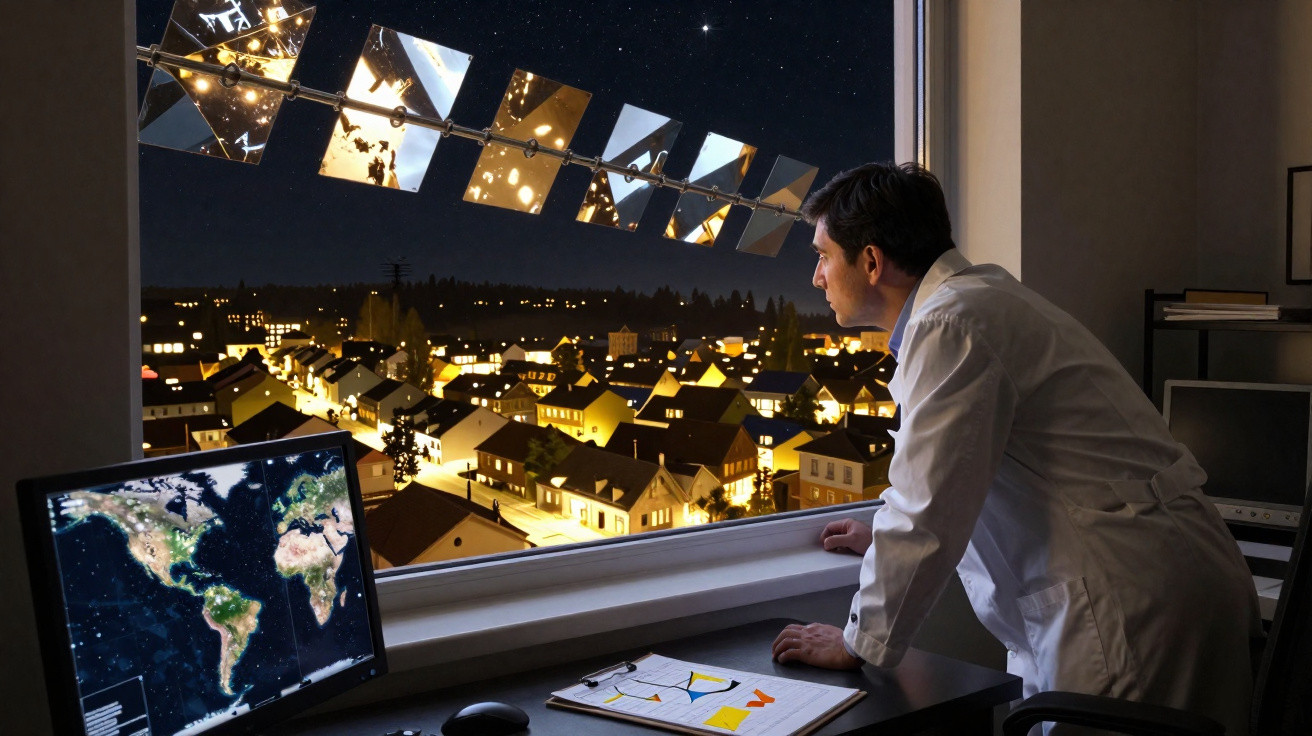
Lighting the Earth in the middle of the night to boost solar power: the extraordinary promise of Reflect Orbital has just received approval from US authorities. Scientists, however, are warning of an unprecedented threat to our eyesight, biodiversity and astronomy.
Last month, the Federal Communications Commission (FCC), the US telecommunications regulator, authorised the launch of an entirely new type of satellite. Called Eärendil-1, the spacecraft developed by California start-up Reflect Orbital carries an 18-square-metre mirror. Its purpose is to reflect sunlight directly back towards Earth during the night.
Reflect Orbital’s solar power plan after dark
The idea aims to tackle one of renewable energy’s biggest obstacles. By directing light on demand over selected areas measuring 5 to 6 kilometres across, the company intends to allow solar farms to generate electricity after sunset. The technology could also provide illumination for remote building sites or support rescue operations during natural disasters.
Yet this experimental trial is only the first stage of a far larger scheme. Reflect Orbital plans to place as many as 50,000 mirror satellites in low Earth orbit by 2035. Such a deployment would alter the night-time environment on a vast scale - and it would inevitably have consequences.
Scientists sound the alarm
The scientific community is raising concerns. When viewed through an ordinary amateur telescope, the concentrated light beam could cause irreversible eye injuries. The FCC nevertheless described the danger as a “minor risk” compared with the anticipated industrial benefits, and did not require the company to notify people in the illuminated areas.
The danger is just as serious for professional astronomers. These vast mirrors could permanently contaminate sky observations by leaving major streaks of light across images. Constellations on this scale could increase overall night-sky brightness by three to four times, making it almost impossible to spot distant galaxies or potentially hazardous asteroids.
Night-time light and living ecosystems
All living things could also be disrupted. International chronobiology and sleep-research organisations stress that the cycle of day and night is vital to biological balance. Continuous artificial lighting has been shown to disrupt humans’ internal clocks, interfere with sleep, disorient migrating animal species, and alter the life cycles of plants and phytoplankton.
A universal natural heritage under threat
This initiative comes amid an unprecedented acceleration in the occupation of space. Alongside the mass rollout of telecommunications satellites, recent proposals seek to put artificial-intelligence data centres into orbit, meaning space is set to become crowded at a frantic pace. If current trends continue, hundreds of thousands of artificial objects could be travelling through low Earth orbit within the next decade.
Regulation is struggling to keep up, while the current US administration favours industry and technological progress at the expense of wildlife and plant life. Equally, no international body currently has the authority to impose strict limits on either the brightness of satellites or the number permitted in our sky.
Without greater awareness and binding legal rules, the proliferation of such projects could permanently damage the night sky: a universal natural heritage shared by humanity since time immemorial.




Comments
No comments yet. Be the first to comment!
Leave a Comment